they are so silent, they are in another world
by Alison Rumfitt
On occasion she hears the children talk about it. It’s only natural. It’s part of the fabric of their lives. They can all see it from the small square of grass that acts as the school playground. If they are sat next to the window in the classroom and turn the right way, they can glimpse it. It is always there. Sitting in their beds at night. Walking to the post office and the sweet shop. The chalk figure, stark white even on the murkiest English days, has been on the hillside since long before this country called itself a country.
Julian claims to have seen it move. Nobody believes anything Julian says, of course. He’s a troubled boy and she doesn’t know how to help him. He told her once that he saw a flying saucer, a black disk, like a frisbee, ringed with tiny white lights. It came silent down the valley, neither slow nor fast, before rising up and vanishing behind some cloud cover. He also confided in her that his father was in the secret service. That’s why he wasn’t around now. But she had to promise not to tell anybody, because if word got out all sorts of national secrets would be in jeopardy.
One day he points out of the window at it. “Miss! Miss! It just moved again. I just saw it move.” The class laugh and roll their eyes. If she sees any of them be cruel, she thinks, she will reprimand them. But she only has control over what happens within the small world of the school. Once they’re off the grounds, she can’t see or hear anything. She just has to hope he stops being such a fantasist.
But that night, she dreams of it. She is sitting astride its back, feeling its firm body beneath her legs as it bounds across the landscape, covering hills in great, animal leaps. She wakes and finds herself breathless and wet down there.
She wasn’t born in this village. She doesn’t think she’ll die here.
***
There are three pubs in the village. The most popular is named THE WHITE HORSE, and its painted sign features a rendition of the figure. The road leading up to it is named White Horse Lane. How do they keep it so white? It is chalk. Locals maintain it. Once a year they churn the chalk to give it back its vibrancy.
The village is a very small world, a green ribbon. Less than half the houses are occupied at any given time, so many of them owned by men from the city chasing some parish, traditional fantasy. Inevitably this place bores them to death. There’s nothing to do other than walk around and drink beer. The phone service is awful. Fibre internet hasn’t made it this far out yet. No coke at all. The only dealers in the village are teenagers, and even then, all they sell is low quality weed. They like to deal in the shadow of the thing on the hill at night. People don’t go out there at night, so there’s little to no risk of being seen. Foxes and badgers; owls and field mice. Things that move around in the dark out there. The trilling phone alarm sound of nightjars calling out for one another. At night, the chalk seems to shine. It catches the glow of the moon. Fireflies can sometimes be found. Natural bioluminescence.
It’s called the white horse.
It doesn’t look anything like a horse.
***
Sayani doesn’t remember this, but the first time she ever saw the white horse was when she was very young and happened to open up a random book from her parents’ shelves. It opened to a double-page spread of a black and white photograph. The animal on the hill, a gentleman in a tweed suit standing in front of it, hands deep in the pockets of his trousers. Colloquially the figure is known as the Yewill White Horse, although some theories posit that it may have been intended to represent a big cat or some unknown prehistoric god.
Her university funds for her to stay in the area for two weeks, studying the folk traditions. She gets a room above a pub—the one named after the horse, obviously. She even manages to sweet-talk them into letting her partner, Selina, come along.
Selina and Sayani have been together for three years. Selina has a small box stashed away in her suitcase. Lined with velvet. A diamond ring. She doesn’t yet know how to phrase it or when to ask. She just knows that she should. If she doesn’t do it soon, it will never happen.
The first night they eat at the pub named after the hill figure. At the bar, Sayani tries to make small talk with the girl who takes their order. She looks vacant, half-asleep.
“You know,” Sayani says, “it’s not really a horse.”
The girl frowns. “What isn’t?”
“The white horse. You know. On the side of the hill.”
“What about it?”
“It’s probably not really a horse.”
“Can I get you anything else? Dessert menu?”
Sayani retreats. “No. No, that’s fine.”
***
Selina wants to ask Sayani to marry her, but they haven’t had sex in months. They’ve masturbated mutually, kissed, made out in bed. But then Sayani gets overwhelmed. She freaks out about being touched too much, about doing too much touching.
At first Selina thought something had happened, but if that is the case Sayani has kept it completely to herself, unlike her completely. She hates herself for falling into this pattern. Tells her friends about it. Ah, the old lesbian bed death, they laugh. She protests: that’s a myth, a mean joke. Not like that anyway.
The first night in the village they lay in one another’s arms, hearts beating almost as one organ.
Sayani is drifting in and out of sleep. She thinks of the thing on the hill. Eases herself out of her arms and goes to the window. She can’t see it from here. Disappointing. Tomorrow she will walk up to look at it closely. She might try to sketch an image of it in her little book or go and talk to the local history society. Those sorts are often dusty, rarely helpful, but she has to make use of the time she has. Hope that they won’t be weird about her ethnicity.
It really is so white. Chalk. Read once of a compulsion in pregnant women to eat soil and chalk. In Freud, the white horse has a mouth filled with teeth that bite, a fear of a small boy that psychoanalysis posits is in fact fear of his mother’s reproductive organs.
Across the room, Selina stirs and opens her eyes.
“Jesus, you look creepy,” she says. “Standing there so still like a ghost. I didn’t think you were real.”
“What does that mean?” She climbs onto the bed. She straddles her and takes her face in her hands. “What does that mean?”
***
The “local history society” proves to be one man in a badly organised room. He speaks with barely a whisper; she has to lean in close to him and she can smell something sour on his breath.
“Strange thing, strange thing. If you look at this old drawing from the…civil war, that sort of time. Look here.” He ruffles through a pile until he finds what he’s looking for. “See?”
“It’s in a different position.”
“Yes. Bad artist, I imagine. Or maybe over…the years…our efforts to maintain it have moved it somehow.”
“That doesn’t seem likely.”
His laugh wheezes out of him. “More likely than it moving by itself.”
She thinks about it. Moving very slowly over close to five centuries. A centimetre a year. In an early photograph, it resembles the figure she can see from the street outside. But the angle of that picture makes it hard to tell the exact position of one of the legs. This photograph from, what, the late nineteenth century?
“Who is it that maintains it? Could I speak to them?”
“The whole village.” He shrugs. “We put in the work. Not sure the kids these days have much interest.”
“How do they maintain it? What’s the process?”
He laughs. “Not much of a process to it. We just focus.”
***
Sayani imagines a world where the figure is only there through memory. A whole village thinking about it keeps it there, keeps it real. The names of the pub, the street signs. The tourist shops that sell kitschy fridge magnets and stuffed toy representations of it. The shape of the thing changing as the people change.
That night, Selina and her get drunk. It isn’t planned, but before they know it they’re four pints in each, swaying and kissing right there in the bar. Some of the clientele can’t stop looking their way, but neither of them care. They stumble upstairs and into bed.
“I think it’s a fertility god,” Sayani says, lifting up her dress.
Selina crawls across the sheets. Her smell, she thinks. Her smell.
“Marry me,” she says.
She isn’t sure if Sayani hears, because when she looks up from kissing her thighs she is looking to her left, out of the bedroom window.
“What is it?” Selina says.
“I can see something out there. Look, look. Out there. In the dark. Coming closer, over the buildings. Can’t you see it, my love, can’t you see it?”
Alison Rumfitt is a writer, semi-professional trans woman, and the author of Tell Me I’m Worthless and Brainwyrms. Her debut pamphlet of poetry, The T(y)ranny, was a critical deconstruction of Margaret Atwood’s work through the lens of a trans woman navigating her own misogynistic dystopia. Her work has appeared in countless publications such as SPORAZINE, datableed, The Final Girls, Burning House Press, SOFT CARTEL, Glass Poetry, and more. Her poetry was nominated for the Rhysling Award in 2018. She loves her friends.
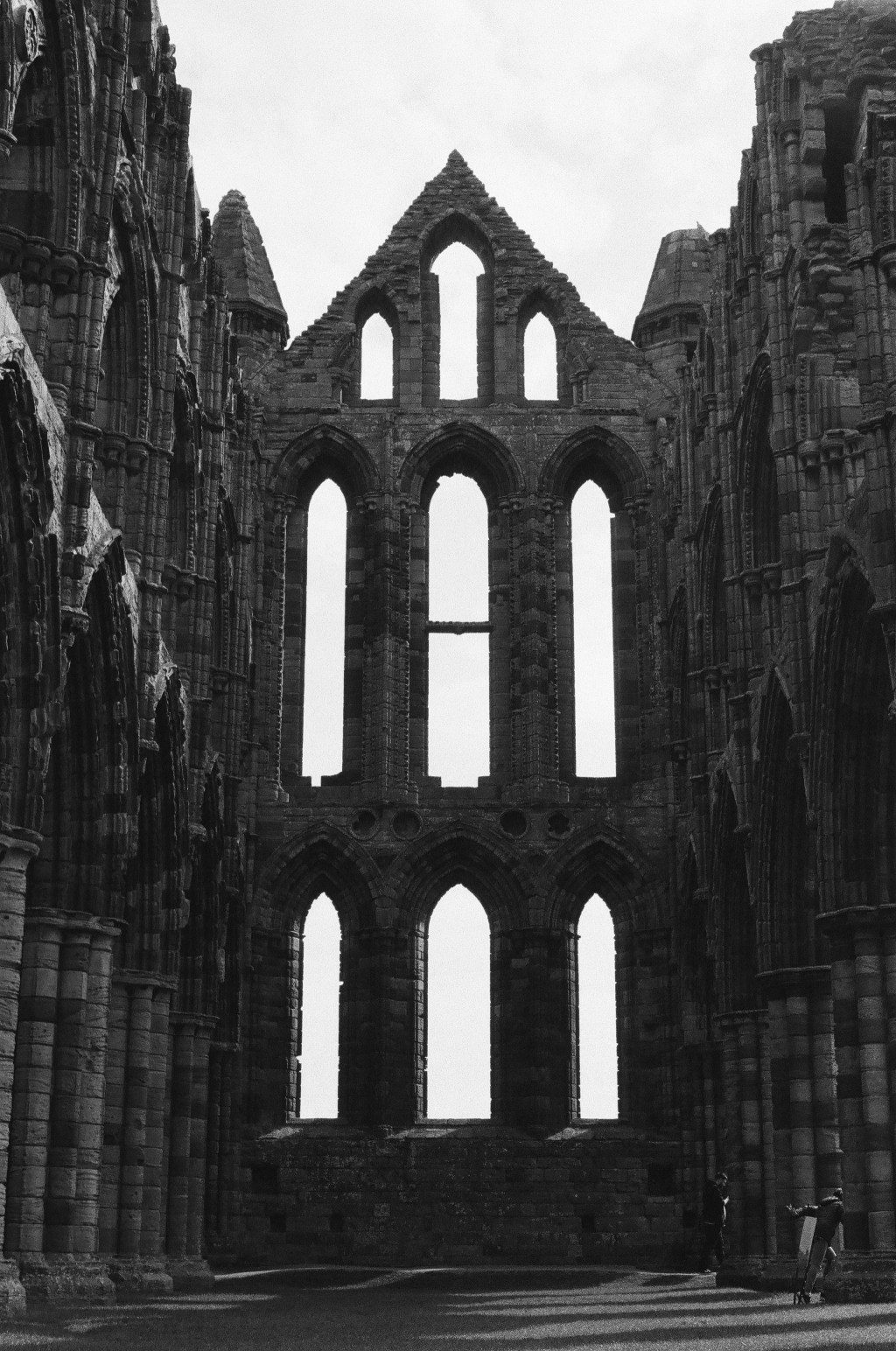
Photo Credit: Rosalynde Agatha Kasper
Rosalynde Agatha Kasper is a writer and photographer with an eye towards harvesting the rot of analogue media. Her writing on film and culture has appeared in The Maple, Protean, and other venues. She has a master’s degree in gothic studies and will never turn down a chance to give a talk on the cultural implications of slime moulds. Rosalynde is the co-(g)host of the film and gothic theory podcast Horror Vanguard.

Leave a Reply