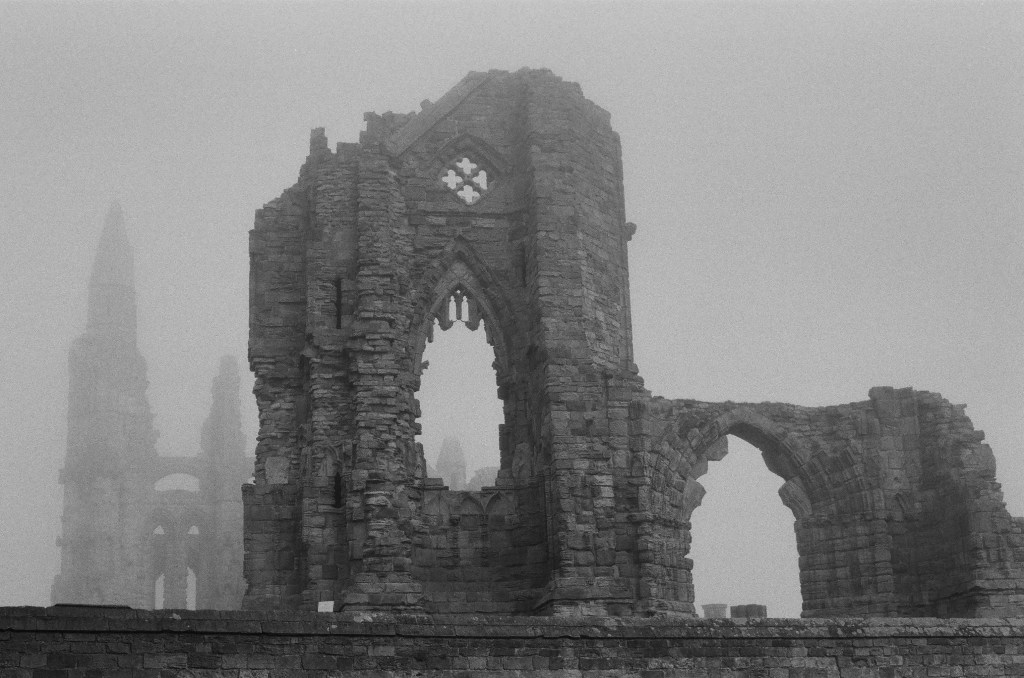
Gothic Marxism: A Manifesto on the Dark Way of Being Red
by Adam C. Jones & Jon Greenaway
Spectres, ghosts, horror and monstrosity are everywhere. These discourses are not simply aesthetic or cultural markers. These are political symptoms, produced by a necrotic and decaying capitalism.
As a result, the last few years have seen an increasing interest in an analysis of the horrors that surround us, for a Marxism that can speak to the bleak, haunted nature of our present moment. What follows is not intended as an exhaustive or rigid program for Gothic Marxism, but a series of interrelated principles that feed into one another, acting as a guide to shape analysis of the current conjuncture and, like a flare in the night, to illustrate our own illumination on the dark way of being red.
1: Capitalist Monstrosity
Monstrosity in general is nothing exceptional or monstrous. It means little other than difference in excess of what is taken or given as standard. In other words, being a little more than what we are understood by others or by ourselves to be. Nobody fully conforms to every fixed category which is said to apply to them, or to every norm about how we ought to live. However, not every monstrosity, every difference, is made into a monster. Gothic Marxism analyses monstrosity as a basic fact of difference to be encountered in life, a phenomenon that forms the dark shadow for any set of norms.
With regards to the production of monsters, a Gothic Marxist approach understands the figure of the monster as a double gesture encapsulating the political and economic process of monstering and the products of this process. Further, we analyse these from the critical standpoint which understands the process of monstering to be one which emerges from certain social, economic and political conditions, in which the production of monstered subjectivity is essential for the (re)production of the society in which monstering occurs. The production of monsters is a political problem, one which is key to the operation of our current historical conjuncture.
What marks the production of monstered beings is that it occurs under the social relations of capitalism. This system and its political and historical tendencies both determine and distribute the production of monsters as categories of monstered life and those living under the material effects of this categorisation. Capital is rapacious, always excessive, always needing to make more of itself everywhere, to the destruction of everything else around it. Capital seeks its own monstrosity, its own excessive difference, in the form of profit. It will monster others in order to cut costs, to devalue their labour, to rid itself of sections of the population deemed “surplus” to its continuation.
Capitalism is therefore the system which we analyse as the Monstering Monster. Those monstered under capitalism – made disposable, earmarked for liquidation, are the monstered monsters. A monstered monster is a being designated for devaluation, derision, and exclusion under capitalist conditions of existence.
Capitalism is a system which requires people to treat themselves as the owner-manager of “labour power,” which they rent to capitalists in exchange for wages. Why would anyone do this? Because they require wages in order to secure housing, food, healthcare, and the enjoyments that ease the strains of life. Additionally, they need them not only for themselves, but for their loved ones and communities.
They need wages to secure these things because they neither possess wealth which would last them for the span of their natural life and that of others in their care (or in their future care, as regards aging, disablement, and having children), nor do they possess the means to produce these necessities. The means of production are not owned by them, nor do they have any real say in its ultimate usage and direction. Even if they owned these means individually, they would not have the labour power, skill, or time to produce these necessities. If they wished to maintain these means as private property, then they would simply have to purchase the labour power of others, and become a common capitalist.
Instead, they rely on wages from the owners of those means in order to purchase goods and services—sourced from labour power rented from others much like themselves—in order to provide for themselves and others in relationships of care. In more extreme circumstances, those wages will allow them to purchase the means to live another day. Yet on this next day they will still not own the means to make bread, beer, medicine, or movies. A vicious cycle erupts where they must ultimately work to secure a material foundation for their life. Yet securing survival requires them to reproduce themselves not only as flesh and blood but as the kind of flesh and blood which isn’t simply alive, but is fit to go to work and to compete in the labour market.
In the absence of the means of production, the ability of living beings to reproduce themselves and their ways of living with each other requires a submission of their entire self to capital for the purposes of labour. It is through this labour that commodities are produced, investments are made in new ventures driven by those compelled to labour or suffer, and the system of capital expands. It has expanded the same way it always has: by impoverishment, displacement, and the introduction of this split between the means of producing goods for living and those who rely on them, all behind the barrier of private property. The category of people for whom this is the economic reality of their existence is the working class.
The capitalist class plays the role of paying wages not for the worker’s sake, but for that of their own position and its reproduction through a return on their investments. A primary strategy for maximising profit is minimising labour costs, such that the worker is just about able to return to work each day without too much disruption. Whether or not this worker is the same worker, or is a worker who has the same health and happiness beyond their working life, is by itself a matter of indifference to the capitalist. As long as the worker returns at the same or lower price, with the same ability to do the work which their wage commands of them, the capitalist has little formal incentive to care whether this or that worker lives or dies beyond that which is imposed upon them by law or by the organised force of the working class itself.
To achieve this struggle against the working class as regards its wages and ability to survive beyond the demands of work, the capitalist class employs multiple strategies. As Marx taught us, they attempt to maintain wages at the same amount but extend the hours of the working day. When there are many workers who can do the same jobs, they can make workers compete against each other to sell their labour power at the lowest possible price. They can even move the means of production to places where workers are less organised and less protected from poverty wages by local political institutions.
Ultimately, the struggle of the capitalist class against the working class is a history of devaluation and the economic justification and infliction of impoverishment. This is true not only for the working class as a whole, but for the fact that this whole is one which has been shattered by this struggle from the very beginning. This shattering is the production of monstering segments of society which devalue the life and social worth of those monstered—a monstering which above all affects the working class, pushing them into an underworld of precarious, murderous conditions which expose them to premature death and social murder at an even greater rate than the more normative segments of that class.
Monstrosity is a strategy of devaluation which places segments of society at a greater distance from their own social reproduction. This strategy is enacted in order to reduce the cost of those labours which reproduce both capital itself in the form of profit, as well as the workers whose labour produces this surplus, such as the unpaid labour of housework and child-rearing, the arcana is revealed to us in the works of theorists such as Leopoldina Fortunati.
Further, monstered life is a life which is often targeted for elimination. This is in order to discourage forms of life that deviate from the normative categories of social being. Such a targeted destruction occurs via the social murder of directed impoverishment or through more direct forms of state violence. In the case of exterminationist monstering, a capitalist society monsters certain groups of living persons as being fundamentally incompatible with societal reproduction and continuation. It is often the result of a process of devaluation taken to a higher intensity where monstered life is devalued to the extent that its death means little to the society which monsters it. Either way, monstering is a social process directed at securing the reproduction of capitalist society—feeding lives to the Monstering Monster.
Gothic Marxism seeks out the products and tendencies of social devaluation and the apartheid which produces underworlds within the structures of capitalism. It seeks them in culture as a reflection of anxieties, of colonies of capital within the imagination, and of images constrained by a fear of loss in which life has become cheap as much as living has become expensive.
Gothic Marxism seeks monsters in the underworld. This is a benefit of its approach, because we are, all of us, already there. The axes of devaluation under capitalism show us how many of us already have one foot in the crypt: racialisation, ableism, gender, queerphobia. All of these are forms through which segments of populations have been culturally demonised and excluded in order to reduce their value and with it compel them to even harsher labours to survive. This is true from the total commodification of a living being in chattel slavery, to the socially mandated dependence on the wages of a patriarchal husband to survive in the case of the unpaid and gendered labour of housework, to those so monstered that they are pushed into working in sectors where their work is illegalised and exposes them to an even greater threat of state violence, and to those who have to fight to live in a world built for an ideal “normative” standard of body which treats their difference in labour capacity as symptom of a life essentially unworthy of living. We encounter them on the fringes and in the heat of the class struggle, and we encounter ourselves as being monstered. When we find the monstered ones, find the process of monstering, we find the apparatus of class division.
Monsters are everywhere today. Contemporary right-wing politics is best understood as an operation for the production of monsters. The techno-reactionary Peter Thiel famously argues that Greta Thunberg is the Antichrist, Trump propagates racist visions of ab-human external Others coming to eat cats and dogs in the street. At the same time, seeing the migrant, the refugee, the poor and the outsider as threats to an imagined security has become the default position of much of the mainstream Anglophone media. The powers of old have entered into a holy alliance: Pope and President, Labour and Conservative, old Guard Stalinists and liberal journalists, to monster the life of trans people. Vast swathes of the world population are seen as disposable at worst. At best, they are monsters and thus all violence towards them is completely justifiable, a political logic made viscerally clear in the ongoing genocide against the people of Palestine.
This disposability—like the category of the monster itself—is not rigid, but expanding according to the interests of an increasingly speculative and spectral capitalism. AI techno-feudalists dream of a future in which all labor is liquefied into the abstractions of their data streams, with the stated end point being the complete disposability of human capital. This is, in itself, an intensification and acceleration of the precarity of the gig economy in which other human beings are simply functions to a specific end rather than fellow beings with which we share any kind of subjectivity. The ground of Gothic Marxist politics is one that insists on a solidarity with those made into monsters and a resistance to these discourses of liquidation and disposability by whatever means necessary.
The point of seeking out the monstered one(s) is to allow for the clarification of the mechanisms of enforced fragmentation in the working class. Through our connections with the monstered, we can articulate solidarity, disenchanting the narratives of monstering as a weaponisation of impoverishment. The Monstering Monster requires, in part, our complicity to join in with the moral panics, to feel the libidinal thrill of sadism or collaboration in identifying and expunging the monstered monsters. This is a cultural and interpersonal labour which we must come to refuse in the form of a monstrous solidarity. The refusal of one’s role in reproducing monstering is the first step in a gothic strike action, one which turns back the gaze of monstering to the root of the process itself.
The focus on monstrosity in Gothic Marxist analysis can be summarised with the following strategic aim: to transform the underworld of capitalism, turning the ghetto, the closet, the factory floor, the club, and the clinic into a war room.
2: Private Property is a Ghost Story
The end of Gothic Marxism is the production of new theoretical weapons towards the political and practical ends of achieving communism through the abolition of private property.
In order to do so, we require a notion of private property to frame our approach to its abolition. Gothic Marxism begins with monstrosity. It begins in the underworld, within the ruins in which we find each other. So we begin our examination of private property by outlining what it would mean to think of private property in monstrous and monstered terms.
When monstrosity is posited in the realm of private property, what exceeds the standard set within said institution is that which appears a surplus of ownership. A surplus of ownership within the owned thing is one whose monstrosity is monstered by an excess of possession. Gothic Marxism is not simply drawing upon a dual meaning of our economic and proprietary language. Private property is a spectral societal narrative.
Property, as that great bourgeois thinker Hegel knew, requires the implantation of an individual will into an external object, where this individual can—at least in principle—command, use, and dispose of this object as they please and is recognised as being able to do so by others. The monstrosity of property is therefore encountered as an excess of individual wills within the owned object. Such wills are excessive, monstrous and threatening, not simply because they are plural, but because they are unsanctioned. Ownership has not been divided in converting property into an incorporation of many properties or shares.
Monstrous property is thus the violation of sanctioned and implanted wills by another power which the recognised owner or owners does not or refuses to recognise. Private property is also the right of excluding others from your property. Hence monstrous property defies the prohibition of itself from the state in which it has been declared unwelcome.
The owner of a piece of property supposedly has their will within the object even if they are not physically present. They are represented through the mediation of institutional and interpersonal respect for private property but also through their capital– money as a communicator of their will. It is as if their will can possess people to treat their property as if their personality truly resided in it. Private property is a possession of the object that extends far beyond its sensuous appearance.
When we act in recognition of someone’s private property, we act as if the person were invisibly in the object, having command over it. Individual owners may die, but families, corporations, and offices of state can own property without being embodied in any one individual will. Indeed, a corporation can exercise a will beyond any one life. In its immense power to affirm the institution of its property, it does so every single day.
In upholding the regime of private property through its preservation and development into the corporate form, capitalist societies are reproducing spectral narratives. In other words, private property is a ghost story, one whose force as a code of social practice is backed by police, prisons, and nuclear warheads.
Case Study: Exorcism and Capitalism
What happens when one’s property has a mind of its own and wills something that is not sanctioned by the will of its owner and the society which recognises this ownership? In this case, there is an excess of wills, a surplus which the owner can only recognise under the terms of private property as a theft, a perversion of their property as its alienation by an external power.
When property is a monstered being, the alienation of property and its framing by the owner as a dispossession, allows for the formation of narratives around not only alienism (an early term for mental illness) but also possession in the demonic or spiritual sense.
In the case of alienism, the clearest historical example is drapetomania or “runaway slave disease.” This term pathologises an excess of unsanctioned will in an owned person already monstered by racialisation. However, even after the end of chattel slavery, propriety over human beings—where the will of another is granted the right to direct their behaviour in the manner of an owned object—is nonetheless socially sanctioned under patriarchal regimes and consolidated in the rise of the nuclear family as a relation of social reproduction. That is, women are treated as the property of their husbands and children as the property of parents.
In Purging the Devil, Grafton Tanner points out that there is a direct lineage from the exorcism crazes of ages past to homophobic and transphobic panics today. Tanner cites the transphobic ideologue Abigail Shrier’s book Irreversible Damage, who posits that “Today’s diagnostic craze isn’t demonic possession—it’s ‘gender dysphoria.’ And its ‘cure’ is not exorcism, laxatives, or purging. It’s testosterone and ‘top surgery.’” Shrier draws a line back to Priest Malachi Martin’s bestseller Hostage to the Devil in which a case study presents a trans woman, Rita, as being possessed by a demonic force responsible for her transness and presented as being connected to her radical university education.
Tanner notes that so-called “conversion therapy,” which strafes the line between medicalised practice and religious ritual, is isomorphic with the recent history of exorcisms. Adding to this, we argue that exorcism, and hence conversion therapy, is itself a capitalisation upon monstered, predominantly queer life. Under patriarchal relations, women and children, especially if they are LGBTQIA+, are treated as being possessed by either “literal” demons or “social contagions” such as feminism, so-called “gender ideology,” or even the spectre of communism.
Exorcisms offer a conversion of human capital for its owner, claiming to raise its market value (by forcing it to appear normative) and returning it to the realm of propriety. Under neoliberalism, we are encouraged to see ourselves as entrepreneurs, individual capitalists rather than members of an oppressed class. As such, when we take ourselves into the job market, we carry our labour power as if it were our private property, a means of production, and as if we were possessed of this abstract quality of ourselves which we could sell for wages. From the viewpoint of human capital, it is as if my will possessed within my body a set of machines, one which sends emails for X price, one which delivers packages for Y price.
When we are monstered and offered exorcism, we are offered the incorporation of a higher, normative will into the management of our human capital, one which can guide, direct, or even become our own by means of repressing, abusing, and traumatising a monstered form of living out of us. To speak of this as an “offer” however mistakes the fact that patriarchal structures, from the church and the family to “corrective” forms of medical power see human capital as belonging either to a religious anthropological vision, to the propriety of the familial norm, or to the medicalised schema of normality applied across populations. In either case, exorcism is a form of what Ira Hybris calls “structural corrective violence in order to be assimilated into social reproduction,” whether it arises from a coercion of the will or a violation thereof.
Exorcism is not a banishment of ghosts so much as it is a repossession of the monstrous by the Monstering Monster—capitalist social relations—and its agents in the forms of priests, patriarchs, and other bourgeois structures.
Understanding private property as a ghost story means comprehending how we can become possessed by it and how alien powers can come to offer us succor from the hauntings they impose upon us. Understanding exorcism means understanding a mechanism of monstrous shattering, one of the Monstering Monster’s techniques of devaluation and social apartheid.
Monstrosity is not simply a structure which exiles the monster and cuts itself off from the monstered. On the contrary, monstering is a rigid and intense form of inclusion. In elevating normativity, it posits monstrosity as a problem in monstering it for which exorcism can be sold as a solution, where complicity and compliance can be bought for a fragile safety. It therefore creates a desire for normality which reinforces monstering at the expense of solidarity. The abolition of possession requires therefore abolition of repossession, the entire edifice of private property which introduces monstering spectrality into social life.
Let us be clear: Gothic Marxism is not a reversion to a literalism about ghosts. Such a framework does not reveal that ghosts are “real,” so much as it reveals that communism
is a ghost haunting a ghost. It offers us a solution: a ruthless exorcism of all that exists, an underworld without ghosts, of monsters without monstering, a Gothic Communism.
3: Historicize the Horror
“Where are we?” To ask the question is already to admit our profound disorientation. At the twilight of the twentieth century, as the entire lifeworld of Soviet communism collapsed, the promise was that the political struggles of the entire previous century had resolved. All that was solid had melted into a seamless, frictionless eternity of liberal democratic capitalism. The future was supposed to be a sanitized panoply of endless innovation and infinite accumulation, in which the grand narratives of progress, of history itself had, at least, been solved. Yet here we stand, having reached the end of the end of history: a moment in which modernity is grasped best not as smooth totality but as a ruin.
In contrast to the romanticized ruins of antiquity, draped in ivy, idolized as picturesque images of that which is long gone, what we are living through is a slow, attritional rot. The ruins of capitalist modernity are not merely physical—the crumbling public infrastructure, the poisoned rivers, the hollowed-out company towns—they are temporal and psychological. Forced to labour for survival, we navigate a zombie gig economy that resurrects and refines the panoptic tools of nineteenth-century labour and combines it with surveillance and algorithmic data streams to drive alienation ever deeper into our flesh and blood. We participate in a haunted housing market endlessly forced to subordinate our need for shelter to the demands of speculative finance. We consume an endless procession of cultural reboots and algorithmically generated nostalgia.
Everywhere we look, we are stalked by the lost futures that neoliberal capitalism violently foreclosed but could never entirely expunge. These are the spectres of a world which could be free, free from the demands of work and free from the anxieties of insecurity. We are demanded to maintain the manic, hyperproductive rictus grin of the “entrepreneurial self,” optimizing our sleep schedules and monetizing our every waking moment, all while navigating a system that is deeply necrotic. There is a pervasive, creeping dread that defines the present: a claustrophobic realization that the ground beneath us is hollow, while the machinery of extraction continues to whirl, feeding not just on our physical labor, but on our nervous systems, our attention spans, and even our vitality.
None of this is new. In fact, accepting and understanding modernity as a ruin returns us to the problem of history and the fundamental incompleteness of the present.
The world is marked by what Ernst Bloch termed “Ungleichzeitigen”—non-synchronicity in which modes of existence are not unified. “We do not all live in the same Now” as he put it, but older forms of life, traditions, and modes of cultural production do still persist.
This persistence is despite all efforts of contemporary capitalism, which seeks to impose its false universalism on every aspect of life. Bloch’s still underappreciated thought is an extension of the Marxist thesis of primitive accumulation, understanding it as not just a problem of productive economic forces, but of internal subjectivity.
The wider polemical debate between Brecht, Lukács, and Bloch over the status of expressionism in Germany in the twentieth century is essentially a theoretical wrestling over fidelity to a certain conception of totality on the one side (Lukács) against Bloch’s recognition that expressionist, non-realist or non-mimetic art is a response to a fragmentation of the social totality that requires new modes of thinking through the question of how that totality is to be grasped.
If Gothic Marxism is a ghost haunting a haunted world, there are ruins of possibility encased within the planetary ruins of modernity. How many of us sense this kind of loss, like Hölderlin, who wrote in the recently translated fragment, “Communism of Spirits”:
“It is an agonizing feeling about the memory of a disappeared greatness: one stands like an outlaw before History, and the deeper one has experienced it, the more violently one shudders when awakened from this dream; one sees a chasm between here and there, and I, at least, must give up as lost so much of what was yet beautiful and great—I must give it up as lost forever.”
Whatever the object of history may be, revolutionary possibility, perhaps even communism itself, the question must be confronted: is it lost forever? Can one stand like an outlaw before History and not just shudder violently at our sense of loss, but grasp the contours of something which cannot be completely destroyed?
If we accept the teleologies of history, and the enclosure of the present and future, whether that be capitalist perfectibility or communist inevitability, what more is there to do then accept our own passivity and subordination to some abstract law of history. In contrast, Gothic Marxism sees here in the darkness of our lived moment, a world which is not yet present, glimpsed in fleeting traces, spotted in the ruins of what once was.
Gothic Marxism grounds itself on history because the fundamental concern of the gothic is the question of return. The crypt opens, and the monster of the past makes its way back into the light. Marx, of course, knew this well, as he wrote in The Eighteenth Brumaire:
“Men make their own history, but they do not make it as they please; they do not make it under self-selected circumstances, but under circumstances existing already, given and transmitted from the past. The tradition of all dead generations weighs like a nightmare on the brains of the living. And just as they seem to be occupied with revolutionizing themselves and things, creating something that did not exist before, precisely in such epochs of revolutionary crisis they anxiously conjure up the spirits of the past to their service, borrowing from them names, battle slogans, and costumes in order to present this new scene in world history in time-honored disguise and borrowed language.”
The synchronic contradictions of a particular epoch drive forward struggle against capitalism, but the non-synchronic contradiction is not simply an anachronism. It too is a dynamic force in the unfolding of the class struggle. The dead always lay unquiet in their graves, the ghosts of revolution and struggle in the past are, in a sense, active constituting forces of struggle in the present.
This doesn’t presuppose an easy revival of either Nietzsche or Freud (as useful as these approaches are). Death and finitude are always in some sense open to question. So the Gothic necessarily cuts against what Walter Benjamin calls the bourgeois habit of thought that is progress. Or, as Benjamin put it in his own magnificent ruin, The Arcades Project: “the history that showed things ‘as they really were’ was the strongest narcotic of the century.” History is not some temporal progression, a smooth movement from one stage of development to another. Rather, history is rupture. The ruins of the past built over by modernity contain within themselves traces that point to historical possibility. Things could well have been otherwise. If that were true then, it remains true for us now.
If, for the Gothic Marxist, history is rupture, then horror situates that rupture on the level of phenomenology and subjectivity. Or if as Fredric Jameson wrote, history is what hurts then horror is where the pain of history meets the flesh and blood of the body. This requires a politics, already tacit within the broader communist tradition. For example, take this passage from Engels’ The Condition of the Working-Class in England, a passage not out of place in the darkest horror fiction:
“She lay dead beside her son upon a heap of feathers which were scattered over her almost naked body, there being neither sheet nor coverlet. The feathers stuck so fast over the whole body that the physician could not examine the corpse until it was cleansed, and then found it starved and scarred from the bites of vermin.”
Vast swathes of The Condition show that Engels is a correspondent of the monstered monsters, a body horror writer of the nineteenth century. Social murder is horror on the level of subjectivity, but it is a horror produced by capitalist structures and the processes of capitalist history. Engels’ work showcases the Monstering Monster of capitalism itself.
It is also a horror that can only be comprehended as such—as both political and historical process—through the subjective phenomenological experience and the language-imagery of horror as a form. This is what Michael Löwy and Robert Sayre call “critical unrealism.” What this entails is a revolutionary romanticism, or a philosophy of history that looks back (always, always, always historicize!) with the intent of looking beyond the strictures of history towards a future that is a qualitative and quantitative break with the present. Or, as The Arcades Project puts it, “History is like Janus: it has two faces.”
As Walter Benjamin well knew, the past arriving into the present, or, to put this another way, a Gothic Marxist philosophy of history, represents the fracturing of capitalist time. Time is out of joint. If the past is never completely dead and buried and if the present is incomplete, this opens the question of the future.
Too often talk of the utopianism of monstrosity has isolated horror from history, but the category of the monster is not simply a cultural or discursive positioning but a historical and political one. Thus for Gothic Marxism, a philosophy of history is not simply a mode of cultural analysis or theoretical exercise: it is essential. The past is not over, the present is incomplete and the future is, despite all the best efforts of the capitalist classes, still to be determined. History as rupture raises a new Spectre, one still to arrive from a future still to be determined.
4: Communize the Underworld
Just as Paul B. Preciado demands, we ask: Can the monstered monster speak? Perhaps most terrifying for the reactionary is that the monster has done so for centuries. In Mary Shelley’s Frankenstein, the creature stands before his creator and in the language of Enlightenment rationality and legality demands to be heard, claiming the same rights, and demonstrating the same eloquence as the creator who views him with nothing but repulsed annihilationist violence.
“Hear me. The guilty are allowed, by human laws, bloody as they may be, to speak in their own defence before they are condemned. Listen to me, Frankenstein. You accuse me of murder; and yet you would, with a satisfied conscience, destroy your own creature. Oh, praise the eternal justice of man! Yet I ask you not to spare me: listen to me; and then, if you can, and if you will, destroy the work of your hands.”
Frankenstein’s creature is quite literally stitched together from the bodies of the working class and the poor, denied even the barest dignity in death by Frankenstein himself. This moment of confrontation on the mountaintop showcases the false universality of his creator. Victor, an avatar of the Enlightenment, sees his role as bringing the New into being. Yet those same discourses that shape his actions construct the creature he brings forth as a violation of the normative. The monster is both always a warning and revelation. For Victor can only look upon what he has created with revulsion, unable to grasp that the monster is not a stranger or some radical break. What truly horrifies him is that his creation speaks back. It is the very incarnation of all that he has tried to surpass, and in so being offers the possibility of a monstrous solidarity. The normative is revealed as a violently policed boundary.
Monstrosity is the porous category of modernity. The Monstering Monster of capitalism will turn on us all. The monstered monster truly does serve as a warning. Look, behold, and see yourself. As the great Susan Stryker put it, in her “My Words to Victor Frankenstein above the Village of Chamounix”:
“I offer you this warning: the Nature you bedevil me with is a lie. Do not trust it to protect you from what I represent, for it is a fabrication that cloaks the groundlessness of the privilege you seek to maintain for yourself at my expense. You are as constructed as me; the same anarchic Womb has birthed us both. I call upon you to investigate your nature as I have been compelled to confront mine. I challenge you to risk abjection and flourish as well as have I. Heed my words, and you may well discover the seams and sutures in yourself.”
For Gothic Marxism, this is a statement of solidarity. We are all, like Frankenstein’s creature, artificial constructs, stitched together flesh and blood, carrying our own scars (whether metaphorical or literal) from the operation of the capitalist machine. The category of monster is a boundary, designed to violently expel modes of life and ways of being that represent threats to the normative. The monster is the harbinger of the New and thus, the herald of a possible future still to be won, and yet already present and latent within the here and now.
As a harbinger of the New, the monstered monster stands at crossroads of hegemony. To be monstered is to be a product of class struggle from above. Yet it is only from below, from the underworld, that monstered beings may become the organs of a great Frankensteinian force – the New Adam against the capitalist Leviathan. The monstered one, alone, is not yet a vector of utopian defiance and revolutionary pre-figuration. Latent within this abjection, we find a communist hope for what Hybris calls a “counter-hegemonic politics that lies in the monstrous seams and sutures” as originally theorized by Stryker.
Capitalism is the Monstering Monster. Through its operation, it creates underworlds and entire swathes of monstered monsters, cast out beyond the boundaries of the accepted and normative. Here, we find one another. In the ruins of modernity, new modes of life, of organization, and of political struggle can come into being, informed and infused with the still as yet unexhausted potential of capitalism’s non-synchronous contradictions.
To borrow a line from the German philosopher, Daniel Loick, “every occupation is an act of repair” So for the Gothic Marxist, every haunting is an act of revolutionary possibility, showing a world in which the spectre of property, of violence and ownership as both use and the imposition of will can be negated through a communal mode of living between both the ghosts of history, and the rest of us.
The old question stays with us. What is to be done? The task is not to flee the underworld, seeking an ephemeral and contingent place of safety and security. Rather, we must organize the underworld. The monstered monsters are told they are ghosts in another’s house, trespassers in a world built on their own labour and suffering. Like Victor’s creature in the Alps, they are looked on as disposable, marked only for destruction. Gothic Marxism begins from the recognition that the underworld is not made up of isolated monsters. Rather, it is crowded: populated with the discarded, the disappeared, the surplus, the demonized, along with all those futures capitalism promised and then sought to bury alive. Yet, despite everything, the dead do not rest. The ruins do not stay silent.
Every operation of the Monstering Monster leaves behind traces. Every attempt at exorcism produces new hauntings. Every burial site conceals the possibility of return. Our fidelity as Marxists is not to the spectres of authority, but the ghosts of unfinished struggle. For if capitalism is the great Monstering Monster, then communism is its nightmare: the moment when all the creatures in the cellar discover one another, when the dead speak, when the underworld ceases to be a place of exile and becomes, at last, a revolutionary headquarters. And from that darkness, from those ruins and crypts, in the company of monsters and ghosts, a new world claws its way upward, into the light.
Adam C. Jones is a philosopher and author of The New Flesh: Life and Death in the Data Economy and a member of Acid Horizon.
Jon Greenaway is the author of A Primer on Utopian Philosophy and Capitalism: A Horror Story. He co-hosts the podcast Horror Vanguard.
Photo Credit: Rosalynde Agatha Kasper
Rosalynde Agatha Kasper is a writer and photographer with an eye towards harvesting the rot of analogue media. Her writing on film and culture has appeared in The Maple, Protean, and other venues. She has a master’s degree in gothic studies and will never turn down a chance to give a talk on the cultural implications of slime moulds. Rosalynde is the co-(g)host of the film and gothic theory podcast Horror Vanguard.

Leave a Reply