Finale of Seem
by Yared Kay
Every week on Thursday, the packing plant stokes the rendering furnaces, and the stone smokestack that towers over town coughs up the burnt blood from the slaughterhouse. Even with closed windows, all anyone can smell is the incineration of cow blood. The stink is too similar to food not to recognize, and because it mingles with the ever-present smell of manure, it curdles the stomach.
I’ve heard some folks say that the smell used to be worse, before they built the smokestack. Used to be it billowed straight into the streets and no one could breathe at all. At least now with the stack, it gets sent skyward to God’s doorstep for Him to sort out.
The townsfolk joke that you are better dead Wednesday than breathing on Thursday. Well, my husband was breathing and killed on Thursday, so I guess he got the short end of that stick.
I have always hated this town. Chapel, named after the company that founded it. Earlier this year, Hugh got hired and we moved cross-country to be here. A drip of cold and caustic wrongness, like paint thinner, pooled in my stomach the moment we sighted the town, with that hulking black smokestack separating the halves of the horizon. Hugh was driving when we first spotted it.
“Thar she blows!” he said, smiling.
“Thar she sure does,” I said.
“What’s wrong?”
“Nothing. Probably the smell of cow shit. Been a while since I’ve been in cattle country.”
“You know what they say: that’s the smell of money.”
It was the smell of money, alright. A too good to be true amount of money. Enough to buy a house in town, start a family. Packers don’t get that kind of deal. Packers are replaceable. Plants get outsourced.
But Chapel is progressive, the job offer said. Chapel gives you the benefits that you normally need a union to win. Our workers have it so good, they don’t even want to unionize, and we wouldn’t stop them if they did. Too good to be true or not, times were tough. Hugh had to take the job.
“Honey,” I said, “where are the cows?”
“What?” he said.
“Where are the cows? I can smell them but I can’t see them.”
We could see the golden hills of dead grass. Scrub and sage crowded barbed wire fences just past the edge of the road. The smokestack cleft the sunset ahead and a long gash of shadow darkened the entire highway leading straight to town. But in the sunlight, no cows could be seen in the empty farmland, which stretched for miles and miles.
“Probably just on the other side of town,” he said. “I’ll have to find out where they’re kept sooner or later.”
Since then, I never saw cows on the other side of town either. If he ever found out where they were, he never told me.
***
“I’m terribly sorry, Mrs. Delmer, just terribly sorry,” the company man says.
He says his name is Shemp. Yes, he says, like the stooge, but he always liked Curly more. Ha ha.
He’s the second person who has spoken to me about Hugh’s death. The first person was the lady on the phone who broke the news. She may have been nice about it, I don’t remember. I do remember that I screamed at her, called her an uncaring bitch, and then lobbed my phone at the wall before I broke down. Shemp came to the house, likely because my phone was now shattered into a thousand pieces and he couldn’t reach me.
“When accidents like this happen, I’m the person in town who helps facilitate the affairs.” Shemp is the biggest man I’ve ever seen. His white three-piece suit strains against his bulging physique. His skin is the kind of pink that makes you wonder about your own blood pressure. He smells strongly of cigars.
I don’t remember letting him inside, but I must have. He’s sitting on my couch, drinking my iced tea. He explains that the company will cover the full cost of the wake, the funeral, the burial. He explains that everyone at the plant sends their condolences and all the love in the world.
“So do you work for the funeral home or Chapel Meat?” I ask.
“Both, ma’am. Chapel owns the chapel, so to speak.”
“So what happened?”
“Beg pardon?”
“What happened? The lady on the phone said there was an accident but didn’t want to say anything else. I want to know what happened.”
“Well,” he says and clears his throat, “it’s unclear exactly what happened, but I won’t pussyfoot around it. A bull got loose and charged him.”
“They don’t get restrained and sedated?”
“We take every precaution to ensure the livestock are calm and contained. Especially by the time they get to your husband’s station. Stress at time of death makes bad meat. So we do what we can to keep them docile by the time your husband would stick ‘em. But sometimes those bulls fly off the handle at a moment’s notice, and when you breed for meat, you breed for muscle.”
Whether he intends to or not, his own muscles flex and the suit looks close to ripping. His tobacco reek is giving me a headache. I am going to puke in front of this man.
“I want to see him,” I say.
He shakes his head and says, “No, you do not.”
“That bad?”
“Bad enough.”
“What’s enough, exactly?”
He stares me down. He has dark beady eyes, and I can hardly see a pupil or sclera. I can’t tell if he’s trying to find a way to soften the blow or is very, very annoyed at me.
“I said charged, but gored is a better word,” he says.
He sips the iced tea. He doesn’t break his gaze.
“I’d still like to see him,” I say.
He blows out a long breath.
“I will see what I can arrange,” he says. “But I can’t guarantee you’ll like it.”
After he leaves, the smell of cigars lingers for days.
***
The funeral is sparsely attended. We always had a difficult time making friends. We couldn’t focus on community. We were busy devouring each other. I wanted to consume Hugh and be consumed by him, like a spider, like a mantis. Now I’m left to starve and rot, alone and uneaten, in a town where I am a stranger.
The only people in attendance are his coworkers from the plant. The casket, closed and locked, is at the far end of the chapel. I’ve yet to see the body. Shemp stands near the entrance behind a counter. He’s in another three-piece suit, black this time, and wearing a burgundy apron that almost matches the pink of his skin. Stacks of shallow paper cups line the counter.
“Chocolate or vanilla?” Shemp asks as people enter.
They respond, “Chocolate, please” or “Vanilla, please” or “Can I please have both?” He hands them ice cream that he scoops from a freezer underneath the counter.
When I arrived, I asked, “For the service? Not the wake?”
“Chapel tradition,” he said. “Ice cream helps the grief go down easy.”
I don’t know how anyone can stomach anything in this chapel, where the air is thick with the taste of Shemp’s cigars.
When he asked what flavor I wanted, I shook my head, but he insisted. Now I’m holding a melting cup of vanilla on my lap while I sit at the front pew. Around me, I hear Hugh’s coworkers whisper.
“Closed casket,” one says. “All the king’s horses, I guess.”
“I saw it happen,” another says. “Got him schlong to schnoz.”
I want to grab the witnesses by the lapels of their department store suits. I want to sink my teeth into their eyeballs and taste my husband’s last moments on their retinas. I was supposed to be there to the end, not them. I deserve to say goodbye.
The reverend, an ancient man whom Shemp had introduced as Reverend Bishop, shambles to the lectern and everyone is seated. He recites a psalm in a shaky, papery voice. I can only hear the sounds behind me: soft licking, the scrape of plastic spoon on paper cup, the hum of the freezer.
I turn to the entrance. Shemp is staring at me. He smiles, not warmly, but with teeth, a hyena grin. I face the front again. Paint thinner burns cold in my stomach. The condensation on the cup is wet on my leg.
When the ceremony finishes, the packers in attendance line up at Shemp’s counter to get a second scoop of ice cream. I leave the cup on the pew and push past the line. I don’t bother excusing myself as I move through the crowd. I feel all their eyes on me, full of pity and exasperation, but I don’t care.
“Mrs. Delmer,” Shemp says when I get to him. “Chocolate or vanilla?”
“I want to see my husband,” I say.
“I’m sorry, Mrs. Delmer but—”
I slam my hands on his counter. The tower of paper cups topples and clatters to the floor. The room is silent except for the hum of the freezer. Shemp puts down his scoop and smiles. He looks to the rest of the room.
“Let’s give the Widow Delmer some privacy, please,” he says.
He motions for the congregation to leave. Soon, the chapel is empty besides me and Shemp.
“Now,” he says, removing his apron. “I don’t rightly appreciate interruptions like that. But I’ve seen my fair share of grief. You surely know not what you do.”
“Just let me see my fucking husband,” I say.
“Alrighty. You can see your husband. No going back, though. Come on.”
He gathers a tub of ice cream from the freezer and makes for the exit.
“Aren’t you going to open the casket?” I ask.
“Why? It’s empty.”
***
I ride shotgun in Shemp’s van. He’s content to jabber with no response from me. “You know that if Reverend Bishop were Catholic he’d be Bishop Bishop? I tell him that every service. Never gets old.”
He’s eating from the tub of ice cream wedged between his thighs, spoon in one hand and wheel in the other, as we drive toward the smokestack.
“The ice cream is my own recipe. Churn it myself. Twenty percent butterfat. If I had it my way, there would be one flavor of ice cream. Not chocolate, not vanilla, but pure, unadulterated cream.”
Shemp blows through red lights. The other cars stop for him and don’t honk. He spoons more ice cream. Melted drips stain his pants.
“I believe that people demand a choice of flavor because they have been spoiled by society. Choice isn’t something people should get, in ice cream or in life. Does anyone honestly
think nuts or caramel swirls can hide the vulgarity of ten percent butterfat? For shame. Shoddy cows. Chapel cows, they’re another story entirely. You can taste the particular breeding. You can taste the specialized diet. I’ll take cream from a Chapel cow any day, straight from the bosom.”
We reach the plant. The black spire of the stack looks like it’s leaning over me, ready to fall. I get a whiff of burned blood, despite the smokestack’s current dormancy. This close, every day must smell like Thursday.
The van enters a tunnel that descends underground. At first I think it’s the parking, but the tunnel corkscrews down and down under the plant. My ears pop as we descend.
“The Land of Milk and Honey is here, and Chapel Meat is the font from which it flows. I would work for free if they let me. Did you like it?”
“What?”
“The ice cream, did you like it?”
“I didn’t try it. I’m lactose intolerant.”
He shakes his head. He grins that hyena grin.
“What a waste,” he says.
The van stops. We exit. We’re in a vast chamber full of semitrucks and trailers, parked in front of a concrete loading bay. Past the bay is a gigantic cast-iron door. Each of its three hinges is as tall as I am. White letters are painted on the door: FEED YARD. The smell of manure burns my nostrils. The only people here are me and Shemp. He points at the door.
“Mr. Delmer is just past those doors,” he says. “There are three, one after the other. Each door opens when the previous door closes.”
I’m dizzy and haven’t eaten anything all day, let alone the ice cream. My head is swimming with questions.
“None of this makes sense!” My voice cracks and echoes through the chamber. “Why the fuck would you have him down here? Are there fucking cows in there?”
He stands by a set of three levers next to the door and opens his arms wide.
“Chapel believes the old ways are the best ways,” he says, “and this is one of the oldest. Pardon the expression, but this ain’t bullshit. You want to see your husband’s mangled corpse? You want to say goodbye to some meat?”
He pulls the first lever. The massive door begins to silently swing open. The black passage yawns.
“You go through here,” he says. “Once you’re in, no takesies-backsies.”
“What, you’re not going to let me out?”
“Every maze has an exit,” he says, hyena grin wide.
Fuck it. I enter.
The door swings closed silently behind me, and I hear a gargantuan deadbolt slide into place. I am alone in utter darkness. I feel the disturbance of air in front of me as the second door swings wide. I shuffle forward, hands extended to catch myself. Once I’m past the second door, it too swings shut silently. Soon the third door opens, but this time with a long, low creak that sounds like a fishhook being dragged across my cerebrum. The darkness is broken by a dim yellow light that shines beyond the third door.
Here, the stink of manure is strongest. The air is warm and stagnant. A singular passageway, narrow and tall, is laid out before me. The walls extend well past the height of any cattle. Yellow sodium lights are recessed in the walls. Everything is either dim yellow or black.
The ceiling is impossible to see in the darkness.
The passageway curves sharply up ahead. I try to keep my breathing steady and move forward, but the stuffy, foul air is choking me. I follow the curve. The walls twist and turn, this way and that, in a confounding knot that seems to extend forever. The passages coil over and around themselves, a great serpent eating itself. I’m running. I’m tripping. I’m limping. I’m running again. Even though there aren’t any branching pathways, it feels like I’m running in circles. I gag and nothing comes up. I keep going.
The path widens to a chamber. A massive stone table is at the chamber’s center, and Hugh lies upon it. He still wears his overcoat, boots, and hardhat, all stained yellow in the light. His rubber apron is torn down the middle, and from it, ribs are splayed with a mess of guts tangled among them. His face is ripped open from the chin. Only his eyes are intact—his open, dead eyes are gazing at me, past me.
I approach and touch his face, cold despite how warm the air is down here. I’m doubled over with sobs. My tears and snot drip on his face. I kiss his ruined mouth. He tastes of rot, but I don’t care. I’m cradling his head when the heavy footfall of a hoof sounds at the opposite side of the chamber. My heart stops.
A tall, tall shape looms. The yellow light plays over the muscle and sinew of the figure’s arms and hands. A long tail drags along the filthy stone floor. A bovine head, crowned with horns, tops the broad, bare torso. Particular breeding. Specialized diet. Oh God. Oh God. Another is standing behind the first, and another. So many answers dawn at once. The paint thinner in my stomach is ablaze.
Why didn’t Hugh tell me? This labyrinth, this prison, was under our feet all this time and he didn’t tell me? Maybe he didn’t know. Maybe he only saw their heads. Maybe there was some clever mechanism that hid the body, like a magician’s box in a stage act. A cow’s head shows
through the hole, the killing bolt enters the brain, and they disappear. But horribly, I find myself believing that he did know and didn’t care. He knew the truth of these creatures and he didn’t care, because this job let us live on easy street. We could devour each other in peace. I hate myself for believing it, but it’s the only thing that makes sense.
They just stand there. I should be running, but something is stopping me. Not my fear, but their hesitation.
The lead one points at Hugh. Then it points at me. It tilts its head and doesn’t move further. It looks expectant.
“This is my husband,” I manage to say, voice hoarse from running and grief.
I now notice that the horns of the lead one are small. Breasts hang from the chest. She points at Hugh, then points to her forehead, where the killing bolt would enter.
“Yes,” I say. “He worked the killing floor. He worked the bolt gun.”
She shakes her head. She points at the ceiling. She points again at her forehead. She points at Hugh. I think I understand now. I nod.
“Chapel killed my husband,” I say.
They enter the chamber. They all let out deep lows that vibrate my chest and teeth. The moan is the most mournful sound I’ve ever heard. They grasp me, their strong hands as big as my chest. For the first time since my husband’s death, I am embraced.
Yared Kay (they/them/theirs) is a Los Angeles based writer, jeweler, musician, and freak. Their poetry and prose has been performed alongside the Gay Freedom Band of Los Angeles. They can be found on yaredkay.com.
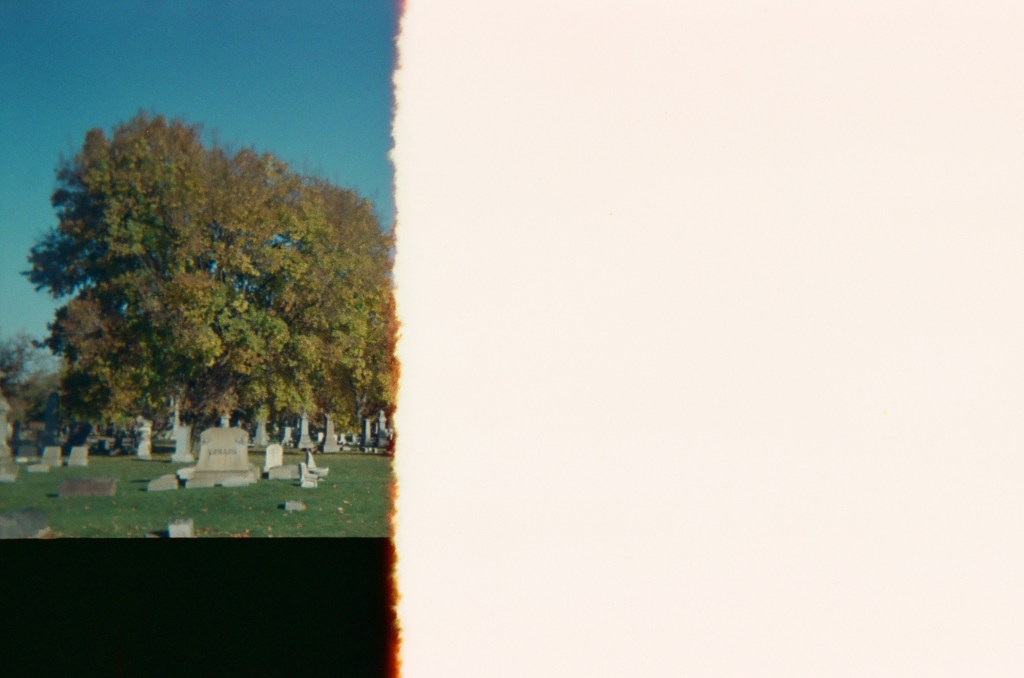
Photo Credit: Rosalynde Agatha Kasper
Rosalynde Agatha Kasper is a writer and photographer with an eye towards harvesting the rot of analogue media. Her writing on film and culture has appeared in The Maple, Protean, and other venues. She has a master’s degree in gothic studies and will never turn down a chance to give a talk on the cultural implications of slime moulds. Rosalynde is the co-(g)host of the film and gothic theory podcast Horror Vanguard.

Leave a Reply