How to Keep Well in Wartime
by Garen Torikian
Over the last twenty-five years of war, our nation’s indefatigable commitment to unity and our unwavering faith has been instrumental in achieving unprecedented strides toward peace. Even so, our nation still loses a combined total of 92 million work hours each year due to common and often preventable illnesses. If left uncorrected, even mild symptoms, such as shortness of breath, indigestion, or fatigue, can fester into more severe cases. The Department of Health has calculated this to be equivalent to the loss of 4,100 soldiers, 2,750 pilots, and 6,000 adjutants a year, not to mention the pain and burden we inflict on our friends, families, and communities. The Department of War, our nation’s largest employer, spends about $3 billion annually in obesity related health care costs for current service members, as well as costs to replace mentally unfit personnel.
As Surgeon General, it is not only in my personal interest to promote our collective well being, but also my responsibility. Hence, this guidebook, which compiles the best advice from our nation’s dutiful medical officers. The human body is like an engine: it requires constant maintenance to keep it running. Now that we are at a turning point in the war, it is more important than ever that we should do everything we can to keep fit—fit to hasten victory, to tackle the tasks that lie beyond, and to enjoy the fruits of our ignoble labor. Victories are won not just through a general’s leadership, but also through the fortitude of each and every soldier. You may not think of yourself as a fighter, but make no mistake: when a drone flies over your neighborhood, the enemy will make no distinction as to whether you are enlisted, a veteran, or a designated invalid.
However much heroism it may bring out in people, the atmosphere of war is itself unhealthy. We are all aware, now more than ever, that what we are battling is nothing short of pure evil. Everyone knows that they are fighting for the freedom of others as well as for their own. By committing ourselves to health, we will keep the nation strong. To victory!
1. Keep Cadence
The first guidance on keeping healthy is to be regular in the habits of living: eating, working, sleeping, and so forth. Establish a routine and do not deviate too far from it. If you start the day well, you will have no trouble maintaining your natural rhythm throughout it. To do so, simply follow these guidelines:
1. Drink a glass of water the moment you wake up in the morning.
2. Give yourself time to expel all waste from the previous day.
3. Ensure that you arrive at work at the same time every day.
4. Take your lunch at the same hour.
5. Return home soon after the night shift arrives.
We cannot control the world around us, but we can minimize external and unwelcome shocks to our nervous and digestive systems by keeping a regular cadence. Do not rebel against routine. If you become irregular in your habits, your unpreparedness could harm all of us.
2. Worry Less
Through any period of unfortunate war, there is an increase in the number of citizens expressing their worries in the most vocal and unhealthy ways. The anxious person presumes themselves to be a benevolent force. They think they are helping others avoid dangers. They formulate plans of action against a variety of scenarios, and their enthusiasm is infectious. They agitate themselves and others. Scientifically speaking, an “agitator” is one who feels troubled about problems that don’t exist. Agitators have a form of neural divergence, an anxiety over absolutely nothing at all. In other words, agitators have an illness. You will find them easily enough: they are the members of your community—your neighbors—who are always too tense, too restless, too distressed.
As per the Department of Civility’s census data, agitators have become increasingly prevalent in our society. This may be because the real danger we all face amplifies the imaginary dangers that produce anxiety. Their concerns spread to others like a mold, infecting them with unnecessary doubt. Feelings have their time and place, but wartime isn’t it.
The recommended guidance to stave off this purely mental disorder is to reflect, not react. If you observe a family member or friend worked up for no apparent reason, try to engage in a conversation which draws their fears out. Determine whether there is unreasonable envy, jealousy, or even hatred of another person or of an institution. Some people, as you undoubtedly know already, hate any kind of authority, whether it comes from their neighbor, their spouse, or their government. In every case, the advice is the same: do not worry about things you cannot change.
3. Choose the Right Food
Scarcity is a consequence of war familiar to us all, the result of which is the increased interest citizens have taken toward food. It is probable that you have already learned a lot about food and food values from our Department of Health. If your interest has been galvanized, pursue it and continue the curiosity when peace surely comes! For others, remind yourself of the creed every child knows: healthy bodies eat healthy foods. Only eat foods which fit within the SFP triangle of:
- Sugar, which comes from starch, which is the primary substance in bread, potatoes, rice, corn, and wheat—all the essential crops this country grows in bountiful bushels.
- Fat, which can appear in many forms, such as butter, margarine, milk, salmon, or even the sweat of roast pork.
- Protein, the principal ingredient in the billions of tiny cells which make up your body. Since the war has reduced our supplies of first-class protein, you must plan to make the most of the amount you are allotted.
Provided you eat as much as possible of these food groups, you needn’t worry much about eating anything else. Unfortunately, it has not always been possible to eat the right kind of foods, much less find them. If this describes your situation, you can visit https://doh.home and subscribe to the Department of Health’s RCS broadcasts. Their recommendations are specially selected to keep citizens fit after considering a wide variety of factors, including cost-to-benefit ratio and overall efficacy. Remember that in these days of fiscal responsibility, any adjustment to your diet must be carried out carefully and with proper observation.
Above all else, I discourage the use of weight loss supplements without a doctor’s prescription. You are encouraged to be fit, but shortcuts will only hasten your body’s decay.
4. Get Enough Sleep
While it is true that some people can do with less sleep than others, the average adult should obtain six hours of sleep every night. While we all have our obligations—to our colleagues, our customers, our communities, and our families—we must not let them overwhelm us. We want to be busy—it is good to be so—but we must also remember to rest!
It is too convenient to delay sleep, for the most industrious among us can always claim ignorance of when they should stop before starting again. However, determining when to lay down and reach the maximum number of hours of sleep is simple arithmetic. If you are required to wake at six in the morning, be in bed with all of your devices and unit lights off by midnight.
People who find it hard to go to sleep are often those who find it hard to relax. We all face unavoidable distractions, whether they’re our brave pilots roaring overhead to their next target or buildings thunderously collapsing in the distance. The solution is to find an activity which frees your mind from the stresses it has accumulated over the day. If you have been working indoors all day, a fifteen-minute walk around your housing complex before bedtime may give you a pleasant feeling of mental relaxation.
You may try to simply forgo expending effort to find a solution if you are still unable to sleep for several nights in a row. In that case, consult with a doctor for prescribed remedies. A special consideration must be given to those of you who are ill or malnourished: don’t lose sleep wondering what the doctor will think of you when you go to him. You need not worry about a scolding or inquiries as to your neglect. Of course, our nation’s medical staff is under heavy strain during wartime, but their responsibility is to provide considerate treatment to all patients, regardless of their caliber.
5. Obtain Your Share of Sunshine
Just as our bodies need water and food, sunshine is an essential nutrient. There are days when the winds blow atmospheric particulates, and there are days when the air raid sirens never seem to cease. In these cases, you may not be able to step outside for even a moment. Therefore, you must seize every possible opportunity you can to immerse yourself in as much sunlight as possible. The ultraviolet rays of the sun act on a fatty substance in your skin, turning it into a vitamin your body relies upon to operate efficiently. Children will benefit the most, as the process assists in forming their bones well—bones which only grow stronger as they become older, in the unlikely event of their drafting.
On the days when you observe that the soot from the air has cleared, gradually attempt to sunbathe. Don’t start in the early part of the morning, interrupting your pledge of allegiance, or the latter part of the afternoon, when you are most likely to dawdle and shirk your work responsibilities. Take in the sun during the heat of noontime, when the sun’s rays are at their most intense. It is no accident that this coincides with your lunch hour, and you can achieve two healthy habits in one go. Ten minutes—or if you can spare it, fifteen—of direct exposure should be adequate for your body. Blondes should remember that as a rule they can stand the sun less well than brunettes. Caution is also advised to senior citizens with weak hearts and weak chests: undue exposure to the sun may make their troubles worse.
6. Keep Mind and Body Active
Relaxation is encouraged, but lethargy is dangerous!
It is necessary to continuously refresh oneself, mentally and physically. As demonstrated by the recesses of our diligent legislative branch, taking time off from work to rejuvenate your body and mind can serve to strengthen you.
There is, it must be said, a line between rest and complacency. Sloth is not only one of the deadly sins. It is the first to lead the procession of the other six. You may think that laziness requires no effort, but it is the conscientious destruction of the good work which has been built up all around you by the men and women who have died for your comfort. The least you can do is not insult them with your apathy.
Relaxation is the process of setting boundaries between one duty and another, so that your “engine” can cool down before starting up again. What is often needed is a change of activity, something that will exercise the muscles that you haven’t used during the day, and which won’t be used during a State Guard procession or in your Homesec duties. One way of doing this is to get up half an hour earlier in the morning and walk around your housing complex, before driving into work. Here, again, you can tackle multiple health initiatives at once!
Alternatively, find your local branch of the National Guard and ask to enroll in their unit training assembly program (UTAP). UTAP will assist you by not only providing a vigorous and inspiring regimen alongside other members of your community, but you’ll also receive an evaluation of your aptitude towards service.
For those essential workers who only take time off when federally mandated, I salute your dedication. On your holidays, you should aim to provoke a change in your environment. Any change in and of itself will help you to relax. And it need not be a drastic change. You may never have entered the casino just three or four miles from where you live. You may not have enjoyed a hefty steak at a restaurant or gone to a movie theater for months or even years. It is possible that you have never even thought about mailing a letter! Do not spend all your time on slot boxes and video cards at home. Try something different.
By the end of your holiday, a sense of exhaustion means that you have done yourself some good, and you will be eager, in all capacities, to return to your work.
7. Delight in Moderation
Tobacco, marijuana, and alcohol should be enjoyed sparingly. The inhalation of tobacco and marijuana, whether through rolling papers or vaporizers, may soothe the nerves, but they also disrupt one’s appetite and irritate the mouth, throat, and lungs. Last year, the citizens of our nation spent nearly $100 billion on these herbs and related products. Their use has become a social custom, and a bad one at that.
Yet they can interfere tremendously with mental and physical productivity. The loss of productivity affects not just your own output, but threatens the efficacy of everyone around you, who must make up for your excess. The act of smoking seems to relieve a sense of strain—and in wartime, everyone is living under some sort of strain. However, in excess, apart from its harm to physical health, smoking worsens the very nerves it claims to soothe.
Similarly, the effect of alcohol on the brain is to relieve stress and anxiety—but as everyone knows, it also dulls one’s capacity for self-assessment. It is inevitable that people should seek relief from strain, and there is nothing to be said against the occasional drink—but only in moderation.
Every doctor who respects the Hippocratic Oath has no desire to moralize regarding the behavior of consenting adults. Our concern is with health and disease. Yet every doctor is familiar with the notion that interactions between men and women, men and men, or women and women may lead to irresponsible acts, especially under the influence of controlled substances. Casual sexual relations often end in permanent sexual disease.
It would not be so bad if the disease affected only the person who caught it—this alone is a serious matter, as it immobilizes the labor force. A hospital full of gonorrhea cases means a loss of soldiers. But diseases sprung from such encounters may also affect the unborn child, who may be born blind, paralyzed, crippled in mind and body—a pathetic victim to the irresponsibility of its father and mother.
Of course, sexual relations between healthy and committed couples are not only benign but strongly encouraged. The next generation is just as vital to this country’s future as the one currently in it.
The more artificial our lives become, the greater the strain upon so natural an instinct as sex.
Anyone who is worried about their sexual health should go to his or her doctor and talk frankly about them, as an open discussion is good for the soul. Often, difficulties are greatly exaggerated in the mind of the worrier because he or she is not rightly informed about the matter in question. Leave the decision making to your doctor, and trust that any issues plaguing you have been observed and addressed by so many others before you.
8. Pass On Our Values
On the matter of children, a considerable amount of literature has been made available by the Bureau of Future Citizens on how to ensure they are engaged with schoolwork in the absence of adult supervision. These highly recommended tactics need not be reiterated here, as our concerns are with the physical health of children.
Recent breakthroughs in the field of psychoanalysis suggest that the seeds of nervousness, and therefore of future ill-health, are planted in childhood. Therefore, on the occasions when your child seeks to demand your attention, you must permit your child to settle themselves.
A “nervy” child is often made so by a parent who, although otherwise composed in their day-to-day, is over-anxious about the conditions surrounding their babies: the parent who worries about every little detail. Of course, the child wants attention—but never give them too much. A child is an unstable little creature, quickly passing from laughter to tears. A spoiled child is also an unhealthy child, and, without health, a child will never be happy.
There is one form of interference with a child’s dignity that is still popular, and that is corporal punishment, or, more colloquially, a “good smack,” should your child choose to engage in more irresponsible behaviors. A person skilled in the training of dogs knows that a dog can be brought up by kindness and that there is no need to strike it. What good can you hope to achieve by physical punishment except obedience inspired by fear? But a long lecture may be crueler than a quick slap.
Mothers especially have the very greatest responsibility, and bringing up and caring for a child necessitates endless patience. A child’s future happiness is in their hands, which is precisely why we seek to limit as much unnecessary decision-making as possible. No trouble should be too great, and the young mother must realize that she must give up many of her personal pleasures and much of her freedom to devote to her children. Often the quickest way to resolve disputes is to ignore explicit attempts to elicit approval. Either the child will move on and have strengthened their self-esteem, or they will fail and be dissuaded from entertaining their self-indulgence.
9. Fight Disease with Hygiene
People have complained that some of the children evacuated from the slums were dirty and uncared for. The condition in which some of them had to live did not make it easy to be clean. But, without cleanliness, perfect health is not possible.
Diseases are the result of contamination with germs. It is easy to see if you have rodents infecting your household. It is not so easy to see how some other infections spread. The little demons responsible for these conditions are unpleasant and cause a lot of discomfort and irritation to the person they attack. Once settled into your body, germs multiply, producing thousands upon thousands of other germs. All that is needed is a cough or a sneeze, and these germs will go out into the air, to be breathed in by someone whose throat will probably be infected as a result. In fact, it is through careless coughing and sneezing that many germs rely for travel, going from one human being to another.
Altogether, influenzas and infections cause a vast amount of illness and human suffering and unhappiness, and a vast loss of hours of work to the national war effort. One way to stop germs spreading from one person to another is to isolate the infected person. If everyone at the very first sign of a cold would go promptly to bed and stay there for one or two days, then the common cold would not be so common as it is, and everyone would lose much less time at work overall.
The usual thing that happens is that someone goes to their office with a streaming cold because they do not want to miss a day of work—an admirable attitude, indeed, although given the circumstances, an irresponsible one. This knowingly sick person then comes into contact, either willingly or inadvertently, with a wide variety of people, in the bus, on the train, within the office break room, and in so doing, negligently cripples them all with their infection.
Those who have dangerous germs within their body without being ill themselves are known as “carriers.” Therefore, it is doubly important to adhere to all the guidelines recommended above, and to report any suspected carriers to the relevant authorities. Scientists are constantly searching for new vaccines which can treat these infectious diseases. We may soon discover that a combination of sunlight and chlorine is all that is necessary to combat illness.
Conclusion
You are saved from all sorts of infections and poisonings by an elaborate Medicare service which you hardly ever hear of until something goes wrong. Your food and water are kept pure by a system of inspection, regulation, and control that tries—with unobvious successes—to prevent any harm coming to you. It is inevitable that at one point or another a disease of the mind or body will weaken you. But by isolating yourself, and by continually helping yourself to keep well and free from infection, you are helping not just your community, but the entire country.
Obviously, no one who is always brooding over disease can ever really be well, even though their body is perfectly sound. The person who thinks in terms of health and healthy living will automatically feel better and fitter than the ones who think in terms of disease. Don’t believe that thinking about yourself in this way is morbid.
The human body is a marvelous piece of construction! The human mind is a most delicately adjusted mechanism! And this war has shown us once more that both are, at the same time, amazingly tough. But the men and women who vanquished the enemy at the Battle for Kalamazoo did not fulfill their heroic task with minds and bodies that were untrained. To get the most out of life, you must put the most into it. To live, to laugh, to labor to the fullness of your capacity, you must get fit and keep fit.
Good health is not just something the young have. Each period of life has its standard of good health. Whatever your age, strive for the best health available to you. Without good health full happiness cannot be obtained. To be happy means to have a job you are suited for, to have a household arranged in the approved manner, friends within your community, and hobbies to fill the hours between labor and rest. These, in their different mixtures, bring happiness.
If you want to reach happiness and to be complete, seek health with the eagerness with which so many foolish others have sought fickle fame. Good health is the real riches: it is up to you to get it and to keep it. The pursuit of good health can be an adventure. And in this adventure, all the doctors and the health services in the country are here to help you.
As a result of this war, it is well-understood that this country is worth dying for. It is also worth living for and working for. To do this to the best of your ability, you must be as fit as you can be made. And you probably haven’t yet found out just how healthy you can be!
Garen Torikian is a writer crafting stories that examine the power dynamics that occur between individuals, communities, and larger social entities. He occasionally dabbles as a Western Armenian translator. Previous works have appeared in Guernica, Electric Literature, Speak, Potomac Review, and Wasafiri. He was the editor of Mo(a)t, an anthology of translated contemporary Arabic literature, which was published in 2021. He now runs Inch Press, a zine devoted to making Armenian literature more accessible to English readers.
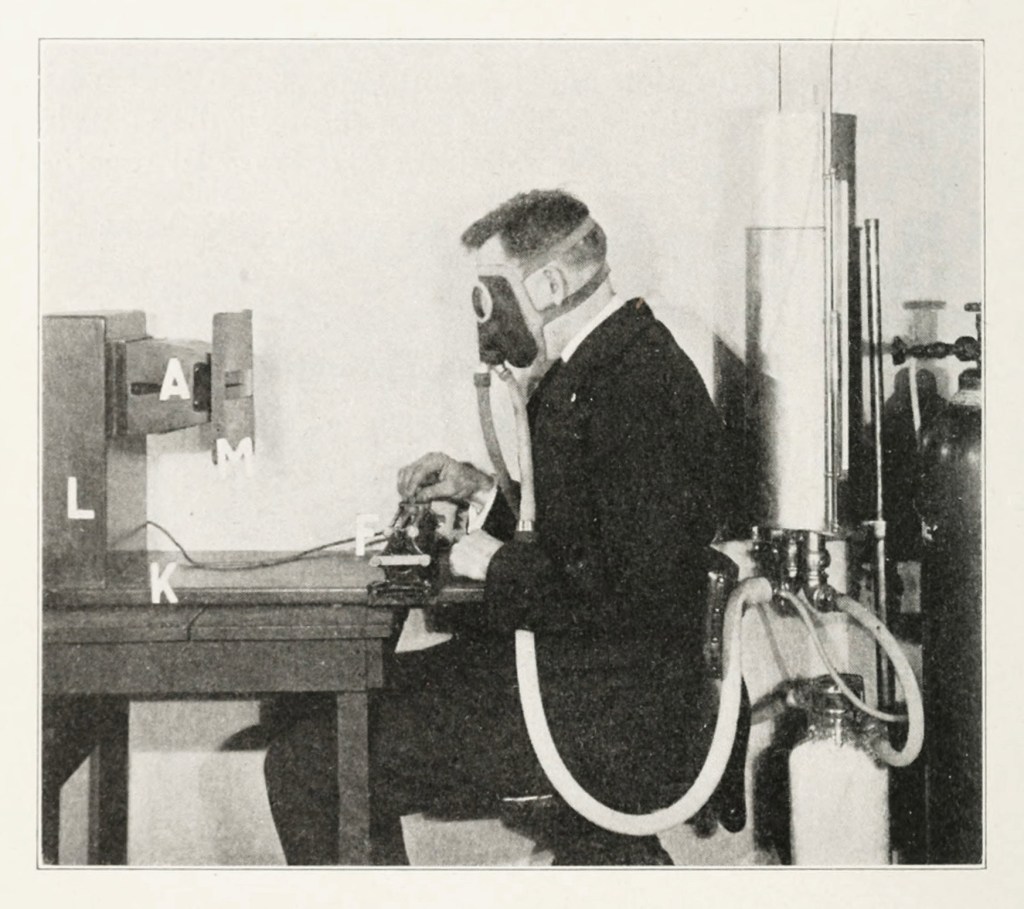
Picture Credit: A test subject has his oxygen consumption measured while using Walter R. Miles’ Pursuitmeter (1921)
Image sourced from the Public Domain Image Archive / Internet Archive / University of Toronto Libraries

Leave a Reply