What Scares Us in the Backrooms: Horror’s Revolutionary Possibilities?
by W. Scott Poole
“America is giving off dying mall vibes.” This phrase produced a tremendous amount of online discourse since it first made the rounds about a year ago, so much meme-jabber that my own years-long boycott of social media did nothing to prevent me from learning about it. That said, the precise origins of the phrase are unclear, though a Karen Attiah tweet and Substack essay seems to have been the viral nexus of the image. Whatever the origin of the words, it offers a vibe recognizable to enough of us to produce posts about everything from the material conditions that killed the mall to discussions of the putative end of American exceptionalism and American empire.
Many of these hot takes have come caked with the spun sugar nostalgia so annoyingly typical of capitalist realism’s view of the world. The centrist-liberal element in this discourse manages to extort from the meme the idea that “if only the dying mall could live again, that we could once again look at the country’s 250-year history and Hilary Clinton (well, not her but someone like her) could assure us that “America is great because America is good.” To paraphrase Engels, the liberals look at the ruin of late capitalism and promise “society exactly as it is but with its defects removed.”
Translated into lib-speak, this becomes something like: May the Mall of American Capital thrive, but maybe with some vegan options at the food court and without the sleaziest of the fast fashion outlets? This could happen for us—“you can just do things”—but if only we could get rid of Trump or even if he’d just be nicer and stop rhetorically crapping the carpet.
“If you do not wish to speak of capitalism, don’t bother speaking of fascism.” Max Horkheimer’s exhortation may tell us something of why a strange, in many ways unsatisfying, film performed on the level expected of that now seasonal commodity form: the summer blockbuster. In its second weekend, Backrooms, a film that takes place almost entirely amid sickly yellow walls made more garish by late-stage capitalism’s love affair with fluorescent lighting, sold more tickets than the summer’s star war.
Kane Parsons, the director of Backrooms, began his meditation on the creepypasta phenomenon in 2022 with a hugely popular web series. His 2026 film expanded that series with darkly funny look at the minimalist despair of “Captain Clarke’s Ottoman Empire,” a beached whale of a nineties furniture store incapable of even deciding what kind of postmodern kitsch it wants to fabricate. At one point,an employee/videographer stops filming a truly ludicrous local TV spot featuring his boss Clarke dressed as a pirate while talking of the empire of the east. Baffled, he asks his employer, “Are you supposed to be a pirate or a sultan?” We get no answer and what answer could there be? Neither/both, it doesn’t matter…we are trying to sell sectionals and particle board desks here.
Clarke, creator of the pirate/sultan manqúe, owner of the failing store, and the closest we have to a protagonist in the film, faces divorce, unpayable bills, and the stress of holding on to bourgeoise status by his fingernails. We learn he wanted to work in design in an economy that slotted him into the disposable furniture business. The dissolution of his marriage, often one of the many economic death rattles in American class slippage, forces him to sleep in his dying rooms-to-go-no-credit-no-problem hellscape. He discovers that the store features an unknown space, another dimension that’s inexplicably large, so large that we eventually meet an odd organization mounting expeditions into it, trying to map it, and seeking to discover its nature…and what’s lurking there.
“Going to Another Place” certainly doesn’t qualify as anything more than an overused trope in genre fiction. Parsons has, however, frightened audiences with the sheer banality of what that “other side” reveals. No centaur waits by the lamppost, and Hogwarts is not a train ride away.
Instead, it’s the same craptacular accoutrements that we find in the nightmare worlds we inhabit in office buildings, universities, institutions of control and discipline, really anywhere the flow of capital briefly coagulates before flowing onward to the next capillaries of surplus value. The labyrinthine nothingness channels you to room after room, some empty, some littered with detritus of Capital’s wake. One room features a sad office party Christmas tree and the disturbing sense that something terrible and malignant happened there…like an office Christmas party.
Backrooms, as web series and film, are ultimately spaces that failed. Commentators before me, who are partially right, have suggested that the film works because it manages to capture the angsty shriek of postindustrial horror. Bradley Earl Wiggins connects the popularity of this Internet folklore to a nostalgia for precisely these kinds of failed space. He writes that they critique “consumerist society” by reminding us, in nostalgic mode, of the failures of late capitalism. The backrooms of the postindustrial economy are the empty storefront on a forgotten main street, a former fast-food restaurant turned strip mall ruin, a dead big box store abandoned to rot in the middle of an endless sunbaked parking lot, or a down-at-the-heels furniture store with mysterious backrooms that are little more than the ghosts of regret that gather after capitalism leaves behind its inherent contradictions.
Shira Chess claims something far older for the frightening genealogy of the Backrooms. It’s not the condition of modernity as much as it’s the literary tradition of the gothic smashing into the postindustrial present and making a Castle of Otranto-sized hole. Chess sees a direct line between the terrors of eighteenth century gothic and what she refers to as the “institutional gothic” that now chants and thunder narratives in the ruins of neoliberalism.
These are compelling answers though, if true, this might mean American popular culture has developed a rather sophisticated awareness of ideological mystification. Should we expect Marx’s The German Ideology will join the stacks of Tolkien knockoffs and romantasy titles that dominate BookTok? No, we should not. I’m afraid Backrooms appealed for more terrifying reasons than my fellow commentators have noted.
Backrooms offers up the contradictions of capital, packaged and ready for sale. The film is about itself and in this it shares in the commodity fetishism of everything around it. The fandom that has created hundreds of hours of YouTube “lore videos” promising explanations for the alleged ambiguity of the film are telling a joke that they are not actually in on. The secret behind the horror of the dying mall of America is simply that it was never anything but a mall.
Backrooms also reveals something about the contradictory nature of bourgeois ideology in the development of the horror genre, and of our current interest in the varieties of fantasy, dark, and light. Saga, myth, and epic fantasy both ancient and modern have long made the otherworldly journey, Going to Another Place, a primary trope of human cultures. Odysseus and Aeneas make journeys to Hades in search of knowledge while Orpheus does the same in search of stolen eros. In the medieval world, Dante descended into hell to find heaven. These are models of what becoming a human being could look like in a world before wage nexus and capitalist social relations, the enclosure of the commons, and the creation of the bourgeois citoyen, free once a year on Election Day.
The heirs of heroic saga—horror, fantasy and science fiction above all—offer a revanchist reclamation, a louche representation of exploitation not dissimilar from the nineteenth century tendency to build workhouses in the style of the gothic castle or cathedral.
Genre is make-believe but not exactly escapist. In the last fifteen years, as social relations have become increasingly brutalized, a romantic sadism bloodied screens small and large, with franchises like Game of Thrones offering tales of liege lords and oaths of fealty that recall a world before the commons closed while also consistently reminding its fans about the throat-slitting exploitation on which such worlds are built.
Horror has long held an odd position among America’s fantasy multiverses. Like comedy, the genre demands of its practitioners a widening gyre of outrageousness. This has led, really throughout the history of the genre, to at least a mildly subversive streak, generally against bourgeois attitudes about gender, sex, race, and family life rather than against the bourgeoisie itself.
This elision in horror’s social critique perhaps explains why audiences found Backrooms compelling, even when they did not know why. Indeed, even more interesting than those few films that have attempted to make class social relations the basis of their grue (preeminently Jordan Peele’s US). The jump scares of Backrooms are their monotonous demand that we recognize they are simply where we live.
There’s no final revelation in the film and the murderous horrors that we meet are just banal versions of the characters whose labor has become their social identity. Our humanity reduced to commodity, with Clarke being haunted by his own absurd Ottoman Pirate masque, enacts the reality of our capitalist kitsch trying to kill us. Parsons consistently stages powerlessness and gives us less Hitchcockian suspense and a lot more Kafkaesque frustration. There’s no better moment in the film than when Renate Reinsave’s “Mary” attempts to escape being murdered by a paper-mache advertisement by crawling over, around, and under unsold furniture inventory in yet another sickly yellow room, not so different from all the rest.
Is this revolutionary cinema, a Battleship Potemkin or Strike or even Sorry to Bother You? No. Oddly, the film’s profound lack of interest in agency, the demand to accept the illogical logic of the backrooms, may make it less subversive than it could have been and a much more ideologically powerful tool for the bourgeoisie. Everything in the film is a dead end, there’s always one more corner to turn and discover that everything looks almost the same. One almost expects a horror puppet of Margaret Thatcher to appear behind Pirate Clark, raising her hands to bless the banality and announce that “there is no alternative.”
This does not mean that the film itself fails, nor that horror itself cannot become an expression of revolutionary discontent, if not the trigger for revolutionary action.
Surrealist horror, dating back to The Cabinet of Dr. Caligari, wrestled with how easily its despondent nature falls into political nihilism. Frequently it manages to draw us into darkness far enough to urge us to find our way back.
Severance, the streaming series that shares some of the DNA of Backrooms, at least imagines the agency of workers trapped in the banalities of corporate culture. Boots Riley’s work, from Sorry to Bother You to the critically acclaimed streaming series I’m a Virgo and his recent I Love Boosters, features subjects that consistently refuse to become commodified or at least rebel against that reality.
Yorgos Lathimos, creator of hilarious horrors, has proven more than a little chary of sharing much of a political vision beyond a disdain for the absurdity of bourgeois institutions and assumptions. Poor Things refuses its own title and reimagines the Bride of Frankenstein as an archetype of sexual, intellectual, and eventually economic liberation. Bugonia rather broadly satires our tendency to laugh at the proles—especially of the lumpen variety—for their tendency toward conspiracy.The film ends with inversion, dark laughter at the bourgeois passion for trusting institutions of glass and steel.
These are films that deploy their absurdities as heavily armed platoons on the battlefield of our contemporary nightmare, using genre tropes to answer Lenin’s always haunting question “What must be done?”
But, let’s not get carried away. Once I believed rather strongly that horror, maybe alone in the many-tentacled culture industry, could subvert the basic dynamics of American society. I thought, with some backing from John Howard Lawson’s 1953 book Film in the Battle of Ideas, that critique could release the commodity form from the power of its own fetishism. The adoption of horror tropes sampled from A Nightmare on Elm Street (1984) or Candyman (1992) by hip-hop maestros from Wu-Tang Clan to Kendrick Lamar meant these films had the power of people’s art, that they belong to the language and music of the streets. As Lawson wrote, after he’d been blacklisted and served a year-long jail term, “We must examine film and all forms of art as class weapons, serving a specific purpose in the cultural superstructure of capitalism.” If Lawson could see such possibilities, how could I be less hopeful?
I suppose I paid little attention to the fact that Lawson does spend most of his fine book describing how film works as a class weapon—but not for the proletariat. His closing paean to the possibilities of a people’s cinema in independent production leaves one with an especially clammy feeling at a time when “indie film” long ago became as much of a commodity form as any Steven Spielberg production. A24 Studios, at the time of the production of Backrooms, depends on a $224,000,000 investment from private equity firms and maintains a market valuation of over $2,000,000,000.
Capital can make light of itself and its irrationalities while still laying claim to Rationality writ large. It adores your three hour long lore videos that create excitement for a film about its own inherent emptiness as capital craves your enthusiasm. We loved Backrooms because we recognized its lurid emptiness. Ideology ultimately makes us fans of our own prisons.
W. Scott Poole is a Professor of History at the College of Charleston. He is best known as the author of Monsters in America and an award-winning biography of H.P. Lovecraft that’s been translated into four languages. His most recent work is Dark Carnivals: Modern Horror and the Origins of American Empire.
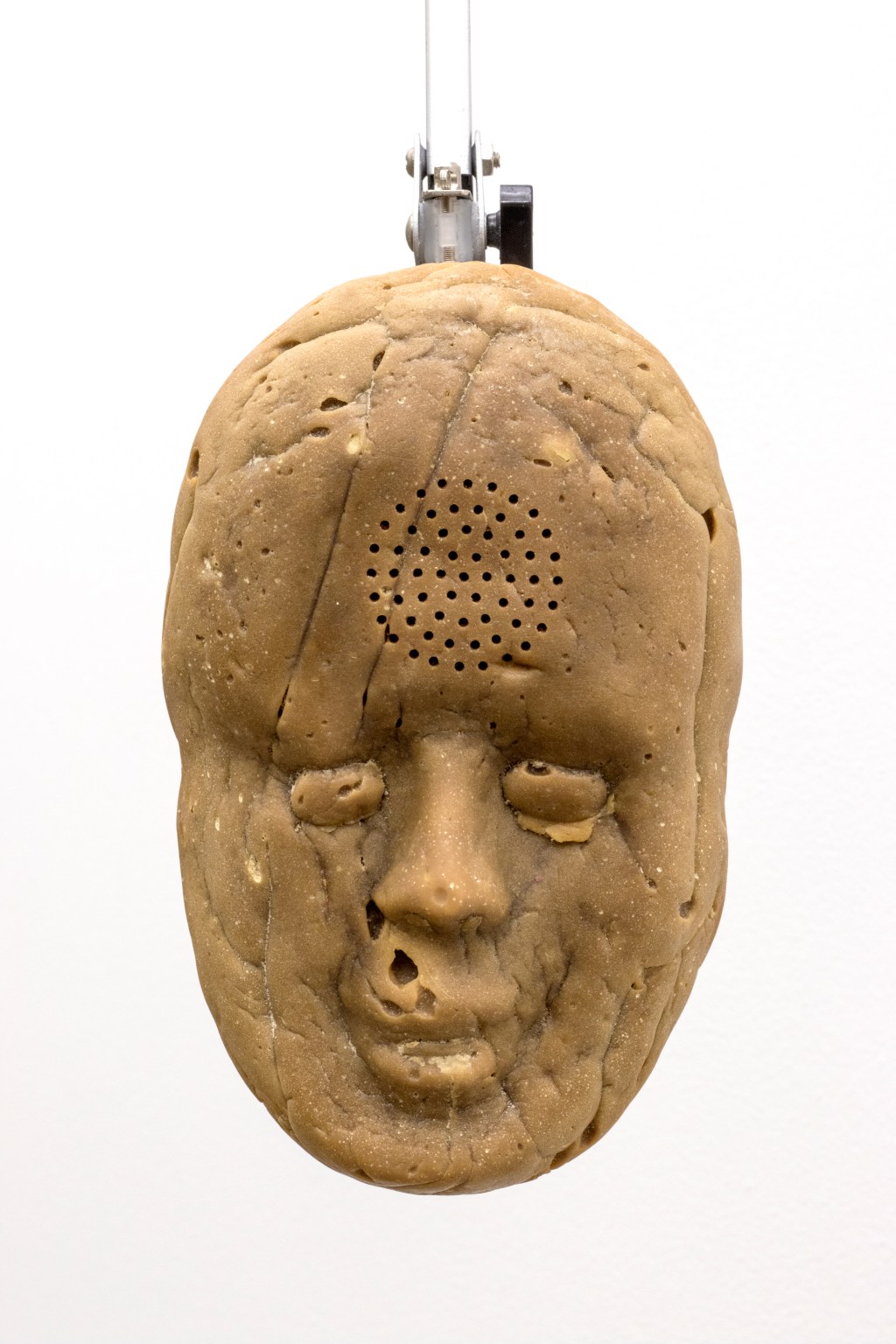
Image Credit: Archive of Eggs, rehydrated freeze dried egg, speakers, sound (2018) by Christopher Smith
Christopher Smith is an artist and educator living in Chicago,IL. In addition to his studio practice Smith has organized experimental exhibitions out of his apartment, a vacant lot, a fire pit, a crawl space, and a medicine cabinet. You can find more of his work at https://visualdesolation.tumblr.com/ .

Leave a Reply