Rage Against the Domestic Work
by Agnieszka Kotwasińska
Working out of an Eastern European university, in an institution that arose from a Cold War fascination with America in the seventies but has since morphed into a globalized North American cultural studies melee, you get to see what tickles young Poles about the US of A. Three evergreen topics for BA dissertations are the feminism of Disney princesses, the found family of Friends, and the fame of serial killers. As a thesis supervisor, I grudgingly agree to the first two, but it’s a hard pass for me on the last one.
Sure, students try to convince me that they will be doing a bona fide cultural studies paper on the representation of male serial killers in films, novels, or on TV, but I’ve read their proposals, and I can already spot the red flags, redder and shinier than any fake blood on Ryan Murphy’s ghoulish true crime shows. The allure is too strong. The students will end up psychologizing Ted, Ed, and Jeffrey, wondering what made them tick and commiserating their traumatizing childhoods. Then I will drop dead of apoplexy seeing all the Psychology Now references.
I promise, I won’t be psychologizing anyone today. My deep dislike of male serial killers’ tales and their supposedly libidinous or phantasmatic connection to the heart of “Americanness” steers me clear of Ted, Ed, and Jeffrey. But I would like to follow a fictional female serial killer for a while, one who not only comments sardonically on male-centered narratives, but also carves her own space within the subgenre—one Fred Notty, from Virginia Feito’s Gothic satire, Victorian Psycho (2025).
Playfully riffing on Bret Easton Ellis’s American Psycho (1991), Feito’s tale takes place in a mid-nineteenth century English manor, where Fred, a new governess, attempts to reunite with her aristocratic father, but her plan is rudely interrupted by her own murderous tendencies and a mounting pile of corpses. In sharp contrast to the tales of male serial killers and their psycho-sexual obsessions or larger-than-life evil villainy, in Victorian Psycho, the female serial killer’s production of death, her necro-work, proceeds from a deep-seated aversion to the Victorian gender politics and its main product—the domestic work system. It’s a system rigged and detrimental for all the parties, but especially bad for women and children, and then especially bad for those of the working class.
Our narrator’s own class ambiguity does not help. Fred is a daughter of a domestic servant and a step-daughter of a minister and an illegitimate daughter of an aristocrat. To make matters worse, Fred works as a governess to a wealthy family, which means she’s educated but earns a precarious wage just like a housemaid. She is a special kind of domestic servant eating at the master’s table but is treated just as contemptuously as the footmen serving the meals. Finally, she is someone clearly below her employers’ station but at the same time at least theoretically capable of moving up the social ladder through a serendipitous marriage à la Jane Eyre.
While the novel references Victorian Gothic, it is written in a contemporary Gothic mode, which is characterized by a playful shifting of readerly identifications and a deep fascination with (even affection for) monstrosity and non-normative embodiment. Still, at its core, the Gothic is first and foremost a family matter, obsessed with the shaky twin roots of property and propriety.
Commenting on the original English Gothic novel of the late eighteenth century, Ruth Bienstock Anolik notes that it “is preoccupied with the legal and seemingly literal questions of ownership: the questions of who actually owns the property (the frequently contested castle), who owns the self, including the body and mind, who owns the narrative and the text.” But rather than offer clear-cut answers and reaffirm epistemic boundaries, the Gothic obsesses over these questions and offers only “ambiguous and ambivalent answers that work to desynonymize ownership and possession rather than stabilize the terms.”
On the one hand, it is through Gothic tropes of (female) madness and body horror that Feito’s novel interrogates contemporary readers’ expectations vis-à-vis true crime-inspired narratives and mercilessly mocks the exhausting predictability of male serial killers’ stories. On the other hand, the Gothic’s preoccupation with family, home, and matters of ownership paints a grim picture of domestic arrangements, class animosity, lack of solidarity between the oppressed and the exploited, and a constant stream of abuse gushing down through the highly hierarchical corridors of a model Victorian household.
It is from a violent disavowal of the fraught space of domesticity, care work, and familial obligations that Fred’s killing rage flows, even if she remains somewhat unaware of her exact motivations. In one telling episode, Fred imagines an aristocratic infant taunting her desire to be acknowledged by her father, Mr. Pounds: “‘Your father doesn’t love you either…Only heirs are worthy of their father’s love…You don’t even carry his name…You’re but a trollop’s daughter. Twat.” Fred responds not with words, but with her father’s razor, slitting the baby’s throat.
Domestic work and care work are part of a larger constellation of reproductive work, which in classic feminist Marxist theory, has been defined as that which makes productive work feasible in the first place. It is predominantly women who are pushed, socialized, and induced to care for free for their family members and/or take up jobs within the ghastly underpaid and quickly expanding care work sector. In what Nancy Fraser calls “the globalizing financialized capitalism of the present era,” it is women of color and migrants of different genders from the Global South who rapidly fill the ranks of low-paid care sector jobs in the Global North.
Kirstin Munro hones the definition of social reproduction in that it refers not only to “the reproduction of labor-power” but also to “the reproduction of capitalist society as a whole.” This distinction allows us to move from the question of “how much social reproduction is actually worth?” to “how should we transform social reproduction in the first place so that it stops replicating capitalist structures of power and thought?” Munro’s diagnosis is “that exploitation and domination are inherent in the organization and processes of production and reproduction in capitalism, and thus that the reproduction of capitalist society proceeds by perpetuating these forms of organization, no matter the rates of exploitation or the amounts of redistribution.”
To put it simply, while redistribution of money, resources, and time within the social reproduction field can and does improve the comfort and well-being of unwaged and/or underpaid workers, it can also deepen the existing inequalities and even increase their social reproductive workload.
In the last decade, social reproduction has often found its way into debates about the so-called “crisis of care,” a global shortage of care which weakens social tissue and threatens to constrain the smooth workings of a capitalist machine. Nancy Fraser, however, points out that what we now call “the crisis of care” is basically “a more or less acute expression of the social reproductive contradictions of financialized capitalism.” A “social contradiction” inherent in capitalism assumes that, on the one hand, capitalism needs social reproduction to work, but on the other, its “unlimited accumulation threatens to destabilize the very reproductive processes and capacities that capital—and the rest of us—need.” Hence, the capitalist paradox of simultaneous dependency and denial of social reproduction.
It would be easy to see Feito’s Fred as embodying today’s “crisis of care.” She is after all a product of a deeply care-less habitus, where neglect, horrific abuse, and violence are bread and butter for children and women. Yet, for all the horrors experienced by Fred as a child, Feito peppers her novel with enough easily recognizable markers of Fred’s (pop)psychopathy to introduce ironic distance (rather than empathy) between us and our first person narrator.
We come to realize that Fred’s mother might have been truly monstrous, but so was Fred as a child. And since we have been trained well by true crime multi-level marketing to recognize serial killers’ red flags—cruelty toward animals, not crying as children, emotional detachment, lack of fear, difficulty parsing social cues—we can identify Fred’s species, to borrow Seltzer’s Foucaultdian term of choice for serial killers.
A somewhat adjacent reading would see Fred’s serial killing through the lens of consumerism in that a never-ending crisis of care (which has enveloped her since birth) pushed her into a quasi-consumerist frenzy with murders-cum-commodities meant to fill an emotional void. Surely there are moments in the novel where Fred’s murderous urges intermingle with proprietary desires, for instance, when she imagines a display cabinet full of “fingers, and rows of eyes with beautifully lashed eyelids, and severed ears, their lobes twinkling with jewellery,” which also works as a persuasive parody of a Victorian naturalist’s cabinet filled with exotic butterflies, most probably plundered from the British colonies.
At another time, Fred bites the earlobe of a handmaid she fancies because, well, she enjoys biting into things. In fact, Victorian Psycho leans heavily into images of biting and eating, both of which pop up frequently in contemporary feminist horror and Gothic satires, where they are used to interrogate women’s fraught relationship with their bodies, the beauty and wellness industry, diet culture, or more generally, taboo desires and strange hungers. Still, the vast majority of food and eating imagery in Victorian Psycho serves as an indictment of the upper classes and their monstrous appetites rather than as a feminist commentary on female embodiment. A case in point, Fred’s fatness does not translate into images of fatphobic voracity or yearning for human flesh.
Even though Fred is not really a consumer, we have grown accustomed to understanding serial killers as allegorizing Western consumerism writ large, for which the United States is both the temple and the warehouse. They consume bodies (often literally) in a warped mirror image of the Black Friday spectacle of consumer goods being torn to pieces and swallowed by hordes of shopper-zombies. They also refuse the slow hard work of relationships and sociality, instead opting for ready-made single-serving experiences of extreme affects.
When it comes to Ted, Ed and Jeffrey, and the scores of their cinematic and TV doppelgängers, I do see the appeal of consumerist interpretations. Still, most female serial killers operate on a different level of imaginary potentialities—their stories are often rooted in abuse and survival, and the questions asked are not “why?” and “how?” but rather “what made them turn from a victim to an aggressor?” and “when did they move from feeding others to satisfying their own appetites?” Female serial killers are often presented not as connoisseurs of human flesh and its masculinist-inflected pleasures but as faux feminist avenging angels and furies, their stories bleak and predictable in the all too familiar contexts of extreme poverty, domestic abuse, and sexual assault.
And yet, a recent wave of fictional female serial killers is gifting us with something a bit different, something with a bit more satirical edge, violent panache, and less primordial
misery. Works tentatively identified as feminist horror, femgore and Good for Her subgenres—Monika Kim’s The Eyes Are the Best Part, CJ Leede’s Maeve Fly, Asako Yuzuki’s Butter: A Novel of Food and Murder, Katy Brent’s How to Kill Men and Get Away With It, Oyinkan Braithwaite’s My Sister, the Serial Killer, and Feito’s Victorian Psycho—give us women killers who are not necessarily forced into killing by their low social status or considerable hardship. No one hurt them so much that they are now possessed by a need to hurt others back. No cold revenge is being dished out to deserving men and women.
Historically women’s motives were usually reduced to the “sad, mad, or bad” triad. Keya Anjaria notes how the removal of clear and identifiable motive for women murderers increases women’s “agency and subjectivity.” Plus, “[i]nconsistency in motive” helps to explain the narrative denouement, in which the female murderers avoid punishment altogether, though novels such as Braithwaite’s or Brent’s approach this rather playfully and unevenly, just like Feito’s. These femgore serial killers kill freely and indulgently, thus, at least superficially, moving conceptually closer to their male counterparts, the Lecters and the Batemans of crime and horror fiction, evil geniuses and larger-than-life psychopaths waving their phallic objects in the air as if it were Freud’s piñata party.
Fred is no evil genius, nor does she exhibit Patrick Bateman’s consumerist compulsions. While horrible and traumatizing beyond doubt, her childhood does not strike me as all that different from the childhoods of many other women populating Feito’s nineteenth-century England. Fred does not embody either the crisis of care or rampant consumerism. She does, however, function as a fantastic expression of capitalism’s inbuilt propensity towards self-destabilization.
In Feito’s Gothic satire, Fred nominally goes after her biological father—Mr. Pounds—a wealthy aristocrat who spurred her domestic worker mother after she had become pregnant. But the revenge trope comes across as tired and unconvincing, especially seeing how Fred kills a whole bunch of people not even tangentially connected to her supposed quest. The murders she commits are mostly disconnected from a larger social field (at least two of her murders are direct results of hallucinations) and feel exuberant, almost accidental, and childish.
But they also demand a lot of physical exertion from Fred: subduing her victims, killing them, dragging their bodies, finding places to hide them, arranging them, and on one occasion running like the wind to the nearby village to kidnap a peasant infant to replace the aristocratic one she’s just murdered. Her domestic work as a governess might be demanding in its mind-numbing tediousness, but it’s her necro-work that really requires a lot of effort from Fred: stamina, resourcefulness, and good knees.
Fred hits her full stride at Christmas, killing more than fifteen people in quick succession, after her father spurns her special Christmas present. He was expecting a love declaration and sex. Instead, she gifts him with unwanted paternity. The exact kill count remains ambiguous, as Fred is now aided by her thirteen-year-old half-sister and erstwhile charge, Drusilla, who starts her own mini-killing spree by first saving Fred from their not-quite-dead father and then helping Fred to dispose of other guests and servants.
Fred’s highly productive necro-work has an air of endless self-sufficiency about it. The Ghost of Post-Care Capitalism, Fred haunts the halls of the Ensor House, seemingly no longer requiring much reproductive work to sustain her. Her Christmastide killing spree is the ideal of self-sustainable work, and funnily enough, Fred’s written narration does not end in prison, right before her hanging, but continues through her execution and the casting of her death mask, lending her a ghostly afterlife and an iron will to continue killing-cum-working forever, in a never-ending mandate of incessantly buzzing death.
The warped space-time of Christmas at the Ensor House allows for a utopia of sorts for the two girls. They eat whatever’s left in the pantry and not too rotten yet, play children’s games with the corpses, hunt marauders and maids hiding in the nooks, invite the horses in. Theirs is a satire on the uppermost classes. All play and no work makes them all very dull,
indeed. No exertion toward one’s survival, no necessities of life to be eked out of a meager existence.
Everyday household chores are subsumed under necro-work. For instance, in an attempt to scare off wild animals that are slowly intruding on Ensor House, Fred prepares a makeshift scarecrow: “I try to impale Mr. Art Fishal on a giltwood torchère, first attempting to insert it into his mouth with the ambition that it might exit through his anus, but after much graceless poking, unsure of the direction of his limited oesophagus, I resolve to just tie him up on the torchère with a twisted, red moreen curtain. He makes a fine scarecrow, one of his eyeballs secreting onto his cheekbone, maggots squirming in his wounds.”
By drawing attention to the grotesque yet inventive transformations of corpse-goods, Feito emphasizes that Ensor House has never been simply a site of consumption for the upper classes, but also a place of production involving all the classes, albeit to a starkly different extent. As Munro reminds us, “Household members must transform these commodities into the goods and services enjoyed by household members via a household production process.”
Practices, habits, behaviors, and specific arrangements of time such as cleanliness, entertainment, education, comfort, or safety are thus the desired goods and services produced by a model household. Yet, Fred’s keen eyes and ears reveal time and again that the main goods generated via social reproduction at Ensor House are stifling conventions, misery, abuse, ill health, and, above all, death.
The novel ends in a ghastly proliferation of death, but this is also how it begins: “Death everywhere. Death in the river, in the corpses floating upstream and down, in the bellies of the things feasting upon them. Death in the drinking water, pooling into wells and unspooling within villagers as typhoid and cholera and diphtheria…In the wigs of the living made from the hair of the not, shorn by enterprising undertakers from corpses sealed in caskets…Death in babies, oh so many babies—the unbaptised slipped into other corpses’ coffins in a cheating bid for a grave and a funeral, stillborn pillows for the dead…[Death is] crushed in paint. It’s papered on the walls. Everywhere, death.”
This ghastly introduction marks the first appearance of the figure of a dead child, a focal point of Victorian death culture. Still, dead children may crowd the pages of Victorian Psycho, but grieving is annulled for most of them. Hosts of dead children are paradigmatic nineteenth-century workers—interchangeable, depersonalized, easily replaceable, extremely cheap but at the same time quite nettlesome in their frailty and neediness.
In a telling moment, Christmas guests complain about a chimney sweep who got stuck in their dining room fireplace: “‘Mr. Fancey tried to pull him out, but it seems he’s stuck there.’ ‘We lit a fire underneath him to coax him out,’ Mr. Fancey adds. ‘So much fuss with child workers nowadays,’ Mr. Pounds says empathetically.”
Children, dead, alive or soon to be dead, are implicated in Gothic’s preoccupation with family, property, and patrilineality. Playacting a devoted father in front of Fred, Mr. Pounds extols his children’s virtues. Fred dryly notes that he seems to be as “proud as he is of all his legal property, to the exclusion, perhaps, of his wife.”
Fred is at a loss to explain all the fuss about children: “They’re only people, albeit smaller. Why care about people when they’re small if no one cares about them when they’re grown? Society has decided, in recent years, that children are precious and worthy of being spared the slightest suffering. Are they truly so deserving of mercy?” Of course, the passing of the Factory Act that the novel references does not automatically protect all the children from harm. It just solidifies death production at home, rather than at the workplace.
The finale emphasizes both Fred’s and Drusilla’s childish abandon. They violently repudiate the domestic work system and social reproduction as such in favor of grotesque necro-work. But, of course, the idyllic sisterhood cannot last forever. The relatives of all the dead domestic workers want to know what happened to their long-awaited Christmas reunions, neighbors are forever nosy, and finally, on the twelfth day of Christmas, the police come for Fred.
For Fred alone, as Drusilla quickly ties herself to an oven handle and performs the poor kidnapped upper-class girl-child routine that no one thinks to question. Placing the finale within the confines of the twelve days of Christmas undercuts the insurgent ambiance of Fred and Drusilla’s necro-work. Even if it had not been for the nosy neighbors or relatives, the food would have run out at some point or the stench would have become unbearable or wild animals would have taken over. It would seem that the binding logic of reproductive work can only be briefly suspended for women villains, but it cannot be circumvented indefinitely.
In contrast to many female serial killers in contemporary fiction who evade punishment and justice, Fred expects to be caught and hanged. The crisis and production stoppage are thus inevitable: Fred cannot sustain her anti-social-reproductive killing spree ad infinitum. Something’s got to give. Either social forces (the police, neighbors, relatives) or individual needs (food, shelter, warmth in winter) will finally force her hand and demand a return to the previous state of social reproduction. Ironically, Fred’s killing spree loses its own momentum once there is no one else left to kill, and the two sisters are just waiting for something or someone to interrupt their short-lived eutopia, to give them more necro-work to do.
In the end, Fred’s turbo-accelerated necro-work at Christmastide unwraps the paradox of late capitalism, which requires social reproduction to operate but also actively endeavors to make it less and less feasible in the first place. Killing all the domestic staff, who, after all, “don’t really count” in Fred’s eyes, means that the two sisters’ quality of life steadily worsens with each passing Christmas day up until Fred is led to the gallows and Drusilla is “rescued.”
In a final stroke of irony, Drusilla saves her life by betraying Fred and feigning a compliant return to the system, which will continue squeezing social reproductive labor from her until she, too, drops dead, if not from the gallows, then from a marital bed.
Agnieszka Kotwasińska works as a teacher and researcher at the University of Warsaw, Poland. A lifelong horror nerd and horror studies scholar, she tells students to be suspicious of monster killers, not the monsters. She has written one book so far, House of Horrors: Familial Intimacies in Contemporary American Horror Fiction (UWP, 2023). Hopefully, she’ll write some more in the future. In her free time, she mothers a medium-sized goblin, writes body horror, and draws pretty flowers.
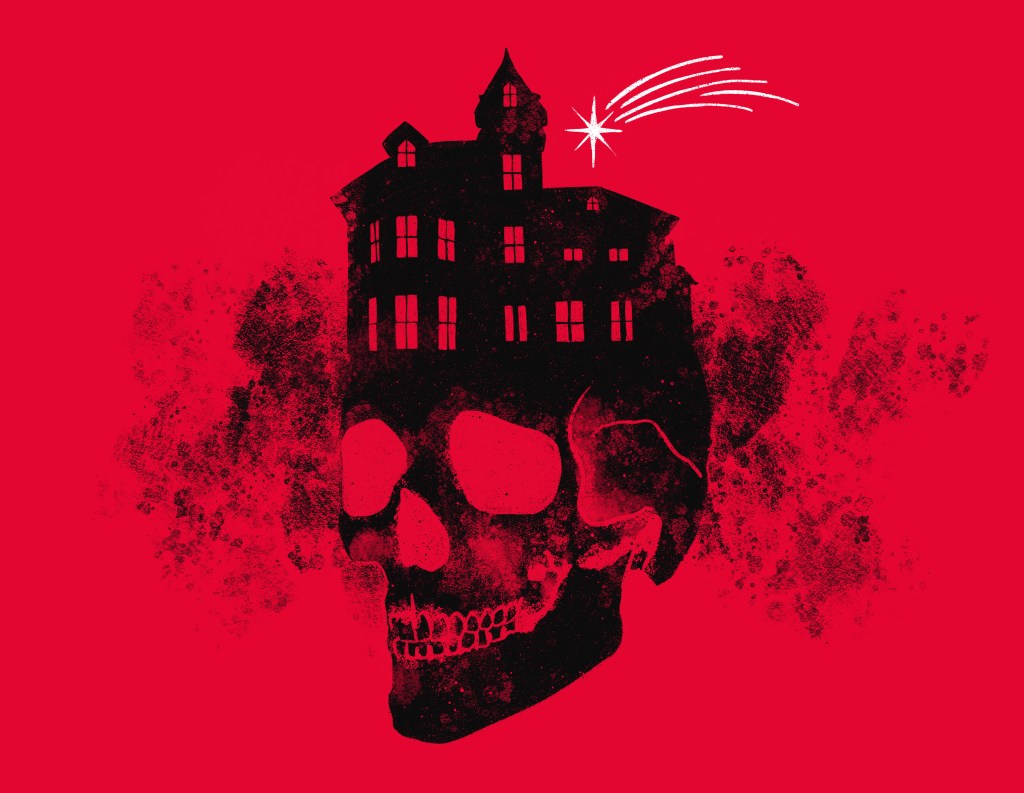
Image Credit: Magdalena Sołodyna
Magdalena Sołodyna is a Warsaw-based illustrator and graphic designer who loves making posters and illustrations for books and magazines. Her work is digital, but she always aims to keep a human touch. Outside of design, she makes music as Zeradyna and shares her home with two cats, Freya and Fisk.

Leave a Reply