Gothic Marxism, The Rouse, and The Nonrational: A Interview with China Miéville
by Dan Dellechiaie
China Miéville is a rare breed of writer and thinker. He’s been on the New York Times Best Seller list and is an outspoken Marxist. He’s penned cogent theoretical works and some of the most-lauded Weird fiction of the twenty-first century. He’s cowritten a book with Keanu Reeves and won The Arthur C. Clarke Award (three times), Locus Awards (seven times), and the Hugo Award (only once, but I expect his new novel, The Rouse, may make that twice).
All the spoilers for The Rouse are marked as such.
DD: As the author of one of the foundational texts of Gothic Marxism (“Marxism and Halloween”), can you please give me your definition of Gothic Marxism?
CM: It’s very nice to be considered foundational to anything so I’m very honored by that. My workaday definition would be the overlapping currents in Marxism that take the spectral, the phantasmagoric, the fantastic, and the monstrous as in part constitutive of capitalist modernity rather than as either epiphenomenal or simple mystification to be dispelled, and that therefore treats it as rich material for analysis, diagnosis, critique. But I reserve the right to update that as necessary as projects become clear.
DD: One of the reasons Jon Greenaway and Adam C. Jones have written “Gothic Marxism: A Manifesto on the Dark Way of Being Red” for this issue of The Gotham Guillotine is that there needs to be some clarity regarding the term. When I was researching Gothic Marxism, I ran into so many roadblocks where it was like there isn’t a good definition. There are some aphorisms. Jon Greenaway’s Capitalism: A Horror Story: Gothic Marxism and the Dark Side of the Radical Imagination is fantastic for clarifying the term. But even that book doesn’t fully give a definition.
CM: It’s worth saying that the moment you come up with a rigorous definition, you are immediately going to bump up against edge cases. My relationship to definitions, as with manifestos and so on, tends to be one of cheerful asymptotic open-mindedness. You’re never going to reach the thing which sorts all these things out. But by all means finesse it here, finesse it there, as long as it doesn’t make one close-minded, and as long as one recognizes that it is a cheerfully Sisyphean task, it can be productive, even so.
DD: What is your literary relationship with Gothic Marxism? Is it something you’re consciously thinking about while you’re writing your fiction?
CM: No, generally not. But that isn’t to say that it’s not in my head. The way I always put it is that I’m always interested in a set of things and have been for a long time. And I’m always interested in them, and they’re all bobbing around in my head like a stew. When I’m writing, I’m ladling to get the right stuff and pour it out. And it might be that the concerns that one might think of as clustering around Gothic Marxism or the various other things I’m interested in—international law, other kinds of Marxist traditions, etc—will become ladled out with that stuff. But what I don’t do, generally speaking, is think: “Now, to write a fictional text that will riff specifically off this notional, intellectual, and political project of Gothic Marxism.”
I will say there is a caveat to that. I do sometimes become wryly aware that a particular thing that I’m doing for aesthetic reasons, that it has certain resonances with certain theoretical interests. And even on occasion there will be a sense of how do I aestheticize that theoretical interest? So I can think of one section of The Rouse, for example, which riffs quite deliberately off a theoretical project that I developed some time ago. I would say that that tends to be the exception rather than the rule. For me, when I’m doing fiction, it’s not a question of saying I’m not interested in these things. So no, I don’t sit there and deliberately throw in fan service for the Gothic Marxists.
DD: What are for you some historical and contemporary works that embody Gothic Marxism?
CM: To me, when I think about Marxism at all and Gothic Marxism as a subset of that—because you know that I don’t go around describing myself as a Gothic Marxist. I’m a Marxist, but I do have a great deal of interest in this research project, this cluster of interests, this tradition.
So the answers to your question would be analytical texts rather than literary texts. There are literary texts that are clearly of particular interest to people interested in Gothic Marxism because they very vividly embody those concerns. But, for me, it seems to me this is a way of understanding the world and the cultural artifacts.
The most obvious one is Margaret Cohen’s Profane Illumination. To the best of my knowledge, she came up with the term Gothic Marxism. That’s, for me, the foundational text.
And then recently, there’s Jon Greenaway’s work, which is very important and interesting regarding this topic. For me, the surrealists loom large, the largest single clustering, the largest inspirational node.
And then there are writers that would not surprise you. Walter Benjamin, Esther Leslie, Avery F. Gordon’s Ghostly Matters , Michael T. Taussig’s The Devil and Commodity Fetishism in South America. There’s Victoria Nelson’s The Secret Life of Puppets. It’s a tendentious reading to read it as Gothic Marxist, but I do anyway.
There’s a certain kind of negative influence. There’s a respectful disagreement with Theodor Adorno on mystification and the occult. And that doesn’t mean being credulous and woowoo. It means having a certain kind of contradictory relationship to the notion of rationality, which to be fair so did he.
Is your question also about literary works or is your question specifically about theoretical works?
DD: I am curious if there were any fictional works that came to mind?
CM: I don’t mind how people categorize my stuff. It is no surprise that because I’m interested in this kind of thing theoretically and that I’m also interested in it aesthetically so it is not a surprise that if you are interested in this research program of Gothic Marxism you find some stuff that is congenial to you in my fiction.
As a project, however, I’m cautious about trying to unite theoretical works and artistic works as part of the same research project. In some ways, I have quite an old-fashioned view of this because I tend to think, broadly speaking, they are doing different things.
So again I’m not making any judgments about how any other comrades deal with this, but, for me, Gothic Marxism is a way of interacting with the world and the cultural products within it. It is unsurprising that it will cluster around certain products that have those kind of concerns in a more vivid form.
But part of what’s interesting to me is precisely maybe being counterproductive, counterintuitive. Like the danger of saying: “Was this book written by a leftist? Does it have a ghost in it? OKAY, GOTHIC MARXISM! THERE WE GO!” And it’s like, I mean sure if you wanna do that, but it’s not the most interesting thing to do. That feels to me more like a collector’s mentality, and that’s not particularly my drive.
One of the things that can be really interesting is, Marxist or not, taking a lens of the Gothic and applying it to a text that is not traditionally thought of as Gothic and saying, “What is the occulted acculturation within what might seem to be a very mainstream text?” Whether it’s written by a leftist or not. And you would never say that that is a Gothic Marxist text, but it shows you maybe a way that you can use some of these tools to bring out hidden tendencies within surprising texts.
So for all these reasons, for me, when I’m talking with my analytical head on, as I am certainly in this part of the conversation, I tend to go to nonfiction. And because I have these interests, the question is really more like, what are the books that you love? What are the fiction books that you love? And rather than say “These I love because they’re Gothic Marxist.” It’s like “Well, I love Jane Eyre, Dracula, and GUESS WHAT? They all seem to—” You know what I mean? Haha! But I would be cheerfully cautious about canonizing them in that sense.
DD: One of the key aspects of the Gothic is the return of History, the inescapability of the past. M.R. James, for example. History never escapes you. Does the contemporary return to Marxist and socialist theory surprise you or was this inevitable? How do you feel about the state of the Left right now?
CM: The return to Marxism, that doesn’t surprise me at all. Partly, you’ve got to remember—I don’t know how old you are.
DD: I’m twenty-nine.
CM: Well, A) Fuck you.
DD: *laughs*
CM: And, B) I’m a couple weeks away from my fifty-fourth birthday. I’m an old guy. One of the few nice things about getting older, is that it’s really true that things come around again. I’m on my third or fourth round of this merry-go-round of this return to Marxism.
On several different levels, one is simply: if you like academic fashions, they come and go. More seriously, particularly if you’re a leftist, you’ll feel that there is a rigor and a perspicacity to Marxist analysis that is indispensable. It is absolutely no surprise that A) it will be disavowed by the mainstream, but B) that it will recur because it’s both politically and analytically persuasive.
And so one of the things that’s balefully funny is that around about once every fifteen or twenty odd years, you get all these titillating articles in the mainstream press that are like “OOO RETURN TO MARX!” Yeah, another one. Right. Obviously because the crisis came back up, and you know who talks about crisis? So it doesn’t surprise me at all.
Having written about The Manifesto, it’s old news that these texts and these traditions recur in particular at times of crisis, at times of what I might provocatively call “decadence.” So no, that doesn’t surprise me at all.
And during those times when you feel very embattled as a leftist, and you feel that no one is paying attention to these texts, obviously you would like them to be changing the world there and then. But it is the case that they will come back around again. 100%. And it’s just always gonna happen.
In terms of the state of the Left, I don’t think I can say anything that would be particularly surprising to you or anyone else. I am very depressed. Politically, I’m scared. I’m genuinely frightened.
That said, I did not expect to be saying this in the US, there are some surprising moments and surprising signs. You’re talking to me from the People’s Caliphate of New York.
Now, let’s be clear. Of course, I have criticisms of Mamdani. I am a Marxist. He is not. I have a certain set of policies. He does not. But I am so tired of this asinine loser stupidity. I really have very little time for the sectarian leftist refusal to take the W ever.
A self-styled socialist won the mayoralty of New York. That’s fucking amazing. It’s amazing. And there’s battles to come. He’s gonna disappoint us, and all of that. But I don’t have to be a slavish and uncritical supporter of the DSA to be excited by some of these aspects. So by all means, all the ultras can now disavow me as a social democrat shill. What-the fuck-ever.
Now to that extent I would probably say that I’m maybe slightly more hopeful than I was a few months or a year ago, but I do think it is important to get these things in perspective. Like in global terms, we’re really fucked. As my friend and comrade, Richard Seymour, said some years ago, and I’ve never been able to get the phrase out of my head: “There has not been in living memory such a good time to be a fascist.” And that remains true. And that’s really really fucking scary.
I would say I’m not optimistic. I’m hopeful, which are very importantly not the same thing. I feel very embattled, but I’m not defeated. There’s a lovely phrase that John Berger uses: “undefeated despair.” Despair has a bad rap on the Left. That’s partly because it feels isomorphic with giving up, and I don’t think that follows. So I don’t feel despair at the moment. I feel very embattled. But when I do feel despair, it remains undefeated.
DD: You’ve also been working on your own communist magazine, Salvage. You’re its fiction editor. Talk to me about Salvage. What is its mission? Where does it fit in the now quite vast leftist magazine ecosystem?
CM: We’ve been doing Salvage for ten years now, and I am in charge of fiction there. Although I’m also part of the general editorial collective so we all agree on everything. It’s a democracy about what goes in. I don’t just deal with the fiction, that’s what I mean.
Salvage has become incredibly important in my political life, which is to say my life. I don’t know how much you know about its start. It started a little more than ten years ago in the aftermath of an extremely unpleasant and very difficult fracture within the British Left. Those of us who were clustered together in a dissenting group left the organization we’d been members of for a long time in some cases. It’s not unrelated to that undefeated despair I was talking about.
It was a really bleak time not just for the Left, but on the Left. It was very sectarian. It felt very insular. It felt very theoretically sclerotic. In the aftermath of a big split and a big crisis, one of the good things that can come out of it—it doesn’t automatically, but can come out of it—is new thinking, being open to rethinking things, getting rid of your nostrums. What we wanted to do was have a venue which said, “We come at this with theoretical humility.”
A lot of the things we had been trained into feeling or trained into thinking by a certain school of the activist, Trot left was ultimately sclerotic or unhelpful. We’re going into this unsectarian. We’re going into this with open minds. We’re going into this with much more curiosity about traditions that we don’t come out of, both of the Left and, to some extent, more broad. But all from a position of communism, of ruptural politics, of a decisive need to break beyond capitalism. We are all Marxists, but we are open-minded.
I don’t know if you’ve experienced this, but certainly for us, people of my age, there was a certain obligatory optimism on the activist Left, which became incredibly debilitating. I thought it was theoretically and politically stupid and dunderheaded and also actively counterproductive because it led to burnout and led to lying and led to lying to yourself and to all this stuff. It was also a liberation. A lot of people were accused of being pessimists for the sake of it. And our position was “No, our pessimism is earned. We are pessimists because we think the situation is really bad. And we’re never more happy than when our pessimism is disproved. That’s what we live for, which on occasion, to various degrees, happens.” But I think it’s about looking how bad the political situation in the world is in the eye very unremittingly, not ducking that.
I want to be clear that I’m speaking for myself here. I don’t want to speak for the other members of the editorial collective. For me, what I always liked about the idea of Salvage, I was always interested in the dissenting minority current within a broad Left current that I was really interested in. Trotsky’s messianique, rather than the Bolsheviks and the Mensheviks. Or the intriguing ultra-left situationists who found a place within a more mainstream leftist current, but operated as a point of friction, but within. Almost a loyal internal opposition. I don’t want to valorize oppositional contrarianism for the sake of it. It’s also not to say that I always thought all these things these currents said were right because I don’t. But I do think it’s very useful to have a serious, rigorous opposition, a comradely opposition that is raising the difficult questions, even if they don’t necessarily have the right answers.
And so for those reasons, my slightly playful but also somewhat serious vision for Salvage is: it’s a journal for a troubled, oppositional current within a mass Left movement. But unfortunately the mass Left movement doesn’t exist yet. We’re a dissenting journal for a mass, vibrant socialist culture that we’re desperately hoping to be a minority current within, a minority current that says, “Yes, but what about this? What about this? What about this?”
One of the things that I do feel good about is the plethora of leftist magazines like The Gotham Guillotine and various others. I don’t have a competitive relationship to that. The more, the merrier. That’s great.
I also will say—and I don’t want to steal valor here—to me, that kind of left pessimism is considerably less uncommon in the leftist magazine ecosystem now than it was when Salvage came out. And I’m not saying it’s because of Salvage, but I’m saying it’s definitely because of us. Haha.
DD: Over the last few years, you’ve published October: The Story of the Russian Revolution and A Spectre, Haunting: On the Communist Manifesto. What pivoted you toward writing nonfiction? What pushed you back into fiction?
CM: You have to remember that the way publishing works, there can be something quite misleading at what you see at the front end. I’ve always written fiction and nonfiction. I was heading into academia before the fiction came off. And I wasn’t doing that joylessly. I enjoy research. I enjoy theoretical writing. I enjoy nonfiction writing. That was something I always did.
Conversely, I didn’t publish major solo fiction for a few years. But it’s not that I wasn’t writing it. A lot of that time I was writing The Rouse the whole time. So I was writing some short fiction and various other things that haven’t necessarily seen the light of day or that I might go back to.
Now that said, it is also true that the tides pull you in one way or the other. And it is true that I have been particularly drawn in the last ten years—and I do think this has a lot to do with Salvage—towards writing more nonfiction than I was before. I find nonfiction much harder as a general rule. Or I should say that a page of nonfiction much harder than a page of fiction and much more time-consuming and also it doesn’t pay as well and this is how I make my living. This means that it has to be some degree a consideration. But I believe and hope that I’ll always do both.
We’ve lived in a—you know, you’ve read Anton Jäger—we’ve lived in a hyperpolitical time in the last ten, fifteen years. I feel a tremendous sense of political urgency all the fucking time. It’s really exhausting. I think a lot of us on the Left feel that. So that has been reflected in the output.
But it isn’t true that I switched entirely to nonfiction or that I wasn’t doing nonfiction before or that I wasn’t doing fiction then. I’m always to some degree doing both.
DD: Can you talk about the writing process for The Rouse? When did you start working on it? What were some challenges? What were some victories, besides obviously the completion of it?
CM: I do want to preface this by saying, I’m being quite literal and honest about this: this is the book of my life. I will never write another book like this. It’s not for me to decide whether it’s the best or the worst or anything like that. I don’t mean that. But I mean, I work hard on all the books I write, but this book has taken me twenty years to write. I started writing it twenty years ago. And I mean that literally. The earliest documents on my computer are twenty-years-old. And for various reasons, it grew and grew in the telling.
The challenges were that it became about everything. I was a different person when I started writing it. I was a young man. The book contains its own archaeology for me. There are sections that were written twenty years ago that then I would rewrite and rework on. It took place over a very personally dramatic two decades, a very politically dramatic two decades. The change of my career, the change of my life, my personal relationships, the death of my mother, which was very powerful and formative for me, completely new political dispensations, etc etc etc.
For initially contingent reasons, because when I first started writing it, I knew it was going to be important, but I didn’t think it was going to be what it turned into. It still retained that core. It ended up accreting. You’ve seen it. It’s big, literally, thematically, and aesthetically. It ended up accreting more and more and more until it became about everything. The earlier drafts were considerably longer than the one that you read.
It was by far the most difficult book I’ve ever written to write. Partly just in terms of time, but also because I was doing other things during that time, because I was going through my own difficulties for a lot of that time, because the world was changing, which meant the book which was about the world was changing.
But I always knew I had to write it. I know that can sound a bit flaky, but it felt true. I knew that this was the book of my life. The challenges are that it became about everything. And you can’t write a book about everything. You can’t do it. So it became a question of building and winnowing, and building and winnowing, and building and winnowing. What you read in the ultimate version is a process of accretion and selection, accretion and distillation, repeatedly.
The main victory is that I still cannot believe it’s done. I can’t believe it. This feels incredibly definitional to me. For this book to come out is absolutely the end of a major chapter of my life in a way that nothing else I’ve ever done has been the case.
I know more than one person who died with their—call it what you will—their magnum opus, their white whale, their Matterhorn uncompleted. Some of them troubled and saddened by that. Some of them at peace with it.
There were many points while writing this where it felt impossible to me that this would ever be done. The fact that it’s done is almost unbelievable to me. It’s very nerve-wracking. But also there is a profound liberation in this thing simply existing in the world.
DD: With it being almost 1,300 pages, it is something that must feel like a weight off of your shoulders, but also a weight that you raise like a trophy. It’s certainly hefty. I personally don’t believe it could be chopped up into a series. It needs to be its full length in one volume. What inspired its size?
CM: When I was starting to write this, I wasn’t conceiving of it as a particularly big book. It’s funny because the elevator pitch for the book—which I’m not gonna give because it involves spoilers—is unchanged. It’s still the same book it was twenty years ago, but it’s also radically different.
One of the things that happened as the time went on was that you’ve never quite sure why one thing is hitting you a certain way. And with this book relatively quickly it became clear to me it was about more than it was about. It was in some way quite central. So it grew and grew and grew.
I did not set out intending to write a very, very long book. But when I was about ten years into it, and I had half a million words or something—it’s not that long now. It went through several more cycles of growing and shrinking, and there was no denying the fact that it was going to be a very long book. So then I did begin to get interested in the specificities of long books. Then I read a lot of very long books. Any long book, one of the first things that is said about it in critical reviews or indeed in friendly reviews is that “it’s too long.” There are people who are going to think this book should’ve been cut in half. Fine. Okay. But all I can say is what the aspiration is, what the hope is.
At its best, when it works, there is something about a very long book—there is a phrase Nabokov uses about Ulysses—and I’m not comparing myself to either Joyce or to Nabokov—he says that there’s something about Ulysses that both in the form and the page level, also in the length, that at a certain point, you have fallen into the book’s dream. You are reading the dream of the book. When I think about the really long books that I like like Miss Macintosh, My Darling or The Tunnel or Gravity’s Rainbow or Mosquito, there’s a strangeness and sometimes particularly involving a certain kind of effort to—because these don’t always have very clear prose. They sometimes have quite knotted prose. It takes an effort to lose yourself into them. This is partly why in an ideal world we would read them very slowly, a few pages a day so you almost forget that this is about reaching an end, it’s about losing yourself to a certain extent in a particular vision, in a particular dream, in a particular world so that when the end comes, it comes almost as a shock or a surprise or something.
Once I had realized that the book had to be long, then the question became “Okay, well what other particular qualities of long books that you think work, that you think they could only be done in long books?” In a sense, this is an inversion of a book I wrote called This Census-Taker, which is a novella. With the exception of The Rouse, it is probably the piece of fiction I’m proudest of. It is very, very short and very terse in its prose. And the project there is “What can you do with a very short book that you can’t do with a longer one?” In a certain sense, this is a companion piece. The attempt is to say “What is it about a really long book that gives you something that the best shorter book in the world can’t do because of its form?” There is an aspiration to that encyclopedic totality, and, frankly, that sense of too much-ness, that sense of needing a break, needing a breather, which is not going to be for everyone, but it’s what I love in Marguerite Young or Thomas Pynchon, as I say “And now I’m going to go back in.”
I’m aware that if you write a long book, you are asking people to stick with you. You are asking a lot of your readers. I’m not going to blame anyone who says “that’s too long. I’m not gonna do it.” But the wager, is something you said before we started the interview, it’s about a certain type of difficulty. The wager is that there can be a certain type of difficulty in a certain type of cultural product, in a piece of work, that can be a gift. It isn’t always a demerit. It can be offering you something in a way that something simpler or easier cannot do. I’m not saying that I got that right, but that was the aspiration. And that was the way at both the form and the page level, length became inextricable. If there is anything to this, it is inextricable from form.
Are you a long book person in general or are there exceptions?
DD: Yes and no. I would say that for a long book, especially with how tight my schedule is these days, freelancing a lot, it’s harder for me to be willing to wait four-hundred pages for it to start getting good. One of the things I love about The Rouse is that I was hooked on page 126. I even marked it. I was like, “OH, THERE WE GO!” Now I have to read the next 1,200 pages. So I’m a big book person, but as my time crunches get tougher, it gets harder. I spent one Christmas break reading Capital and taking it fifty pages a day, paragraph by paragraph. I wish more people wrote long books because, in America at least, 250 page books are the only things being published. Publishers are even shrinking print sizes to make a book that should be 400 pages into 250 pages. I like long books that pay off for their length. Are you a long book person?
CM: Not to the exclusion of anything else at all. I read plenty of books that are short, but some of my favorite books are long books partly because of their length. I don’t have a principled position on it, but there is certainly a quality to long books when they work well that is wonderful. But they are an investment. There’s no question about that. There’s something about being able to lose yourself off in something and reading it slowly. I read Capital a lot longer ago, though I actually read the new translation recently. Did you read that one?
DD: I have an unopened copy of it over there. Is it good? Is it worth reading?
CM: I thought it was great. I know with some people, there is a nerdy—I don’t say that as a diss—Marxological argument about it. I know there are certain people who thunderously denounce it. It will shock you to hear, Dan, that some leftists thunderously denounce something that another leftist did. I liked it very much. I didn’t think it was flawless. There were a couple of decisions they made that I disagree with. But I really liked it because as a whole it comes more out of a value-form theory approach, and it brings those aspects out in a way that I found very, very fruitful. So I really really liked it, and I’m excited because I think they’re going to do Volume 2 and 3, which I think really need new translations. So I really really recommend it.
Fantastic footnotes. Really useful footnotes. The translator’s footnotes. Marx’s footnotes are their own thing. There are some really interesting debates in the footnotes that I thought were helpful.
DD: So I do have to ask you about your main character of The Rouse. It may be surprising to learn that one of your main characters, Allardyce, is a spook, a member of an anti-communist death squad. But one thing that defines him is how his experience has scarred him, literally and figuratively. You even see it on a prose level as you go throughout the book. Can you talk about him as a character and the toll his work takes on him? And after that, would you mind talking about your other protagonist, Maur?
CM: Well, first of all, if you don’t mind, I want to ask you a question: “Why do you think it is surprising?”
DD: Now we’re getting into my opinions about literature. *laughs* I find that a lot of American fiction currently the protagonist is usually aligned with the typically liberal political opinions of the author. In some, let’s call them socialistic novels and short stories that have come out, including my own “Bright Purple Like Nothing Mattered”, my narrator is a communist spy. When I was writing that story, I wanted to give forth a narrator that leftists would agree with. But I do also write satire where there’s assholes talking. So it’s not surprising for me. I think it’s just an interesting angle to look at because there’s so much right-wing fiction that valorizes these anti-communist death squads. I’m curious about the choice of using someone who is in a right-wing death squad, who is of that bent, using them as a way of telling this story about the Left, about anti-communism.
CM: I find this really fascinating. In a way, we could veer and talk about this for hours because this gets to a lot of what I have a lot of frustrations with, as it sounds maybe you do too. That thing you’re saying, about valorizing the opinions of the author, do you know the British comedian Stewart Lee?
DD: Never heard of him.
CM: He’s a fairly well-known left-liberal. He’s a very smart comedian. He’s often attacked on the Right for being too left-wing or whatever. He has a routine where he’s mocking his own fans. The bit is “Did you see Stewart Lee? Did you like his comedy?” And the answer is “No, but I agreed the fuck out of it.”
I do get very, very frustrated because I feel as a response to political defeat, a lot of the Left in particular has this kind of hankering for identifiable avatars of themself in cultural products. They see the lack of those products as a failure of the product. At its worst, this gets to the really unhelpful Left fan thing of “Let me tell you why this MCU movie is incredibly subversive.” It’s like, “Ugh I—Jesus Christ.”
I genuinely don’t really know the extent to which this is true for liberals or whatever, but I notice it a lot on the Left. I’m being slightly provocative with my question back to you because I hear that “It’s surprising that your protagonist is a right-winger” and I’m like “Why? It’s a work of fiction.” It’s not just that if I want to write an overt political argument, I will write an overt political argument.
People can read whatever the fuck they want. But I do find the idea that it is a political demerit if I don’t find my own ideas reflected in the ideas of the protagonist who I want to identify with. This is a generalization of the aspects of a fan culture that pulls against what I like most in fiction and in culture. And I should say, by the way, that I recognize the drive within me, and I fight it. It’s not about saying that I don’t understand it. I do understand it. And I think it’s mistaken.
I remember I saw one review for the book I did with Keanu Reeves. It was a review from someone who probably shared politics with me, who was furious with me as a leftist for writing a book about a special ops soldier, which didn’t include a critique of the politics of the special ops soldier. I don’t quite know how to respond to that because I don’t want to be a dick, but I also feel so tired and sad about it because what an impoverished way of relating to fiction, of relating to art in general.
All of which is to say, this is not at all about saying that there are not politics in the book. The Rouse is a hugely political book, and you’d have to be pretty dim to not to know broadly speaking the politics if you’ve read the book. But I’m not asking you to marry Allardyce. I’m not asking you to agree with Allardyce. I’m not asking you to have tea with Allardyce. I’m not asking you to like anything he does. What I’m saying is my wager is that this person is interesting. Their psyche is interesting. What they do is interesting. Might be horrifying, but it’s interesting.
If you disagree with that, fine. The book is not for you. It’s a boring book. It’s a bad book. It doesn’t work. But the idea that you don’t agree with his politics therefore this is a problem—I know this is a bit of a parody of how the Left reads books or watches films, but it’s a parody that as a leftist I often see. Please let’s be better than this. It’s such a boring way of consuming culture.
I’m fascinated by the psyches of people who I disagree with, no less than those who I agree with. I’m particularly interested in people’s disavowed relationship to their own agency. And for me, a lot of Allardyce’s actions are about having a deeply conflicted relationship with one’s own agency in the world, which I think is very common.
There was never any question for me that one of the viewpoint characters would be one with this particular role, precisely because I wanted to write this large political book about everything. Does that all make sense?
DD: 100% and I agree with you 100% too. I liked The Rouse because it was from that perspective. Do I need to read a hagiography of Lenin or someone like that? No. I’m actually frankly more interested in this. There’s the Blowback podcast that often focuses on the assholes of History.
CM: Great podcast.
DD: Yes, it’s fantastic. One of my favorites.
One of the things I dislike about contemporary fiction is I know the author was scared to give someone they disagree with a voice. I’m glad that my question got you that way because I wanted to hear that.
CM: It’s a soap box that I’m hardly alone on. It’s a very common thing. I would also say incidentally that I do think—I’m going to get in trouble if I say this, but I will. I do think of this as a kind of infantilization of literature.
This is not something just that the Left does. There is perhaps a role in fiction for young readers, which I’ve written myself, I don’t say this with any denigration, in which this process of identification maybe makes a certain amount more sense. And even then, some of the best like Robert Cormier have fantastically horrendous characters that you don’t necessarily identify with. But even if you bracket the leftist thing, the way it is treated these days as completely normal and self-explanatory to say “I hated this book because I didn’t like any of the characters!”
That’s just a bananas thing to say. Again, read what you want. I’m not the boss. But the idea that the book is bad because you do not like the people in it—they are not your friends. That’s not their role. It just doesn’t make any sense to me.
So I think actually what we’re describing is a political iteration of a more broad tendency, which I’m sure one could investigate and figure out how it peaks and troughs throughout history. But it’s one that I don’t share. Sometimes it’s lovely to read a book and warmly fall into a hug where you just completely love the main characters. I’m not saying there’s anything wrong with that. But I am saying that the idea that that is a sine qua non of success in literature doesn’t make any sense to me at all.
And to get to the second part of your question, Maur is a more sympathetic protagonist. Although, I still don’t share a lot of her beliefs or politics or anything. She’s a different kind of person. In terms of selling the book, I’ll say she’s a single mother in her middle age. The Rouse covers quite a bit of her life. So she’s a middle-aged single mother who a terrible tragedy happens to and her family and is trying to discover why. I don’t know how much to say without spoilers.
I think I’m quite lucky because for the most part the people who have read my books over the years are very forgiving and open-minded about me trying things out and experimenting. I’m well aware that the stuff I write isn’t going to be for everyone, and I respect that. These tendencies that we’ve been talking about, on the whole to some degree for me at least, it’s self-selecting. I don’t think people broadly speaking who feel that way would tend to gravitate towards my stuff.
So I’m not saying that this is something that has personally hurt me. I do feel troubled by it in the sense that I feel like it can be a bit of a category about what literature can do.
DD: The Rouse’s characters have well-stamped passports: England, Malaya, the Congo, Oman, Cyprus, Italy, France—there are so many more I’m missing. I don’t know how many languages are spoken in this book. Can you talk about the research that went into all those settings and the languages too?
CM: A lot of the books I’ve written have been set in either in fantastic worlds or corners of our world where I can basically make quite a lot of stuff up. I like making stuff up rigorously so that itself involves research. I try to make things that make senses within certain matrices.
But The Rouse is very different because it’s a very worldly book, which is ironic in some of its themes, but it is. All I can say is a really large proportion of twenty years were research. I did an ungodly amount of research. I recognize that that sounds like a boast. In some ways, it was very difficult to write. I feel like at various points I went a bit mad. I don’t mean that in a lighthearted way. There were various points where I was making myself ill. And not just because of the book. There are always other things that go on in your life.
But I became quite obsessive at points about the details. The details of the counterinsurgency operations that are mentioned are, for my own benefit, rigorous and accurate to a degree that would astonish you. There are tiny details that are absolutely point-for-point correct. I researched every element as deeply as I could. And some of this was stuff I was familiar with to some degree before because I have a history of interest in political upheaval, counterinsurgency, etc. But certainly in terms of the research for Malaya as it was, Kenya, Cyprus, I did an enormous amount of research.
But also more generally, and here we get into SPOILER TERRITORY so I’ll tread carefully, a lot of the stuff about Europe in the 2000s, even certain throwaway lines, is very rigorously researched. And, of course, a lot of the research doesn’t find its way into the final book. One of the reasons that some of the earlier drafts were long was because I tend to write long, and I would put in details because I knew that I needed it for my own rigor. But then I would take them out. I don’t consider that wasted research. Even if the book doesn’t tell you that this was part of Operation Such-and-Such, and it was ordered by So-and-So for these reasons, I know that the texture of the writing had been informed by that research. It doesn’t have to find its way in there in a literal way to be worth having done.
Last month my wife and I were going up to the attic and taking up a load of boxes, trying to sort things out. And there is a section in the attic of research material for The Rouse, and it is boxes and boxes and boxes and boxes and printouts of articles and scholarly articles and rare books. I read an awful lot.
I’m well aware that one of the dangers of research is what people sometimes call “researchitis” where the book operates to drop these facts to show how much research you’ve done. It’s not for me to judge whether I’ve been successful. But I would say that when I put references in, my relationship to specific references, whether it’s references to other cultural things or historical facts, my relationship to them is very much that they are Easter eggs. You don’t have to know any of this stuff. You don’t have to read the Malaya chapters and say “Oh my god, he’s being really exact about that mission.” But if you happen to be one of the few people who are interested in that or happen to be a nerd with the same interests as me, then that’s a little present for you, a little gift.
Especially in these encyclopedic novels, in these large novels, which are about too much-ness, there can be a sense of “I’m not getting it all” so either the book is failing or I’m failing. And I don’t think that follows at all.
I’ve mentioned Gravity’s Rainbow. I know full well that I picked up I would be scared to guess how few of Pynchon’s references I got. That’s okay because the book worked for me anyway. Part of that is that sense that there’s more, that sense that there’s too much, that I’m not getting everything, it can be a feature not a bug. I don’t want to sound offensive. If that’s not for you, that’s not for you. But the book is absolutely, exhaustingly researched. If you know it already or do decide to go on a Google rabbit hole, I hope that you’ll be like “Oh! That detail’s actually true! That’s real. That’s a real person.” But you don’t have to do any of that, if you don’t want to. There can’t be a price for entry.
DD: When I first started reading The Rouse, I knew it had horror coming. It was somewhere in the back of my mind, through some of the email conversations we’d had, but I didn’t know when the horror was going to come. I could feel it creeping for the first hundred pages, and then it hits.
And now maybe we are entering SPOILER TERRITORY. But one thing, as a fan of Lovecraft and the cosmic horror folks, what I enjoyed about the horror of The Rouse is that the central horror object, the Rouse itself, is that it’s ineffable. I loved that there were so many debates about what the characters can even call this thing. Everyone has their own opinion. There’s that funny bit about the swear jar when you call the Roused “dead.”
I would love for you to talk about that ineffability, how that works as a core horror object, and how you wrote something that’s hard to describe?
CM: This is one of the key things I’ve been interested in for years. And I’m really with you. I find an endless fascination in the ineffable, the indescribable. It’s very easy to mock. Sometimes it’s quite fun to mock. It’s quite fun to mock the classic joke about Lovecraft. He’ll tell you something is indescribable and then describe it over three pages. Like fine. I actually find that very interesting that it fails, that there’s always a surplus, and there’s always something that’s never possible to get clear. There’s an element of this in everything I’ve written, fiction-wise. But certainly in The Rouse, it’s more pronounced than anything else.
And that’s partly to your point actually about the conscious bringing in of “Gothic Marxism.” No, but it is true that things that are interesting me theoretically start to crop up in my fiction. Over the last ten years or so, with Salvage and so on, I’ve been going through a lot of very radical philosophical rethinking of certain nostrums and tenets of my own leftism. All of which I should add to short circuit the denunciations of heresy, it has led me to be more committed in politics than ever, but have enriched it in ways that are really interesting.
In Salvage, I wrote a piece on Apophatic Marxism, which is this idea of a Marxism that incorporates that which cannot be said, which is of course what we’re talking about. The limits of language is something that has been a fascination for writers, particularly poets, for generations. And rightly so. For me, this is also a debate about rationality and what I am going to provocatively call “the human soul.”
Partly in that piece on Apophatic Marxism and some other stuff I’ve been doing recently, I draw quite a lot recently on a lot of theological writers. There’s a writer called Rudolf Otto who is very important to me. One of the reasons is his focus on the numinous, and the numinous is precisely that which is beyond words. It is normally in a religious context experienced as a positive numinous, but there’s always an element of terror to it. Conversely, it doesn’t take much, and Otto himself talks about this, to conceive of it as a negative numinous, that which is beyond words, that which is inexpressible, that which is evil.
He has a model of human rationality which goes beyond a dyad. Classically in Marxism, we talk about rational and the irrational. What Otto is very concerned to valorize, not at the expense of any of these other things but in addition to them, is the idea of the nonrational. The thing about the nonrational is that it is very emphatically not irrational. That’s not what it is.
My quick and dirty version of this is, if people want an example, is to say “What’s your favorite color?” Because if someone’s favorite color is red, why? They have no fucking idea why. But it would be insane to call that “irrational”, right? But it’s also not rational. It’s something else. There’s this other pole, and it’s to do with the affective. It’s not reducible to it, but it’s do to with the emotive and the affective.
If you think of language, what we do with language, we asymptotically approach a certain kind of precision. There’s always a surplus. It always fails, to some extent, because it is not the thing. This is implicit in language, but there are certain traditions that draw it out more directly and explicitly than others. Rilke, in poetry. And as you say in fiction, cosmic horror at its best is obsessed with this: Machen, Lovecraft, Hodgson, Blackwood. That tradition is one that fascinates me. Within Modernism, this is Gertrude Stein, Joyce, H.D. This is one of their main things. The thing that I find fascinating about it is that what it forces you to relate to is failure, it forces you to relate to the failure of the mind, the failure certainly of language.
If you’re a writer and what you’re doing is you’re using language, then it’s like “How are you going to fail?” That’s the question. The question is not: “How are you going to succeed?” The question is “Oh you want to talk about the ineffable. Choose how you will fail.” I find that really enriching, really powerful.
SPOILERS!
Within The Rouse you’ve seen techniques that I’ve tried to use to fail as honorably and as interestingly as I can to talk about that which cannot be talked about with language, precisely about that which is beyond language. That is a doomed enterprise. But there’s boringly doomed and interestingly doomed, and the best you can go for is pregnant, powerful, excited failure.
You’re absolutely right. That is absolutely at the core of the book. It’s one of the reasons, there are certain—not like House of Leaves-level—textual shenanigans. People talk about it as a book with two strands. There’s actually three strands. There’s a very short fragmentary style that which is trying to do something else. These are all techniques to, to quote Joyce, to “fail better” at this project of speaking that way about what cannot be spoken.
I will say one thing and I will put if off the record in brackets. You can decide whether you want to do something or not with it.
SPOILERS!
One of the things that I really didn’t do was have the ghosts talk. Classically, ghost stories are moral, and they can subvert that. But they are essentially about the ghost telling their story. And precisely fidelity to this idea that you’re talking about this actually being about the ineffable. I did not want this to ultimately be a story about the recognizability of the ghost. That’s why all the way through the characters, Croome in particular, is saying, “Stop trying to tell their stories. That’s not the work.” Which, of course, the whole book is a ghost story. There’s another structural failure for you.
I’m back on the record. I am really interested in honorable, exciting failure artistically, much more so than dishonorable success. There is something about a book that is about a project which in its very nature cannot possibly succeed, and that’s the project that really excites me.
Have you read House of Leaves?
DD: No, I haven’t.
CM: I really like it. It’s been many years since I read it. One of the reasons I like it is because, as I said, he has a lot more textual shenanigans than I do. I get very frustrated with the somewhat philistine notion that any such experimentation is ipso facto pretentious and pointless. It can be, but it isn’t automatically.
One of the things I thought was very elegant about House of Leaves is, and this was to some degree an inspiration for me with The Rouse, he uses the materiality of the book so that what look like, what are really modernist pertinences also interact very directly with your somatic reading experience, even down to certain points when you’re turning the pages more quickly. I like the fact that he kinda reembodied or re-thematized these modernist techniques. I don’t think they are a self-evident good, but I do recoil from the idea that one should always be scornful of them. I recommend House of Leaves a lot. It’s a terrific book. If you’re a cosmic horror guy and you’re a modernism guy and you’re a pulp guy, it exists as an intersection of your interests that I suspect you would get a lot out of.
DD: I’m definitely going to check it out. And I’m going to get on to my last question now. What’s next for you?
CM: I’m writing some nonfiction at the moment. Something which I’m writing quite quickly because it’s politically timely so I want to try and get it out before too long. Hopefully before the end of next year is the big aim.
But I also have some fiction on the go, but that’s a slightly longer project. Probably nonfiction next, but I’m really really looking forward to writing fiction again. Having written this heavy, difficult book which I suspect is demanding for readers, it asks a lot, and I’m grateful for anyone who is interested in meeting that challenge. I would like now to write some stuff that is a bit easier, a bit easier for me, fiction that is more straightforwardly fun. There’s a place for all these things. Liking heavy, difficult books doesn’t mean that’s the only kind of book you want to write. So I’m really looking forward to writing some fiction again. I think it will be lighter and more fun.
At the moment, some nonfiction, which I will happily tell you about, off the record.
China Miéville is a New York Times bestselling author of fiction and nonfiction. His novels include The City & The City, Embassytown, and Perdido Street Station. A recipient of the Guggenheim Fellowship for Fiction, he has won the World Fantasy, the Hugo, and the Arthur C. Clarke Awards, among others. His nonfiction includes a study of international law and a history of the Russian Revolution.
Dan Dellechiaie is a fiction writer from New Jersey. His writing has appeared in Dodo Eraser, Partially Shy Magazine, The Scare You To Sleep Podcast, and elsewhere. You can find more of his work at dadell.com. Instagram: @dan_dellechiaie
You can read Dan’s review of The Rouse in The Arts Fuse.
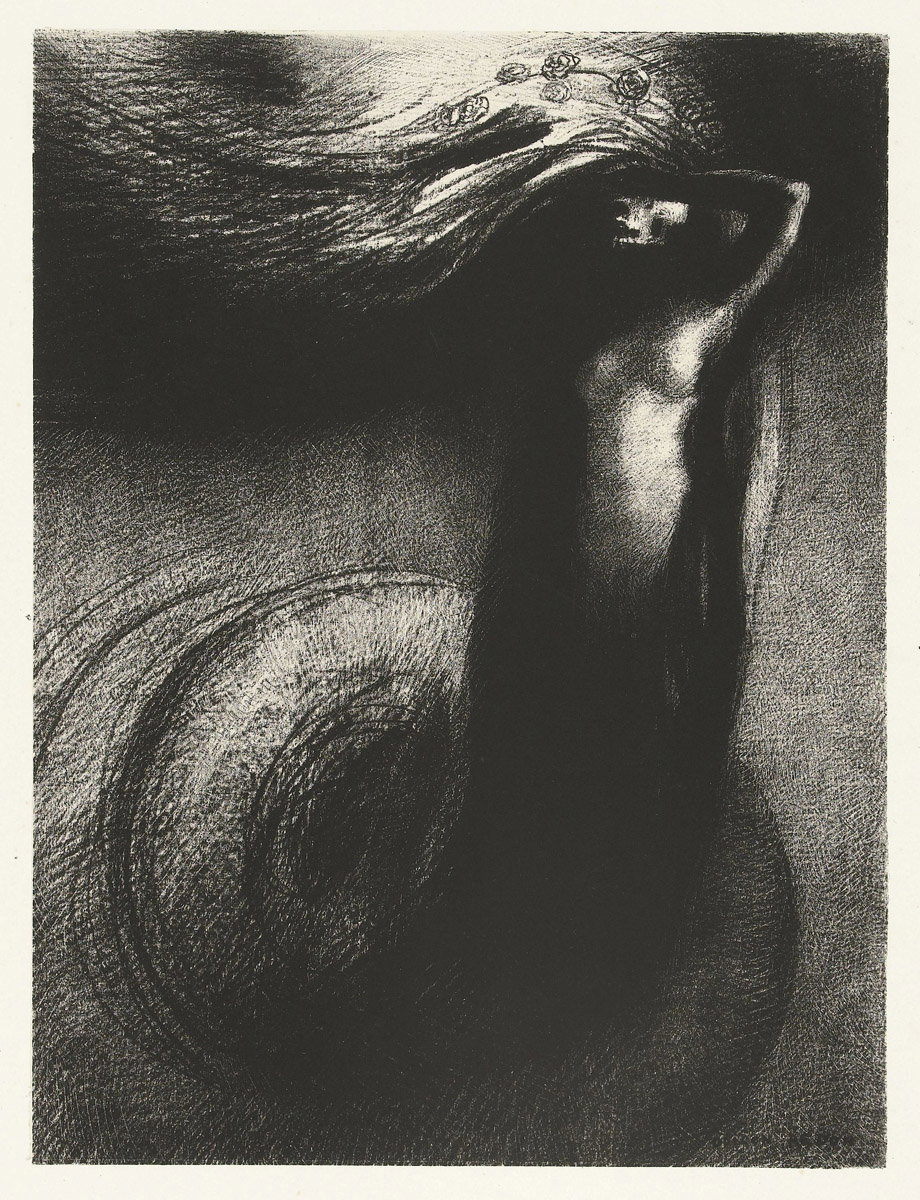
Photo Credit: Death: “My Irony Surpasses All Others” (1889) by Odilon Redon from the Public Domain Image Archive

Leave a Reply