Gogol’s Gothic Marxism
by T.S. Carney
Gothic Marxist imageries are geared to bring the realities of the horror of capitalism with the Gothic imagery of monsters, and those that make us go bump in the night. However, there is a reactionary author whose satirical novel Dead Souls and horror story “Viy” should be examined through the Gothic Marxist lens.
Nikolai Gogol was not a Marxist, but he, like his other Russian counterparts—Pushkin, Tolstoy, and Dostoevsky—exposes life as it was then: a Russian gentry that exploited their people and peasants tied to folklore and traditions. And for the purposes of Gothic Marxism, Gogol shows us a world ripe with both Gothic imagery, and the critique of a capitalist system.
Gogol’s Dead Souls is about a man named Chichikov that creates an elaborate plan to get himself rich by exploiting an administrative error in the Russian state. The plan/scam is that the landed gentry are afforded compensation to take care of the serfs on their land. Once the serf is deceased the landowner is no longer given that compensation. However, due to Russia’s vast empire and poor accounting, it was possible to keep a dead serf on the books and still collect money. Here is where Chichikov comes in. Chichikov “buys” the dead serf, a “dead soul.” A portion of the dead serf’s compensation goes into Chichikov’s pocket.
This premise already is Gothic in principle, literally buying up dead people to profit off them. And Marxist too, reminiscent of Capital where “Capital is dead labour, which, vampire-like, lives only by sucking living labour, and lives the more, the more labour it sucks.”
Chichikov is vampire-like: sucking the labor of the dead, physically and metaphorically. “All that I am proposing to do,” replied Chichikov, “is to purchase the dead peasants who, at the last census, were returned by you as alive.”
Further on, assuring his friend Manilov “Of the ‘dead’ souls? Oh dear no! Let us write them down as LIVING ones, seeing that that is how they figure in the census returns.”
Yet, underneath it all, Chichikov does know he’s being dishonest.
“Never do I permit myself to step outside the civil law, great though has been the harm which that rule has wrought me in my career. In my eyes an obligation is a sacred thing. In the presence of the law I am dumb.”
Gogol never finished the series of which Dead Souls was the first volume. He burned Part II and then starved himself to death. A Gothic end to such a Gothic tale.
But today we can imagine Chichikov’s scam like a Medicare, Social Security, or disability scam where the living member(s) of the family are dead in reality, but alive on paper. Or Mormons creating genealogy websites as a way to convert people posthumously into their creed. Or AI companies devouring antique books to build their models.
The Gothic Marxist critique of the society is obvious: in a society built around money, human beings living and dead become capital and commodities with no value. This story was written when serfs were no better than slaves, and their value even in death was based on a ledger.
Gogol, making all the rich landowners who bought into this scam as greedy and self-interested, adds much more credence to that. As Walter Benjamin wrote, “Capitalism is probably the first instance of a cult that creates guilt, not atonement.” The landowners see an opportunity to make money. The consideration from others doesn’t matter.
***
As opposed to Dead Souls, which was set to satirize contemporary Russian society, Gogol’s “Viy” was purposefully meant to be a Gothic story. It is a master class in a perfect Gothic horror story: a creepy atmosphere, the dead, crisis of faith, isolation.
Gogol states at the beginning of his story: “The ‘Viy’ is a monstrous creation of popular fancy. It is the name which the inhabitants of Little Russia [Ukraine] give to the king of the gnomes, whose eyelashes reach to the ground.”
Khoma Thomas is a seminarian student on a break from school. He encounters a supernatural force that he was unprepared for: a creepy old woman. After she casts a spell, rides Khoma, gets defeated, and then becomes a beautiful girl. And then, on top of that, Khorma is forced to pray over her dead body for three days.
After Khoma runs and leaves the girl to die (the girl who was the old woman) the Cossacks (which she was a part of) track him down to the seminary and demand Khoma do the burial rights. Once in their encampment, Khoma is at their mercy, and thus is demonstrative of the lower classes taking over the higher classes.
Another aspect that can be touched upon is the request that the Cossacks demand Khoma to do: stand over the dead body of the girl, the old woman—a witch—and read the Psalms. This job is given to him at night, like a night shift in a morgue, where you’re stuck in a room with dead bodies.
And here we realize the girl is not dead. She attempts to break Khoma’s spirit, as Khoma forms a defensive circle around himself each night. And as he succeeds each night, his hair gets whiter, and he becomes nihilistic. When he wants to quit, more and more money is thrown at him to complete the job.
A number of class antagonisms are present in the story, but underneath the surface, more abound.
First, taking the Marxist concept of class antagonisms, both Khoma (a man from the city) and the peasants he lives with (Cossacks, if we want to be specific) have conflict right away. Being a city dweller, Khoma has a taste of the bourgeois that only a city could provide. Outside with the peasants, he has to adapt to the “peasant” roots which conflict with his own. Throughout the story there are moments, mostly in his fear of the woman, that Khoma puffs himself up trying to perform “Cossack dances” to have him belong, which doesn’t seem to work. Khoma “belongs” in the end because he becomes “one of them” in the face of adversity.
Second, the Marxist concept of the role of the state in class society plays into a role here. The Russian peasants found Khoma to have him pray over the body. The peasants looked to the Russian Orthodox Church, which served as a proxy for the Tsarist Imperial State. Their authority, the Church, had the worldly authority to allow for the burial to be official, but outside that city realm, the woman’s father, the leader of the tribe, has total authority. Khoma, despite being a proxy, had no way of escaping (and he tried many times). The father, through force and manipulation, made Khoma stay. Thus here, we see too, that the Russian State may have owned the land and had the power in one way, but the individual communities were really in charge.
Third, the Marxist concept of Religion versus Folklore. Khoma, representing both the State apparatus and a religious figure, is pitted up against the power of God against that of the dead woman. While praying over the woman, she comes alive and Khoma invokes God to protect him: he draws a boundary, singing hymns, and calls out to Him; ultimately falling prey to the “Viy”. A very clear, possibly unintentional, conclusion is that God’s servant could not protect Khoma, which in a very “opiate of the masses” context shows how in times of great distress God and religion cannot save you.
These could be radical interpretations but Gogol’s story repeatedly places folklore, religion, state authority, and class relationships into direct conflict. Whether intentional or not, the result is a Gothic narrative that exposes the limits of institutions when confronted by forces they cannot control. Read through a Gothic Marxist lens, Viy becomes not simply a story about monsters, but a story about the weakness of social structures that claim authority over people’s lives.
***
This is not the first time that the connection between Gogol and Gothic Marxism was seen. Writing on Dead Souls, Vissarion Belinsky called it: “a work purely Russian, national, taken from the very life of the people…a revelation, an omen of a freer future.”
However, Belinsky had a falling out with Gogol. He revealed to the world and the Russian Revolutionary Intelligencia, Gogol’s more conservative, pro-Tsarist views.
The main disagreement came with Gogol’s statements that “the peasants should not be taught to read, but to farm and be good Christians; teaching them to read empty pamphlets is a sin”, to “gather the peasants and explain to them your status”, “do not beat your serf, insult them”, and “The Tsar is an agent of God.”
These views clearly went against the tide of the revolutionary mindset. Was Gogol’s newer thoughts a satire in-of-itself? Was Gogol to appease the Russian state writing to curry favor with them? Or was he just a reactionary?
These questions cannot be answered here, but what it does show is that Gogol’s satire, and appeal to Marxists in the past show that his work does have the fingerprints of Marxist thoughts inside of it, and then with his application of Gothic elements, could be considered today proto-Gothic Marxist.
Based upon our understanding of Gothic Marxism, it is easy to see why Nikolai Gogol could be considered a Gothic Marxist. Gogol, unlike many of the other Russian authors, wrote satire about Russian society (Dead Souls), and even included some horror elements, through “Viy,” that still showed satirical characters in that state. Gothic Marxism criticizes capitalistic societies—through horror currently—but not through humor and satire. Gogol achieves both. He’s able to show the absurdities or systems, and at the same time use horror to bring in the elements of criticism that Belinsky found inspiring. Maybe, we should too, reconsider Gogol not just as a satirist, but as a progenitor of Gothic Marxism.
T.S. Carney is a special education teacher. His work has appeared or is forthcoming in The Good Men Project, Your Impossible Voice, Eunoia Review, Neon Origami, Discretionary Love, The Gotham Guillotine, Maudlin House, Soul Poetry, Prose & Arts, Once Upon a Crocodile, FLARE, Robot Butt, miniMAG, Philosophy Now (Issue 175), Philosophy and Literature (10/2027), The Educator’s Workroom, Mr. Beller’s Neighborhood, Bridge Eight, Orichalcum Tower Press, Lunar Nethar, Triptych, Eccentricities Magazine, and more.
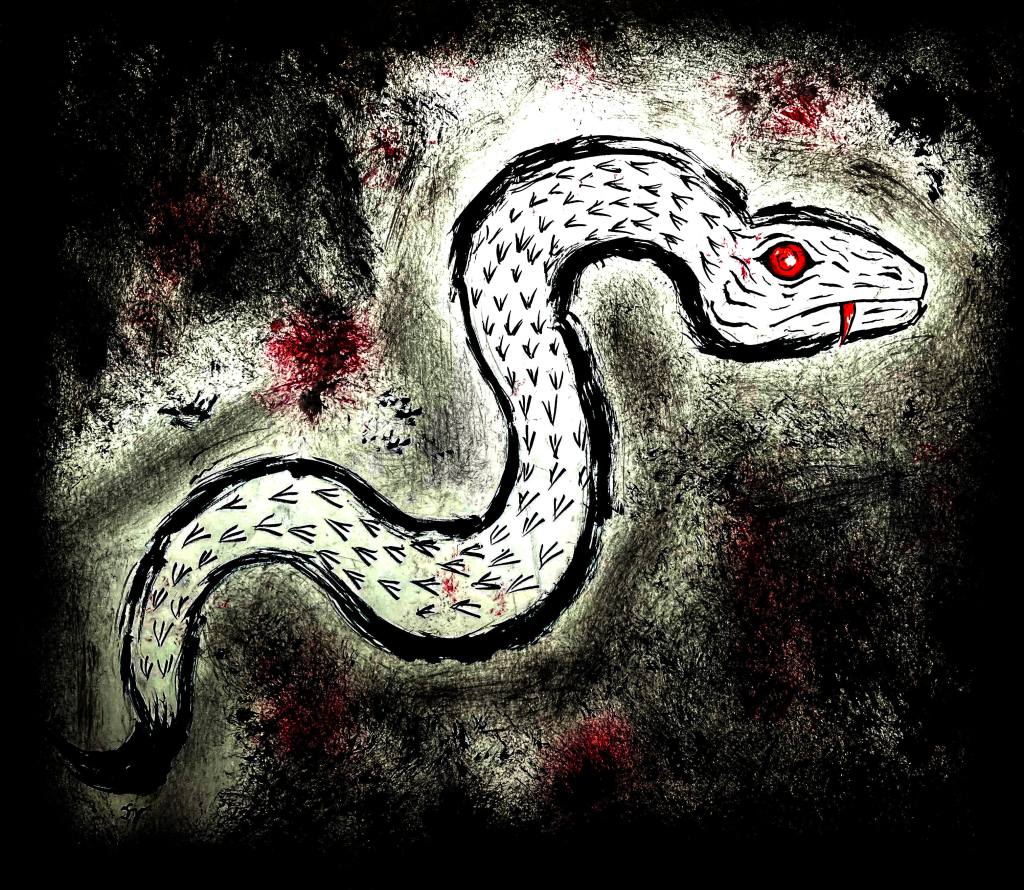
Picture Credit: Hatred (2026) by Line Lizard
Line Lizard is actually a person (artist) pretending to be a lizard (also an artist). He enjoys drawing anime girls, beautiful men with swords, horrors beyond human comprehension and nothing else. Stay tuned for his webcomic coming soon to a computer near you. Instagram: @line_lizard_art

Leave a Reply