Through Proper Channels
by S. Mubashir Noor
The hood over my head stank of a hundred sweaty faces. Low sobs and murmurs surrounded me. Other voices were gruff and threatening, and they punctuated the clicking of a pistol’s safety latch.
I was bobbing about in a boat somewhere on open water, its gentle spray washing over my bare calves. A fierce sun burned through the holes in my polo shirt, searing my sweaty skin.
A sticky breeze blew across my cheeks, tasting of salt and raw fish. My seat was a brick-hard plank with splinters that stabbed my buttocks each time I shifted.
Again, I slid my palm over my pants pocket. The wafer-thin gold plate was a bump beneath the scruffy denim. Good.
Heavy footsteps approached. Someone breathed stale tobacco into my face. Then they poked me hard in the ribs.
“Where you going, huh? Majorca too far,” a man barked.
“Are you Karim?” I slurred.
“How you know?” he said, grabbing my collar.
“I have gold,” I said, smiling through my bloody jaw. “Take us to Majorca.”
The man issued a cackle that repeated in the distance. Then his footsteps thudded away.
I elbowed the fat man seated next to me. He was whimpering.
“Can you take up less space?” I asked.
“I’m scared,” he said.
“Too late for that, jigar,” I scoffed. “You’re the one who introduced me to that beak nosed fiend.”
***
A week ago, I slouched in my swivel chair, groaning and pressing on my temples. My eyes were small and swollen behind my Wayfarers.
I reached for the mug of cloudy ginger tea steaming beside my computer mouse and took another sip. A blue bottle of vodka sat on my scarred desk next to a pile of dusty folders. It was down to its dregs.
Under it lay a four-by-six publicity photo of a burlesque mujra dancer in full swing. I exhaled and caressed the sheen of her full lips.
I took off the toothy key hanging around my neck from a shoestring and rattled open the top drawer. Two wafer-thin plates of gold glimmered in the soft light from the high window behind me. I kissed the plates and locked the drawer.
Then my fingers leafed through a fresh stack of forms. Ah, yes. Different faces, same desperation. No matter who ruled the world, chumps were never in short supply.
My office was a cinderblock cube with thin-gauged iron doors that opened to a field of cracked clay and thorny shrubs. Mold forever hung in the air from water-stained walls.
A bare bulb hung down from the ceiling right over my desk, next to the ceiling fan that whistled like sugarcane in early summer. Rolled-up blankets in many garish colors sat in the far corner behind a bulletin board on wheels.
A clicking sound drew near the door, followed by dragging feet. Chintoo’s wooden crutches entered the room first. He clutched a fistful of envelopes and a vial of syrupy oil that reeked of sewage. He dropped his load on the desk and mopped the sweat off his olive skin. I studied the bottle and ran a palm over the moonlike bald spot on my crown.
“I’m your assistant, not your servant,” Chintoo said.
“Big talk for someone without a home.”
His eyes cut to the blankets.
“The assistant commissioner says he’ll send more clients,” he said, scowling. “If you keep your promise.”
I tossed the vodka bottle in the bin beside my patent leather loafers and traced the dancer’s silhouette with my pinkie.
“That man,” I said. “Four wives and still a hound dog.”
“You’re no saint,” Chintoo scoffed, wagging his crutch at me. “How come you don’t help me go overseas?”
“Humph. This again?”
“I deserve a better life, too. You promised.”
I set my elbows on the desk and tapped my fingertips together.
“You have a better life,” I said. “You work for me. Meals, a place to lay your head. What else does a cripple—”
He stared at his hemp sandals with gritted teeth. I lowered my head and sighed.
“Look, you’re not an idiot,” I said, waving the forms like a hand fan. “Not like them. You’re learning a trade here. Real skills.”
“Selling fake dreams?” he said, rubbing his eyes.
“No! Business. Stick with me and someday you’ll make more than the assistant commissioner.”
He muttered something under his breath but nodded obediently. Then he spoke with steel in his eyes, “You can count on it, old man.”
I winced and reached for the metal-edged ruler on the misshapen side rack. But my phone buzzed. Unknown number. I answered anyway.
Heavy breathing filled the line. It kept on endlessly.
“You bum,” I said. “Don’t you have better things to do than prank call people?”
“Oye, Khalid. It’s me,” a voice whispered.
“Aziz?” I said, pushing my shades up to my forehead. “Since when is the assistant commissioner up before afternoon prayers?”
“Not so fucking loud,” he groaned. “Remember how you keep harping on about going legit to appease your mother’s soul?”
“Yes?”
“Stop by my office tomorrow morning. Nine sharp. And remember, you don’t know me.”
Click.
Chintoo was lingering around the desk, sweeping the bare floor with a feathered broom.
“Who was that?” he asked.
“I’ve been trying to figure that out since we were kids.”
***
The district office was a colonial-era building with a sagging roof and flaking pillars in the portico. Its yellow paint was as cheery as plaque-ridden teeth. It sat opposite the town’s main traffic circle, which boasted the husk of a gray fighter jet with a hollowed nose.
I parked my boxy hatchback along the rutted grooves of the roadside lined with unemployed laborers and hawkers of lentil fritters. Then I zigged-zagged over the sudden potholes in the gravel and dirt, clutching my flapover briefcase tightly to my chest.
The briefcase held the two best tools of my trade: a traveler’s bottle of single malt whisky to celebrate a win and a copy of the holy book to swear on my mother’s soul I wasn’t a crook.
Aziz’s office was at the back end of a labyrinth of poorly lit hallways on the top floor. Of course, the elevator didn’t work.
I knocked on his door once and stepped inside. The curtains were drawn together. I squinted. His room was all dark wood with ribbed trimmings to match the hairy carpet underfoot.
Our founding father’s portrait hung on the side wall, from where he stared down in judgment on all comers in his cream Savile Row suit.
Aziz sat behind his dull oak desk with a face carved in stone. The collar of his cream shalwar kameez was buried under many chins.
He wasn’t alone. Opposite him sat a tall, beak-nosed man with bushy brows. He gave me a long once-over with the eyes of a hawk. I licked my lips and swallowed. The stranger rose and extended his palm. I shook it lightly.
“Thank you for coming, Khalid sahib,” the stranger said. “You have quite the reputation.”
“Is that so?” I said.
“You possess a certain flair that we lack.”
“We?”
I glanced at Aziz, who didn’t move a muscle. The lapel of the stranger’s dark blazer bore a discreet pin in the shape of a fierce ram with corkscrew horns. The stranger nodded.
“You know who,” he said. “My name is Jabbar. We’d like to offer partnership.”
Jabbar invited me to the chair beside him. A stoneware cup filled with steaming chai awaited me. I didn’t touch it.
“The ULU Initiative,” Aziz said, pushing a glossy brochure across his desk.
“Ulu, as in owl?” I chuckled. “We’re naming things after childhood insults now?”
Aziz looked away. His shoulders trembled.
“The United Labor Understanding,” Jabbar said. “A joint program with several Western nations. Completely legal, fully documented migration. All above board.”
I flipped through the brochure. It was no different from the ones stacked under my desk. Lots of brown people smiling at the usual European landmarks.
“What do you need me for?” I asked.
“The program requires local facilitators to process candidates,” Jabbar said, smiling dryly. “You’d be an official contractor. Legit. Isn’t that what you’ve always wanted?”
Aziz nodded along in solemn fashion. My hand reached for my briefcase, but then stopped. Too soon. I scratched the mole under my eye.
“Again, why do you need me?” I asked.
Jabbar and Aziz exchanged a look.
“We need to fill three hundred positions from this district within sixty days,” Jabbar said. “I understand you have the network to make that happen.”
A low whistle escaped my lips.
“That’s a lot of chumps—I mean people, janab,” I said.
Jabbar pulled up a weighty contract and dropped it on the desk with a thud.
“Twenty percent commission on each successful placement,” he said. “More if you exceed the target. All aboveboard.”
Aziz tugged at his collar. I leaned back and stroked my chin.
“You’re paying me from agency coffers?” I said. “Farmers here can barely afford my usual rates.”
Jabbar pushed the contract closer to my teacup.
“Think of it as community service,” he said, tapping the contract. “Helping people achieve their dreams through proper channels. I imagine that would make your mother very happy.”
My fingernails bit into my palm. Denying this devil may prove impossible.
“Indeed,” I said.
“It’s settled, then,” Aziz said, sitting up and slapping the desk. “We go forward to a shining future for us all!”
“Hah. What’s in it for you?” I asked, initialing the first page.
“A certain beauty,” he said with a wink.
Jabbar produced a photograph from inside his coat.
My breath hitched. Her.
“Hands off, Aziz,” Jabbar said, patting my thigh. “She is Khalid’s bonus. See? We’re in the business of fulfilling dreams.”
They laughed. I faked.
***
Years ago, the skinny macaque wearing a red fez danced with its arms raised high. The sweltering sun of the southern wheat belt had bleached the fez’s brim. A circle of scruffy kids sat cross-legged on the dirt track and whooped with glee. Behind them stood shopkeepers in stained singlets and the odd salaryman in his safari suit.
My mother played the dugdugi and tugged on the monkey’s leash before it snatched a child’s peanut brittle.
“Now salute the audience, bacha,” my mother shouted.
The monkey puffed out its chest and placed three fingers flat on its forehead.
I walked around the audience with a tatty bucket hat and collected alms. A shame. The macaque would have to survive another night on squeezed sugarcane stalks.
The crowd soon dispersed. Dust rose off the road, making the monkey sneeze. Mother reached into her bindle for a medicinal bottle of moonshine and took a swig. She wiped her mouth with her dotted red dupatta and glared at me.
“That man’s wallet was bulging at the side,” she said. “I even prolonged the performance so you could slit the seam.”
“I’m not as quick as you,” I said. “My bones still hurt from the last time I got caught.”
I stepped away from her, my limbs trembling. She grabbed a cracked soda bottle and hurled it at my head. I ducked sideways but cut my cheek on a shard of glass.
She rose and stomped toward me. The monkey screeched and flung its fez to the dirt.
Mother dabbed my wound with a patch of her dupatta that reeked of alcohol. She wiped the dewy corner of my eye.
“I’m your assistant,” I said. “Not a thief.”
“Big talk for someone who can’t feed himself.”
She pinched my shoulders until I sobbed. My ears grew hot. She sighed and lifted my chin.
“My life is worth all of two gold wafers,” she said. “They’re at the bottom of the well behind our hut.”
“Are you going somewhere?”
I stared at her, open-mouthed. She laughed and released the macaque’s leash.
“Do better, Khalid. Even if it’s the last thing you do.”
***
Days after my meeting at Aziz’s office, ULU was lettered in gold on the new signboard riveted above my office. Its doors shone with a fresh coat of green paint. The walls inside and out were washed in white.
I took the last drag of my long-ashed cigarette and stubbed it underfoot on the hard clay. These guys were serious.
Chintoo sat on the doorstep and thumbed through forms. He was frowning.
“These are strange,” he said.
“Government paperwork is always strange,” I said. “How can you even read them?”
“No, I mean, why does one ask about swimming ability and fear of water?”
I snatched the forms from his grasp and scanned their contents. My breath quickened with each paragraph.
“They…just want to know everything,” I said. “That’s why the West is so far ahead.”
“Right.”
“Stop looking for problems and get me chai.”
The wrinkles on his brow remained. I lowered the forms and waved him off.
Once he left grumbling, I hurried inside the office and reached under the desk for my briefcase.
The contract’s text swam before my eyes. It referenced documents I’d never heard of in my career. I licked my fingertips and started over from the preamble. What was Section 12B? Where was the damn thing?
Someone cleared their throat. At the door stood a man in a beige shalwar kameez, caked in powdery soot and oily grime. His one eye met mine while the other drifted toward the gray printer-scanner. He kept his elbow over the bulge in his side pocket.
I stuffed my contract into the drawer and beckoned him inside.
“Welcome to ULU,” I said.
“P-please process me, janab,” he said, slipping out a padded handkerchief and depositing it on the desk. “The m-money’s all there.”
He had hints of gray in his hair and a crepey complexion. I motioned him to sit opposite me.
“Relax, relax,” I said. “You’ve come to the right place.”
“Chintoo,” I called out.
No response. I smiled at the man.
“It appears my assistant has gone to Sri Lanka to fetch tea,” I said. “He should be back shortly.”
The creases on his face smoothed for an instant. He gave a sheepish grin. I slid the handkerchief toward me and fumbled with its knot. His knee knocked insistently against the desk.
“Why do you want to go abroad?” I asked.
“I need more money,” he said, his knee knocking harder. “My daughter. She w-won’t survive.”
“But it’s not an easy life out there. You should know that.”
He let out a sour laugh.
“I sold my shop,” he said. “The next motorbike I fix won’t be in this country.”
A clacking sound. Chintoo entered the room carrying a chipped ceramic cup, humming a tune from my mother’s time. His whistling died when he spotted the man.
“Why are you here?” Chintoo asked.
“Hey, how’s the crutch now?” the man said.
Chintoo raised the one with a metal band reinforcing the handgrip.
“Like new,” he said.
“Give him the tea, will you?” I said.
“Sorry, I couldn’t pay you then,” Chintoo said, quietly setting the cup and retreating.
“I would’ve scrapped that piece anyway,” the man said and shrugged.
“Enough talk,” I said, my temples throbbing. “Let’s get your paperwork done.”
I focused on the handkerchief and peeled back its corners. The cash was all five hundred rupee notes, many wrinkled and worn. I counted twice and set them on the side rack.
Chintoo stared at me darkly while I typed up the man’s personal info. Then I photocopied his identity card and pushed a blue ink pad across the desk. He set down the teacup and wrung his hands.
“Sign at the bottom and affix your thumb impression,” I said.
“I’ll be able to save my daughter, right?” the man said.
“Of course,” I said, picking at the mole under my eye. “Your government will do right by you. Don’t you worry about a thing.”
Once he was done, I stamped two printed copies of the paperwork with my bespoke seal and gave him one. He rose, grabbed his handkerchief, and shook both my hands.
“We will be in touch soon,” I said. “Pack your stuff.”
“May Allah bless you, sir!” the man said. “May Allah bless you!”
He exited the office with a skip in his step.
Chintoo pulled a square of spotty linen from behind his blankets and wiped down the man’s seat. He caught me staring.
“Who’s responsible when all three hundred catch lice?” he said.
I threw my head back and howled with laughter. He cracked a smile and lowered himself into the seat. I thumped my chest to steady my breath. Then he held out his palm.
“I’d like an advance on my pay,” he said.
“Mm?” I said. “Why’s that?”
“I need new clothes.”
“Hah. Whatever for?”
“People shouldn’t think you’re a cheapskate. Especially that one beauty.”
I crossed my arms and squinted at him. Then I grabbed a fistful of bills from the cash pile and threw them on the desk.
“Don’t ever patch up your crutches again,” I said. “Go get new ones tomorrow.”
His face turned two shades paler. He clacked away to the far corner and propped his crutches against the wall. Then he unrolled his many blankets and lay down to sleep with his back to me.
“This is not on us,” I said.
He said nothing.
I bent sideways and drew a traveler’s bottle of scotch from the crate behind the side rack. A man had to find sleep somehow.
***
Some evenings later, Aziz’s open shoelaces flopped about the deeply footprinted carpet as he declaimed to the press in halting tones.
He, Jabbar, and I stood onstage in a neon-lit wedding hall along the expressway for long-route truckers. It was replete with askew sconces, thrift store furniture, and sunburnt upholstery. Malty alcohol sprayed in the air each time Aziz opened his mouth.
“Mr. Khalid represents the new Pakistan,” Aziz said in between hiccups. “Going forward, our best and brightest will never lack for good opportunities abroad.”
I rose on my tiptoes to a steady beat. Jabbar’s hands were tied behind his back. He showed a small, sealed smile. We never exchanged glances.
Chintoo cornered me during dinner. I stood at the far end of the crowded buffet table, raking my chicken korma curry aside with a fork to make space for more sponge cake.
“Two women stopped by earlier,” Chintoo said.
“Mmhmm.”
I stepped away and found a chair nearby. He followed. I raised the plate to my lips and sipped the soupy curry along the rim. His fingertips pinched cake from my plate.
“Wives of the candidates,” Chintoo said. “They haven’t heard from their husbands since the medicals.”
Ahead, the wall-mounted TV blared an anthemic tune. Then its screen flashed text in bold: Two more dacoits killed in a police encounter. I bit into a morsel of chicken breast.
“Criminals keep breeding like cockroaches,” I said.
Chintoo leaned on his crutches and eyed me silently.
“They’re probably still at the processing center,” I added. “Can’t use your phone there.”
“You know that doesn’t make sense,” he said, pinching another bite.
“There’s always a cost. That’s life.”
My jaw chewed in slow motion. He straightened, his expression cold as granite.
“You know what?” Chintoo said. “You’re right. This is bigger than both of us.”
I patted his arm.
“Now stop picking at my food or I’ll wring your neck.”
***
The day of departure arrived. Aziz and Jabbar had arranged for a giant canvas canopy across from the district office grounds in the shadow of the turreted clock tower streaked with moss.
A battalion of school kids lined the avenue adorned with spiny kikar trees, waving the national flag and singing patriotic songs from fifty years ago. Journalists loitered about the spectacle, chatting up VIPs, snapping photos of the street performers in sequined outfits on stage, who jangled their chimtas.
I stood near the foot of the stage, grinning at the lizard crawling up a tall bamboo tent pole. The beauty would like Majorca. Hell, she’d look ravishing in a satiny two-piece on the beach.
The left wing filled with the chosen. They sat with their families on shallow plastic chairs, beaming, clutching their travel papers like winning lottery tickets.
I checked my chronograph and rocked on my feet. No tap-tap of crutches or salty cuss words. How long could it take someone to buy another blue bottle of vodka?
Aziz passed me by without a hello and went straight to the floor-stand mic onstage. He flipped through postcard-sized strips of paper.
“Today marks a historic moment for our district,” Aziz said. “Our brothers here will cross the oceans to create a better Pakistan for everyone.”
Applause rippled through the crowd. Some whistled loudly. Then came a clicking sound. Crutches.
Chintoo labored up the stage steps from the opposite end and joined Aziz in the middle. He wore a brocade vest and patent leather loafers.
My brow pinched. What was he doing?
“The buses will arrive shortly to transport them to Spain,” Aziz said.
My feet itched as if ants had crawled through the shoelace eyelets. Aziz consulted his notes.
“However, there is an important matter we must attend to first,” he said.
Jabbar joined him in a black sherwani coat. Our eyes met briefly. He gave a crooked smile.
“Each group requires a liaison,” Aziz said, “to resolve any issues that arise during the settlement period.”
Chintoo stood ramrod straight with his chin held high. The invisible ants spread to my ankles and bit into my flesh a thousand times.
“After careful consideration,” Aziz continued, “we’ve selected someone who embodies the spirit of this program. Someone who has worked tirelessly to make these opportunities possible.”
He stared at me. I swallowed thickly. Fuck, no.
“Khalid sahib, please join us onstage,” Aziz said.
I dug my heels into the dirt and blew quick breaths. Unseen arms then shoved me in the stage’s direction and up the steps.
Jabbar’s smile flowered as he clapped. Aziz grabbed my limp fist and shook it, then handed me a hardbound folder.
“Your assignment papers,” Aziz said, patting me on the back. “Congratulations.”
The audience chanted my name. I leaned toward Aziz.
“What the fuck is going on?” I whispered.
His gaze was fixed on the crowd.
“Khalid sahib will accompany this group as their liaison for however long is necessary,” he said.
“B-but my business—”
“Will be managed by your able assistant,” Jabbar interrupted, gesturing toward Chintoo.
The boy took center stage and waved at the crowd. Jabbar checked his ram-headed lapel pin.
“B-but I didn’t a-apply,” I said.
“This is a tremendous honor, Khalid sahib,” Jabbar said. “Section 12. Just like you initialed it. All aboveboard.”
He passed me a facsimile of my contract. The pages fell from my numb fingers and scattered on the glued-down carpet.
“I-I have g-gold,” I shouted.
The crowd fell silent. Then Jabbar started clapping, and everyone joined in.
“How kind of you to donate to the cause!” Jabbar said. “Another round of applause for this selfless man!”
He guided Chintoo to the microphone, who tossed his crutches aside and held fast to the stand.
“Our doors will always be open for business,” Chintoo said. “Khalid sahib has taught me well, so please don’t worry. We will make your dreams come true.”
Chintoo’s palm covered the microphone as he turned to me. His gaze cut like a knife.
“Don’t worry, old man,” he said. “This is bigger than both of us.”
***
Hours later, some handprints on the chalky wall were fresh, others ghostly. The lone window was barred. Two caged bulbs mounted at either end of the long, damp room buzzed faintly between cobwebs.
Keys clinked in the distance. Another door slammed shut. My lungs strained to suck in oxygen. I banged on the thick double doors until my fists turned blue.
“I paid for a VIP lounge,” I shouted.
“On the way,” a muffled voice outside said.
That was the third time.
My gut was on fire. No cell phone, no Aziz, no Jabbar. Chintoo…
One of the chosen trembled in the corner, his face turned to the wall. Most sat on bolted metal benches and stared at the cracked ceiling or between their legs.
I groped at the front pocket of my jeans. One plate was still there.
The trembling man gaped at me with bloodshot eyes.
“This isn’t the airport,” he said. “This isn’t the seaport. Where is the plane? Where is the boat?”
“Why would they let a bank robber on a plane?” a wiry, middle-aged man scoffed from the floor.
“And you think they’d let someone who maimed children for profit?” a dumpy, bearded man behind him, leaning against the wall, laughed. “We were all fools.”
The others stayed silent. My breath grew heavy. I scratched the mole under my eye until it stung.
“Have…any of you ever been booked by the cops?” I asked.
They hesitated, then raised their hands at different speeds. I fell to my haunches. Fuck.
The bearded man’s gaze fixed on me.
“You look like you’ve seen a churail,” he said.
“Anyone got a cigarette?” I asked.
They gathered ‘round as I took slow, even drags. Past the window, the thorny shrub swayed in the stop-start breeze.
“Well?” the wiry man asked.
I expelled smoky Os from my lips.
“You know,” I said, “it’s best to learn tailoring or making kites. Maybe train a monkey to dance on command. That’s a good living.”
They exchanged puzzled looks.
“What the hell are you on about?” the bearded man asked.
A clamor filtered inside: a familiar whiny timbre, that ever-present slur. I burst into laughter and slapped my thigh.
“An old friend will be joining me, it seems,” I said.
Then I reached into my back pocket for the four-by-six glossy photo with a million creases. I tore it into pieces and scattered them in the air.
Their eyes followed the spray of paper with slack jaws. I stubbed the cigarette against the wall and exhaled deeply.
“Now, how many of you can actually swim?”
S. Mubashir Noor moonlights as a mediocre communications professional by day and crafts short fiction laced with social/magic realism at the crack of dusk. A Pakistani expat based in Malaysia, he enjoys photography, sharply sketched TV shows, and the fleeting euphoria of reaching his weekly word count. His stories have appeared in Fiction on the Web, SORTES, Litbop, Does It Have Pockets?, WayWords, The SCOP, and elsewhere. Find him on Instagram @smobynoor.
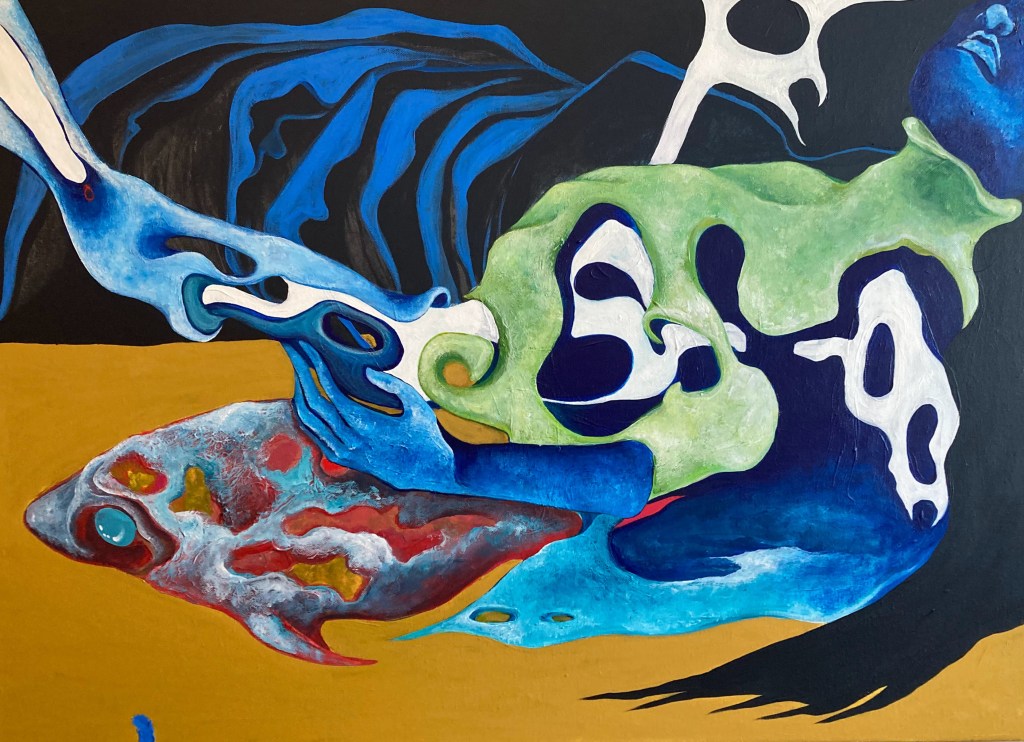
Image Credit: Horizontal Angels (2026) by Natasha Zinos

Leave a Reply