King of the Snobs: On Dwight Macdonald and Mass Culture
by Hugh Blanton
“Today, in the United States, the demands of the audience, which has changed from a small body of connoisseurs into a large body of ignoramuses, have become the chief criteria for success.”
– Dwight Macdonald
By the time Dwight Macdonald’s essay “Masscult and Midcult” had been collected into his 1962 book, his reputation as a culture snob had already been cemented. Macdonald’s mind, enamored of absolutes as aesthetes’ minds tend to be, was impossibly in love with extreme positions. His politics shifted over time—from Communist to Trotskyist to pacifist to anarchist—but his commitment to high culture never wavered.
The essay first appeared in two parts in the 1960 spring and fall editions of Partisan Review. The reactions were immediate. Journalist Janet Flanner called it “caddish.” It drove Nelson Algren, poet laureate to the down-and-outers, into a frenzy. Macdonald’s biographer Michael Wreszin sums him up best: “Expediency, pragmatic compromise irritated him. He was attracted not so much to abstract ideological frameworks as to commitment, enthusiasm, dedication to one’s beliefs.”
Were Macdonald still around today he would no doubt be driven to fits of apoplexy at seeing how Masscult has evolved: President Trump being driven in his limo around a NASCAR racetrack in front of tens of thousands of roaring fans or seated ringside at a bloody and barbaric UFC match. Macdonald had always made it clear that he believed Western culture has for over two centuries been
two cultures: the traditional kind that he calls “High Culture” and the other Mass Culture or “Masscult.” Masscult was manufactured culture for the masses that started appearing at the end of the eighteenth century around the same time as the Industrial Revolution. Macdonald says in fact the Industrial Revolution is exactly what created the “masses,” pushing them from their rural agrarian existence into the burgeoning factory cities. Prior to this, there was no Masscult, just High Culture and Folk Art. Masscult was a continuation of Folk Art. But Macdonald says where Folk Art came from below, Masscult was forced down from on high by businessmen with a product to sell.
Theodor Adorno saw it similarly: the masses want distraction from the mechanized process of labor to which they are subject. In other words, they want to have fun. Sitting in a movie theater watching Tom Cruise blast MiGs out of the sky is easier, and hence more “fun” than trying to decipher a Geoffrey Hill poem. Kicking back with a can of beer listening to belting voices and drumbeats blasting from high wattage speakers is easier than a night at the opera trying to understand what the fat guy in the tux is wailing in Italian about.
Macdonald does not buy the excuse that the Lords of Masscult give for their low quality entertainment, that they are just giving the public what it wants. Macdonald said the truth is closer to “the public gets this and so wants it.” I don’t think that’s entirely accurate.
In 1986, Lucasfilm set out to create what they were certain to become a popular fad with Howard the Duck and ended up with nothing but a huge box office flop on its hands. More recently, Disney got its rear end handed to itself when it tried to give the masses a new and updated Snow White.
And it’s not like Macdonald gave the masses no credit at all: “Yet it is precisely because I do believe in the potentialities of ordinary people that I criticize Masscult.” It’s as if he held out belief to the end that he could reach out to someone and have them trade their season tickets for the Knicks for season tickets to The Met.
Macdonald had more than a few theories about how Masscult obliterated artistic standards. One theory was that every freeborn American’s democratic right to be a “writer.” Editors and publishers become buried under avalanches of nonsense and hence lose their bearings. He quoted a 1956 statistic that showed Ladies’ Home Journal had received 21,822 unsolicited manuscripts and published sixteen. He goes on to tell us that even those sixteen were probably not worth the paper they were printed on.
If social media feeds are any guide, masses of writers make it an annual rite to submit their poems to The New Yorker and then spend the next twelve months refreshing their email waiting for responses that seem to never come. Macdonald, who for a while was on the staff at The New Yorker, considered it to be a Midcult publication.
Macdonald was sure that book publishers operated under the assumption that bad books may sell, but good ones definitely won’t. This, however, flies in the face of King James Bibles and Shakespeare’s plays still selling briskly today, both of which he considered high culture.
Edgar Allan Poe, a starving artist forced to turn out hackwork to pay the bills, was high culture according to Macdonald, even after Poe invented the detective story. Poe’s style was too genuine to be corrupted by Masscult, he said, and even when Poe wrote a piece of hackwork his literary genius shined through as though it were impossible for him to achieve a low enough standard otherwise.
Macdonald concedes that some genuinely good art can become popular: Charlie Chaplin’s films, for instance, or The Education of Henry Adams. It bewildered him, though, when he found genuine art interlaced with Masscult, such as in Balzac, whose keen social observations and psychological analyses were often mixed with cheap melodrama. These admixtures make Masscult a subtle problem and hard to define, even for Macdonald himself. Masscult is not to be confused with bad art. Even the most talented artists of high culture could occasionally create bad art. Masscult is anti-art, or at best non-art.
Macdonald, however, was wide of the mark when he said Masscult is indifferent to standards. Bestselling genre fiction writers will see their advances decline if their work isn’t up to standard, and even fail to get their contracts renewed if the public stops eating up their heroes. Rock ‘n’ roll—Macdonald dismisses the genre as not interesting and not real—is notoriously littered with one-hit wonders who could not keep up standards.
This is not entirely attributable to the public’s ever-changing tastes in music. Mandarins like Macdonald want to be able to tell the public that Masscult lives up to no standards and should be avoided, that it in fact should never be created in the first place. He rarely allowed for any subjectivity in taste. It was his way or the highway.
So what, then, did Macdonald want after devoting so much of himself to telling the world what he didn’t want? He wrote: “The only practical thing…would be to revive the spirit of the old avant-garde, that is to re-create a cultural—as against a social, political or economic—elite as a countermovement to both Masscult and Midcult.”
He theorized this could be done by rebuilding the class walls (like the ones that existed in pre-Industrial Britain) and bring the masses, the “proletarian rabble,” under aristocratic control. The class walls would serve as dikes protecting society from the scourge of Masscult.
Sociologist Edward Shils saw it differently. Shils believed that the entire culture could be raised to a higher level and believed that it was already happening in the 1960s and 1970s. Shils thought of Macdonald and other lords of high culture as disgruntled and reactionary dreamers. Indeed, it would be difficult to see anybody who wants to build walls to keep the unwashed masses in line as anything but.
Macdonald believed that all great cultures had been “elitist affairs, centering in small upper-class communities which had certain standards in common and which both encouraged creativity by (informed) enthusiasm and disciplined it by (informed) criticism.” In 1974, when Macdonald was with the National Institute of Arts and Letters, he selected as his top three novels of the last five years: Gravity’s Rainbow, Armies of the Night, and Portnoy’s Complaint.
Zane Grey always said of his own cowboy novels that they were not to be confused with literature. He was a storyteller, not an artist. That bit of frankness brought praise from Macdonald, who considered Grey to be a Midcult writer. It was the pretentiousness of Midcult writers—Pearl S. Buck, Irwin Shaw, John Steinbeck—that made them so repulsive to him. He dismissed Hemingway’s novels, which he also considered Midcult, as a “sort of inspired baby talk.” He also said Hemingway had the smallest vocabulary in literary history. Macdonald remained undaunted in the face of protests from Brendan Gill and George Plimpton.
Midcult artists, Macdonald felt, stole ideas from the avant-garde and repackaged them for mass consumption. Beyond Chaplin movies, Macdonald had very little patience for cinema. He categorized nearly all movies as Masscult. Susan Sontag and Gary Indiana would certainly beg to differ.
Life magazine was a target of some of Macdonald’s most vehement rage. Its homogenization of high culture and Masscult was an insidious attempt at elevating the frivolous, he thought. Macdonald charged that rather than elevating the frivolous, Life was actually degrading the serious. Having a Renoir montage in the same issue as a roller skating horse sent the outrageous message that both Renoir and the horse were talented and this was anathema to him.
Part of Macdonald’s ire against Life could no doubt also be attributed to how Life referred to him and other American socialists and Communists as “dupes and fellow-travelers.” His leftist politics often brought criticism from publications like Life that were right of center, but even the staunch anti-communist John Lukacs had great respect and admiration for Macdonald’s intellect. It was in fact Lukacs that prompted Macdonald to write a review of James Gould Cozzens’s novel By Love Possessed. Lukacs thought it a terrible novel and was certain that Macdonald would too. He was right.
Macdonald savaged the novel, honing in on its stylistic failings, saying that it “approaches the impenetrable—and indeed often achieves it.” Macdonald chauvinistically wondered how the women of Book of the Month Club coped with it.
It was not just Cozzens he took to task. Macdonald also attacked the reviewers who praised the novel. Eminent critics such as Malcolm Cowley and Brendan Gill had written glowing reviews, calling it a masterpiece and saying Cozzens deserved the Nobel Prize. This rampant misjudgment was a sign of the lowering of standards, Macdonald thought, the “latest episode in the Middlebrow Counter-Revolution.” Their reviews were worse than an attack from philistines outside the gate. This was an attack from inside the ivory tower itself.
Macdonald’s review brought him more mail than he’d ever received for a single piece before. It pleased him that out of the eighty or ninety letters, only three were in support of Cozzens. Macdonald’s friend Norman Mailer, however, thought the review went a bit too far saying, the “animus was so complete that even his best insights began to be lost in the weight of the bombardment.”
When James Agee’s A Death in the Family beat By Love Possessed for the Pulitzer Prize, Macdonald felt he’d done his job as a critic.
Alvin Toffler, who took a more democratic view of culture, referred to Macdonald as “high priest of the culture snobs.” Louis Menand called Macdonald “Lord High Executioner of middlebrow culture.” Toffler’s remark was grudging respect, and Menand’s was genuine affection. It would be too simplistic to dismiss Macdonald’s “Masscult and Midcult” as the crotchety griping of a misanthrope, although a few people did.
Macdonald said that a crowd’s tastes shrink to the level of the least sensitive and the most ignorant. He sorely lamented that Picasso and Rimbaud had passed on with no one taking their place except Midcult practitioners. Modern day painters he felt came from the school of “drip and dribble.” Their paintings were “enormous gloogs and globs.”
Art critic Clement Greenberg said of kitsch—a term that Macdonald said includes both Masscult and Midcult—that it “predigests art for the spectator and spares him effort, provides him with a shortcut to the pleasures of art that detours what is necessarily difficult in the genuine art because it includes the spectator’s reactions in the work itself instead of forcing him to make his own responses.” Macdonald and Greenberg were very close friends.
No matter how one views art today, it can not be said that Macdonald won his war. If anything, Masscult and Midcult are more pervasive now than they’ve ever been. Publishers today—aided and abetted by “critics” who are really little more than publicists—are placing more emphasis on a writer’s identity than on a writer’s talent. There are few critics of Macdonald’s stature today to take a stand against it.
Macdonald was a reactionary figure against progress. He harnessed his ideals to the rhetoric of social snobbery, but his convictions and integrity were pure. His disdain for commoners was well known, but I can’t help but think if his ghost entered my room tonight he’d point to the empty spot where a television was supposed to be, then to the wine glass on my table, smile, and forgive me for my book of Billy Collins poems. He’d praise my six degrees of separation from the masses and offer to lend me his tattered copy of Ulysses.
Hugh Blanton’s latest book is The Pudneys. He can be reached on X @HughBlanton5.
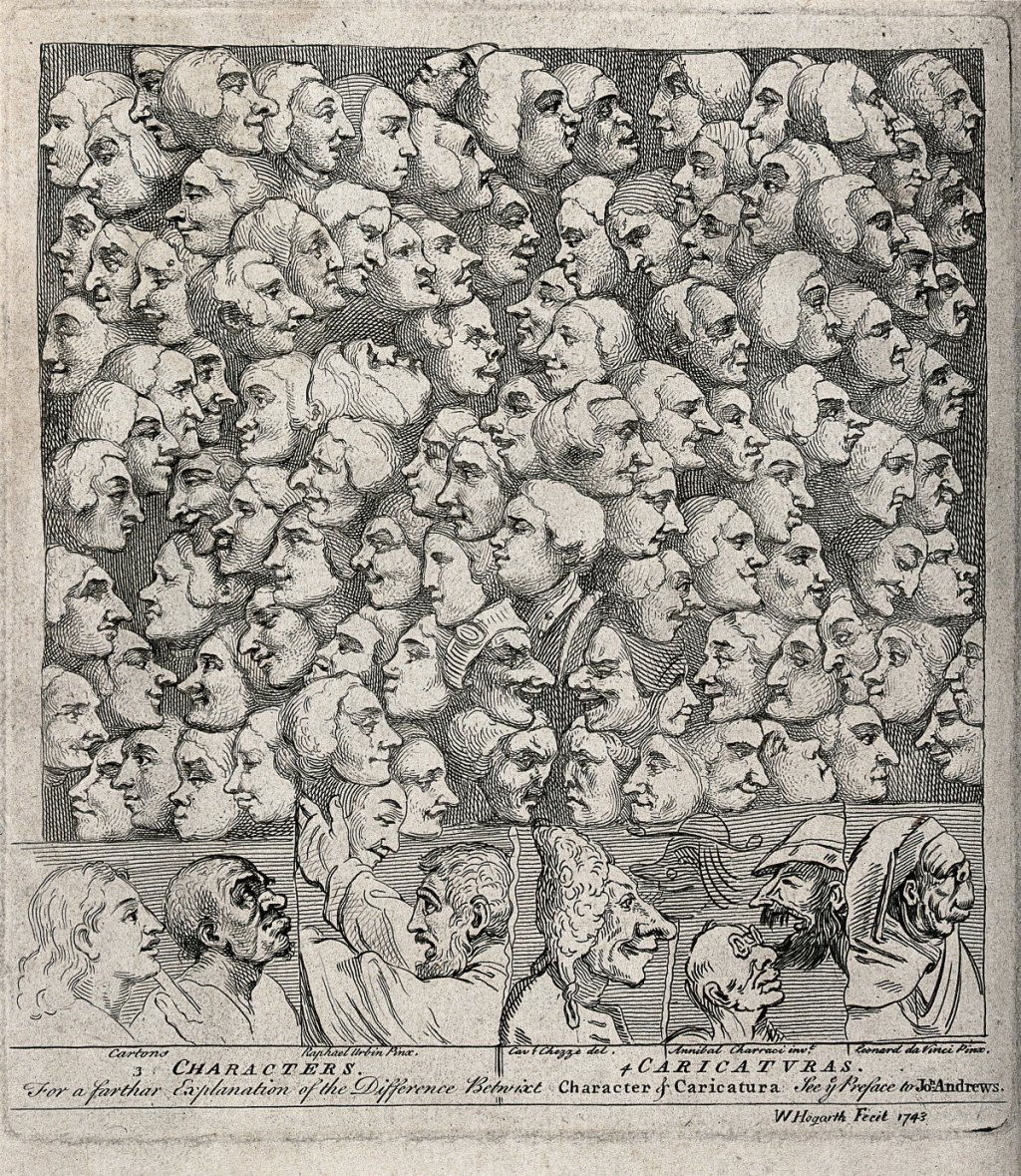
Picture Credit: Characters and Caricatures (1743) by William Hogarth
Image sourced from Public Domain Image Archive

Leave a Reply