The Pantheon of Perseus
By Elias Everett
The following text is part of an ongoing effort to create a guidebook of sorts for a homebrew tabletop RPG called The Pantheon of Perseus or T-PoP for short. My goal is to make this fictional universe of mine more cohesive, concrete, comprehensive, complete, and above all coherent.
The first campaign Assholes in Space was reliably characterized by drunken mishaps; rules being written, altered, and discarded outright from week to week; and player-characters whose existence stood so proudly in defiance of established lore that much like the mighty and mysterious Black Hole, they warped the very fabric of the universe around them.
Needless to say it was a smashing success, and only global catastrophe, chronic pain, clinical depression, ADHD, and exhausting perfectionism have been able to slow the release of the second campaign.
Here: through this speculative alternate future history of humanity’s conflicts amidst the planets, I hope to endear these fictional factions to you, the reader, in the hopes of encouraging you to join this world as player, artist, and author.
Human Planetary Factions: A Brief History
In the final days of domination, when Earth’s governing bodies were consumed by theocratic totalitarians, the Corporatocratic Colony of MarsX, previously only inhabited by techbro elites and their slave-cultists, quickly became a bastion of last resort for those fleeing religious persecution.
The rapid influx of Earthling immigrants was welcomed by the MarsX Corporation, who saw fit to seize on the opportunity to devalue the labor of their already expansive workforce. This willfully enslaved workforce since its conception has been comprised of libertarian meritocrats, each devout in their faith that they alone possess the intelligence to climb above their fellow slave, to ascend each and every sacred rung of the Divine MarsX Corporate Ladder, until reaching its summit: above the might of Zeus’s Golden Throne atop Mount Olympus, greater glory than that of Odin’s Hall in Vallhallah, a sublime state of enlightenment beyond Nirvana, and a higher power than can be found in the Kingdom of Christ: a seat on the MarsX Board of Directors. A position that not only secured an obscene salary, but a sizable percentage of MarsX shares as well as a laundry list of benefits boasting services and contraband that would be grounds to have one’s entire family executed in most Terran countries.
But transcending these other perks as to make them almost insulting by comparison was the highest anointment of all: The Blessing of The Known. To be one of the hallowed few to meet and become mouthpiece for The CEO, Exalted and Immortal God Emperor of the MarsX Corporation LLC.
Reverently pious masses who valiantly left their homes on Earth to follow The CEO on his grand “Pilgrimage Across the Stars” in the days when he was still flesh and blood. Though centuries have passed since he became the first and only human to successfully digitize his consciousness, elder Martians will (after their second daily ration of grain alcohol) insist that they remember seeing him when their parents took them to their first Quarterly Meeting. They’ll reminisce on how the air was warm and smelled like fresh ink on printer paper, which is enough in itself to raise the eyebrows of young listeners and set them whispering soft words of incredulity. Paper hadn’t been commonplace in over a century, and the idea that it was ever given out so freely and in such large quantities was quite the tale to them.
Often the old-timers will slip into hyperbole, and lose their adolescent audience entirely, though a select few recall these things with such presence and verve that even the most skeptical of minds are spellbound.
“It was packed tighter than a can of beans: more folks together in that room then than I’d ever get to meet in my life.”
The sincerity in just work-oriented individuals is enough to draw anyone into their nostalgic rambling.
“I remember the delicateness with which he held the agenda print-out.”
A moment of deep contemplation is customary when summoning the words to describe such holy doctrine.
“He held it as though allowing a single crease to befall the letterhead would plunge all of Mars into the Eternal Void. The gaze of care which he set upon the print-out too was of the utmost delicacy, as if he feared the weight of his usual dower expression might cause the paper to bend and crinkle. It was a look which I’d not seen when he held my infant sister, and one I was sure had never been inspired by my own existence. I had been excited, if a little nervous before, but in that moment, I finally understood the importance of the moment, the event, the company, the reason we’re all here.”
Another pause, as tears well in the Elder Martians’ eyes.
“Then my father turned his attention toward me, and in astonishment my eyes met his and saw that doing so had not snuffed the spark of joy within them: that he was truly happy to see me. To my further disbelief he turned to my mother, a woman whom he tolerated as much as he allowed her to live, and slowly handed her the print-out.”
After blowing their nose, they wipe their eyes with their sleeves.
“The CEO was about to speak, you see, and since I was so small and we were so far from the stage, I was sure I’d never get to see him. But my father was determined to make sure I saw just as well as any tall adult, and rather than recklessly violating company policy and risking his wage by saddling me on his shoulders, demonstrated his immense strength to the surrounding employees by hoisting me up from my armpits.
“In the moments before The CEO spoke it got so quiet, that even the fluorescent lights seemed to silence themselves in anticipation of his word. And when he finally took the stage, when he initiated that Quarterly Earnings Meeting…”
It’s at this point that the old Martians will fully lose the attention of their audience as their touching anecdote descends into sycophantic tirade pontificating on the glory of the God Emperor of MarsX. Yes, these company-owned individuals have fomented quite a unique “work culture” of sorts and have officially assigned themselves the title of Corporate Oriented Go-Getters or “Coggs” for short.
Before the mass migration of The Persecuted, the average indentured employee inhabiting the MarsX Colony lived a markedly shitty life, but one infused with a grim sort of purpose. The presence of The Persecuted generated a sense of unease within the once contently miserable Martian Coggs. For a time The Board of MarsX was able to successfully leverage tensions between their Coggs and The Persecuted (“Persys” as they would come to be known). Their productivity and profits saw record numbers all the while the various food and clothing rations which comprised the average Martian wage not only stagnated, but decreased in both quality and quantity.
Even with an imprisoned population of enslaved workers, The Board had begun pushing the limits of their laborers’ subservience. The unease caused by the ever-increasing inhabitability of their conditions sparked violent riots. The human casualties of these riots were consistently on the behalf of the two classes of worker, as the majority of incidents were the result of confrontations between the rivaling groups, and occasionally among members of their own parties.
Since the first Persys had fled from nations all over the world, fleeing different regimes for differing reasons they are an immensely diverse group of peoples, many of whom clung to dividing ideologies and old ethnic or national feuds. Some pushed for revolution, others assimilation.
On the Coggs’ end, they were fighting battles over near identical conflicts of ideas. Some believing that the masses of the Persys joining their Work Culture could strengthen the MarsX brand, others believing that allowing non-believers the chance at a Board Seat was high heresy.
While the company itself was more than overjoyed at the lack of solidarity and the freedom it offered them from accountability, this constant infighting was starting to affect their margins. A mandate was set before The Board to find a way to ease these tensions without conceding to either group’s demands. In a hasty effort to redirect the passions of their disgruntled populace, an off-the-books project was greenlit and fast-tracked: the establishment of a colony on Venus.
Due to the immensely dense and acidic atmosphere of the planet, the proposed Venusian Colony was to be built as a series of free-floating megastructures: composing one massive MarsX company town cushioned on clouds of stinking, yellow sulphur in the lower stratosphere of the second planet from the Sun. Unlike Mars, which saw most of its labor go to the mining of precious metals and the manufacturing of technology too advanced to be produced by the anti-intellectual nations of Earth, The Board had designed the Venusian Colony with the intent of farming, storing, and shipping solar energy. Any worker: Cogg or Persy alike were promised a wage increase that, among other benefits, famously promised “doubled rations of socks and salt.”
The fastest way for Martians to become the first Venusians was signing up for the construction crew responsible for building their new home. The first sign-ups were Persys of varying ages desperate for another chance, and young Coggs who had become revulsed by their parents’ resignation. To build the facility would be a challenging feat, and one they approached with trepidation to be sure, but something else as well.
In crafting spacesuits with the necessary radiation protection for construction so close to the Sun, MarsX’s R&D couldn’t be bothered to make any of the numerous prototype models distinct in any way. While the intent had been to cut costs on the suits, there was an unintended externality which would reverberate throughout the rest of human history: it made Coggs and Persys visibly indistinguishable from one another.
With the prospect of a new start before them and gripped by a newfound sense of unity, it was difficult for the First Venusians to resist the temptation of hope. Even with corporate oversight lurking behind every asteroid, the distance between this new venture and its investors graced the builders with a boldness of independence like which they’d never known.
Just as the Sun’s light effortlessly permeates every crack it crosses, the Venusians slipped through every loophole, skirted every technicality, and creatively reinterpreted every vague commandment that the higher-ups felt required to saddle them with. As more Martians joined the construction effort, bringing with them increasingly sophisticated equipment, supplies, and materials, it became easier for the First Venusians to conceal their efforts all the while recruiting more into their rebellion.
By the time The Board had begun to realize that their construction force had decided to go in a different direction from the plans they’d been given, it was far too progressed to launch any serious effort in restoring the intended design without a complete overhaul of the project.
The Venus Colony had initially meant to be a massive panopticon: with a central administrative structure responsible for surveilling and managing the life support systems of the surrounding industrial-residential megastructures. While the First Venusians kept the overall physical layout the same, they had managed to deceive their overlords by reversing the direction of the power controls and the camera systems, such that each industrial megastructure had both complete surveillance and operational power over the central administration hub.
This utter humiliation at the hands of their own slave labor pushed the members of the MarsX Board who still possessed shame to suicide. It cast the majority remainder in fear before their revered god-emperor: the CEO, whose wrath had been roused by their disgrace. Their revenge on their builders was to be swift, but to their unexpected delight, it had already been exacted: slowly and through sheer carelessness.
Long before the First Venusians ever donned the raiments of revolutionary heroes, they slipped into their work uniforms: cheaply made, poorly shielded radiation suits. Years of perpetual bombardment from the Sun’s rays had afflicted all of the builders with skin cancer and radiation poisoning.
It’s said that when the first MarsX assassin arrived on Venus, he discovered all of his targets but one had already met their fate. In a small clinic, located at the center of the colony’s foremost solar harvesting plants, the assassin found his target restricted to a cot and attached to all manner of tubes and wires. In their final moments, the last of the First Venusians greeted their would-be killer with weary eyes, but a wicked grin.
“I…I cand’t tell,” The Venusian began in a weakened voice, tinged with a nasal affectation from their oxygen tube.
“If your tda worsdt assassin dey hadt, or tda besdt.”
Chuckling, they looked up from their cot with stars in their eyes and slowly pulled out their oxygen tube before continuing.
“You can kill us all, burn this place to ash, and start anew atop our graves, but we’ll still have built it, and that can never be taken from us.”
A message that when relayed to The Board initiated an intense debate, only resolved by a rare word of guidance from the CEO. And thus Venus, as it was constructed, was allowed to stand. After a small, but well armed, MarsX garrison was deployed to establish the corporate hierarchy, regular harvests of solar energy were processed and shipped out to MarsX and Earth’s various theocratic regimes.
MarsX being the legal owner of the Venus Solar Farm Colony would reap most of the profit, leaving just enough for the Venusians to maintain their industrial machinery and life-support systems. Over decades, the Venusians would strive for better bargaining power, occasionally winning small victories through guile and cunning, but often resorting to outright theft in securing sufficient resources from their oppressive overseers.
With what they scrounged, scavenged, saved, and stole, the Venusian colonists continuously improved on what their forebears had built them. Cramped, sequestered, and poorly lit employee barracks were expanded and renovated, offering inhabitants free breathing room and fresh filtered sunlight.
As materials were smuggled in, the additional space was slowly filled with the spirit of the Venusians. Artists who began their careers with scrap metal pallets of industrial chemicals using tools for brushes found themselves the recipients of studios. Musicians once content with the rhythm of their rivet guns were gifted top of the line instruments. Bland, inedible rations were slowly replaced with real home cooked meals as spices, seeds, and livestock were stolen.
Eventually the countless halls of cold carbon alloy that had previously presided uncaringly and undecorated over every place of labor, lounging, and living on Venus had been completely transformed into great green spaces studded with gardens of various utility. Some simply providing the utility of “looking just lovely.”
Since the various plants which came to flourish aboard the colony had grown over much of the original signage built into the architecture, they were replaced by local artists.
Now, to this day, the seemingly endless localities of the many Venusian megastructures and their native citizens can be easily distinguished from one another. For none could mistake the enrapturing psychedelic geometry for which the artists of Ishtar are renowned, with the sumptuous pastel curves favored by the artisans of Aphrodite.
In an effort to seed the future of local artistic endeavor, a general cultural exchange was highly encouraged by the Arts Committee of the Central Administration who, thanks to the rebellion of the First Venusians, had quickly come into the fold: becoming ardent supporters of the Venusian experiment and key conspirators in protecting it from the MarsX Board.
At the behest of the committee, those Venusians descended from Persys started to make and distribute copies of the various forms of physical art which their ancestors had brought as the last remnants of their earthly cultures. Those of Cogg descent did what they could to share the digital treasures that their families had seen fit for preservation. The exchange was a resounding success. It forged tighter bonds within and between megastructures all the while inspiring a new generation of creatives whose work would defy eons of artists before them, and define eons of art to come.
While all the aforementioned aspects contributed, none of these factors alone nor their totality in concert was the true catalyst that crystalised the identity of Venusian Colonial Society. Rather it was time. Not just time in the sense that any great civilization develops over the course of generations, but the small moments of shared joy which had been illegal on Mars. In each other the Venusians had found an end greater than any reward offered by their oppressors.
Of course, the MarsX Board didn’t take such an effusive degradation of company Work Culture lying down. With each suspicious allocation of resources, an investigation was launched, and with each disquieting shift in affectation away from adulation, an HR Agent was dispatched to conduct a personnel review.
Of the many, many Martian authorities sent to uncover what the Venusians were up to, there were a precious few who, upon experiencing the Venusian dream first-hand, were overwhelmed by its heavenly nature of kindness, curiosity, and growth for their own sakes. These precious few went on to become some of the most invaluable operative assets that the Venusian intelligence would ever attain.
Sadly, the remaining majority were…not as enlightened. And as a necessary consequence: for each suspicious allocation of resources, an investigator was launched into the Void. For each disquieting shift in affectation, an HR Agent was quietly dispatched.
The efficiency with which the colonists did so awarded them the respect and attention of MarsX’s long standing Chief PR Officer, who had laid the foundation of her career with work that was now regularly put to shame by the colonists.
To the disappointment of some and amusement of others within the Martian corporate hierarchy, it had become increasingly clear that The Board had no intention of enacting serious repercussions on the Venusians’ defiance so long as they covered their tracks, met their quotas, and kept the lights on. This was largely on behalf of classic Martian managerial indifference, but also in part because The Board’s attention had been drawn elsewhere.
The human home planet of Earth, reaching the end of its third century of global theocratic despotism, had begun to show signs of weakness within even the most powerful of its dynastic church-states. Fearing potential uprising, The Board had feverishly begun cancelling major contracts with those regimes they deemed “unhealthy” all the while consolidating which Earthen assets they could and liquidating those they couldn’t.
However, like the greedy hand which finds itself lodged in the pickle jar, the haste of the Martians’ attempt to withdraw only retarded their exodus from Earthly affairs. An additional negative externality of the lack of subtlety with which The Board conducted their divestment was telegraphing the vulnerability of various nations to their enemies both domestic and abroad, expediting their downfall. The theocratic despots had beforehand maintained a global cold war through zealotry in an endless bid to pacify their people with rage, but in the torpor of their domination they had carelessly allowed the underlying discount of the citizenry to reach a simmer, and eventually, boil over.
After millenia of praying for an end to their suffering, the masses of Earth at last realized that no god would come to save them. And as dissent took root, transcontinental communication networks were established for secret sects of secularists to coordinate and grow their followings. The theocrats responded in turn by heating up their eternal war, stoking more division and fueling the fires of hatred.
But to the cold, calculating minds of the Martians, the blood had hit the water, and ventures projected to fail just weren’t worth the investment. Between the secular uprisings, abandonment by MarsX, and the fallout of countless wars they’d waged on one another, the pressure became too great, and one by one the great theocratic church-states of Earth toppled.
Though certainly not their preferred course of events, MarsX had planned for such an occurrence. The net cancellation of their contacts with Earth’s theocracies would definitely strike a blow to their income, there was no denying that.
In response, The Board would simply squeeze Venus to recoup their losses while the dust on Earth settled. Once the new guard had taken power or the old theocrats reclaimed it, Mars would simply deploy a few PR squadrons to smoothly re-establish their prior arrangements. Without question the originally agreed upon rates would have to be raised exponentially to cover the trillions these petty rebellions were projected to cost them. Soon enough, this market disturbance would pass, profit growth would resume, and before the CEO had any time to fret, The Board would have restored things to business as usual.
Only, there would be no return to business, as the theocrats were gone, and as the Earthlings were about to demonstrate, there would be no pussyfooting with tyrants. The financial effects of the secular uprising had been long accounted for, but the psychological effects had not been brought into consideration. If they had, it’s doubtful that any Martian metric of measurement could accurately gauge the depth of the Earthlings’ pain and anger.
Following the removal of theocratic forces of power, there came a reckoning for those who had abused religious myth in their quest for domination. Ancient, sacred doctrines that had commanded the souls of humanity since its early days were ubiquitously destroyed in every nation, as the burning betrayal felt by the secularists incinerated church after church until every temple of worship tasted immolation; packed to the brim with the remaining faithful and their holymen.
Worse yet would be the fates of those who had governed the old church-states. Their incessant vanity and obsession with control had injected their horrid faces and hateful drivel into every waking moment of Earthly society, and in doing so forged a powerful sense of personal vendetta within their soon-to-be former subjects.
The table now having turned, it was clear that the secularists had no interest in playing whatever game the theocrats believed (or pretended to believe) they were playing. No, with the positions reversed, it became terrifyingly apparent to the theocrats and their former investors that the secularists were just going to reach across the table and choke their opponent to death.
There were many places in which the people didn’t burden themselves with tribunals. Everyone knew who their oppressors were. The theocrats had forced their hideous personas upon the peoples of earth for so long that their faces had become unforgettable. It was now only a matter of who would find them first, and if their faces would become unrecognisable, more often than not the answers would be: ”I didn’t see who did it” and “yes, not a single one was left unmutilated.”
Theocrats who did face trial often faced crueler retribution. Localized acts of people’s justice offered the satisfaction of justice to those participating, but long, drawn out, broadcasted hearings allowed for the secularists to properly tally the sins of the holy. Laying out the countless massacres, disappearances, and genocides which had driven the Persys to Mars long before the suffering of their lifetimes had even commenced, Secularists garnered the support of the distraught masses. With their support came an equal level of disdain for the theocrats. The people were more than willing to back even the foulest of punishments the secular courts were willing to issue.
For weeks, members of the MarsX Board of Directors were anonymously transmitted, delivered, or dropped videos of their former business partners being onerously tortured to death with intentionally frustrating inefficiency. Immediately a PR campaign was launched in an effort to appeal to the better moral sense of the populace. The campaign called for the peoples of Earth to denounce the barbarity displayed by the vile secularists, who most assuredly through their actions revealed their true monstrous colors!
In some areas the Earthling response to the PR agents’ attempts to stir an ethical backlash against the Secularist movement was to send them back up in their phallic rockets. However, it was far more common that the PR agents would find themselves sent back up on the outside of their phallic rockets.
Taking the hint, The Board ceased their attempts to re-establish diplomatic relations with Earth for the time being, and began redrawing their designs for Venus. Slowly squeezing the Venusians into submission would no longer suffice. In fear of sharing the theocrats’ fate, The Board prepared for a total overhaul of the colony. Too long they’d gotten away with leveraging their productivity to defy Company Culture. Soon they would be brought back into the fold.
A carefully curated fleet of the finest destroyers, fighters, and bombers was assembled for the assault. The majority of the fighting force were MarsX Securitroopers: jackbooted union busters who’d only seen combat against fellow Martians pushing for better conditions. Making up the remainder of the fleet were squads of theocrat mercenaries who survived the uprising and several PR Agents to establish an official narrative. Designated Operation Golden Goose, this single military maneuver is historically regarded as the most spectacular failure that MarsX ever experienced. It was later remarked to be “a bad call in hindsight” by The Board.
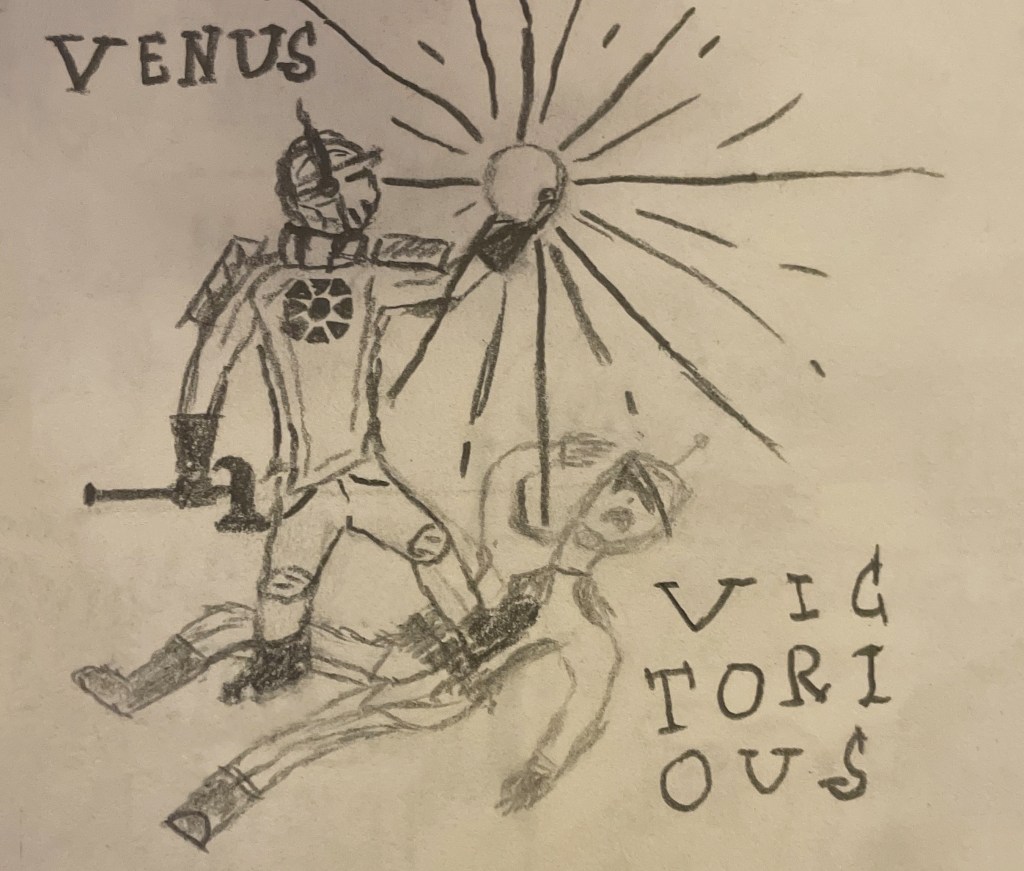
While the Venusians had managed to carve out relative independence from Martian Law, the establishment of a formidable navy was beyond their capabilities. They only had access to shuttles and industrial craft for construction and maintenance tasks. This is to say that upon arrival the MarsX invasion forces were completely within their right to be shocked and horrified as they were collectively carbonized by pure light.
Re-appropriating a speculative design from an age of madness and death long past, the engineers of the Venusian Peoples’ Solar Union had spent decades in secret, developing a superweapon that would become their first, last, and only line of defence from large-scale invasions: The Venusian Sun Gun.
An incomprehensibly massive telescopic array of mirrors and magnifying lenses with the singular function of focusing the sun’s rays into a controlled beam of weaponized hellfire. On that day of revolution, when a single blast secured independence from MarsX rule for all of Venus’s people, the Martian leadership received two broadcasts.
The first was from the commander of their fleet and contained sounds of agony so incomprehensibly distressing that recordings of the message have been deemed implements of psychological torture.
The second broadcast came from the Venus facility itself in the form of music. It was a song brought from Earth by the Persys that had found its way to Venus and slowly grew to be an anthem for its people.
Beginning as an energetic melody, beckoning in an era of peace, harmony, and understanding, the song shifts halfway as it becomes more repetitive and chant-like in nature. During this chant, almost every adult, elderly, and young Venusian joins their voices. At first in a desperate plea: “Let the sun shine.” Then growing in strength to a powerful command: “Let The Sunshine In!”
And if you want to learn of and even play a hand in deciding the destinies of the Venusians, Martians, and Earthings of the Assholes in Space fictional universe, please stay tuned for more contributions as I begin to explore the alien species and cultures that populate it. That’s right! The three human factions together make but one of SIX sapient species that will be playable in The Pantheon of Perseus!
Since I believe the best art and storytelling is collaborative in nature I would love for folks not only to let me know their thoughts but also headcanons! A lot of the large-scale worldbuilding has been overlooked or smoothed over and I’m fascinated in other people’s ideas of what the theocratic dictatorships of Earth looked like, concepts of the intricacies of the Martian Corporate Ladder, or the many Venusian art styles! Thank you my dear readers, may you find safety and strength, and may good fortune find you.
[Editor’s Note: A continuation of Mr. Everett’s lore will appear in our next issue.]
Elias Everett (he/him) is a bisexual Zillenial and a massive dork. He writes largely to buff out the science fantasy setting for his tabletop RPG The Pantheon of Perseus. In his writings, he suffuses cynical humor with sincere whimsy while unsubtly exploring themes of class, gender, race, sexuality, disability, cultural anxieties, existential dread, and alien witchcraft. He makes a mean stew.
Image Credit: Venus Victorious by Elias Everett
 The Gotham Guillotine
Leave a comment