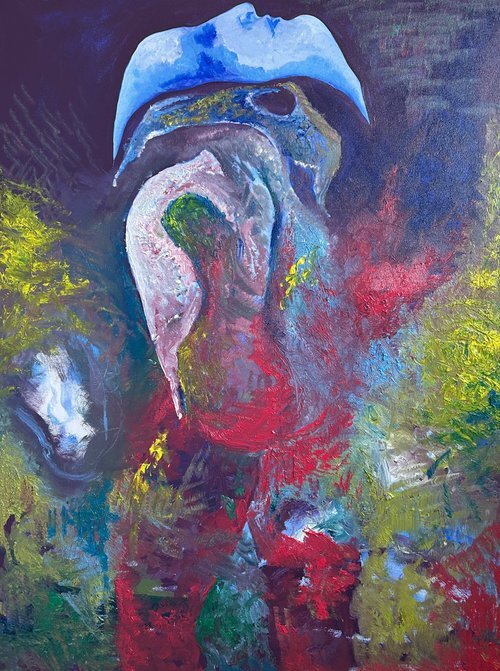
Decommissioned
by Ameer Malik
90 words
On the abandoned hotel’s flat roof, a dead neon sign spelled its name in red looping letters, but Richard couldn’t read it. He hadn’t found the time to learn the language of this European country, having arrived just two months ago.
Street lamps illuminated the hotel against the gray dawn. The building’s windows were boarded with wooden planks decaying from mold. Its front door was chained and padlocked.
He’d passed the hotel on his runs. He’d thought it was just another hotel abandoned when austerity scared away all the tourism dollars. But upon receiving his new assignment last night, he learned that it was another decommissioned CIA black site. It was one secret prison among a web run by the U.S. during its war on terror.
Only agents with the highest security clearance knew where all the black sites were, which ones were still operational. As far as Richard knew, people were still being thrown into the shadows.
He fidgeted with the wallet inside his left pocket, squeezing the fake leather between his forefinger and thumb, as he did whenever he needed to soothe himself. It wasn’t working. He could still hear his heart beating inside his skull.
A hand fell on his shoulder, and he jumped.
“Whoa, easy!” a familiar voice said.
It was Nathan, a co-worker and fellow American whom Richard had met during their last assignment here: another black site, a prison deep in the thick forests of the countryside. The prison clean-up required two two-person teams at separate times due to security reasons. He and Nathan had been the last duo. Here, they would be the first.
Nathan knew more about this kind of work. Most of Richard’s assignments for Decagon Projects involved fixing worn-down army barracks and repairing storm damage at campsites. Nathan’s tasks had been different. He’d spent the last three years rehabilitating old black sites. Nathan was teaching Richard everything he knew about tearing down cells, destroying medieval-looking apparatuses, and wiping away the traces of blood, vomit, and shit in buildings that had once been schools and hospitals so that they could be used for those purposes again.
At the black site in the forest, scrubbing dried blood off the floor, Richard had yelled, “Why don’t they just tear down these places?”
“What?” Nathan asked.
Nathan was blasting death metal on a portable speaker, which Richard tolerated because it drowned out their cutting, drilling, and scraping, sometimes.
Richard repeated his question, louder.
“You really gotta ask that?” Nathan yelled over the music. “Saves money.”
Now, standing with Richard before the hotel, Nathan held a bolt cutter and a flashlight. “You okay, Richie? You seem spooked.”
“I’m fine.”
As difficult as that prison job had been, it had made sense to Richard. But this hotel bewildered him. It was in the middle of the city. How had the agents managed to keep the sounds from escaping into the streets? How many black sites had he unknowingly strolled past?
He took a deep breath and touched his wallet again.
His career supported his family, even though it forced him to leave Abigail and their son Benjamin for months. It also let him contribute to something that mattered. He knew he wasn’t as brave as the troops, but he was doing his part.
Plus, this kind of work was in his blood. His father ran a construction company until lack of shit to build in their hometown caused it to shut down. Richard grew up in his father’s shed, with its powerful, dangerous tools hanging on the walls. He had never imagined all those summers would lead him here.
“Listen,” Nathan said, “I know the prison job wasn’t easy. But you handled it well.”
“Thanks.”
“And I’ve got your back. This one will be okay. You can count on me, partner.”
There was no real choice but to trust Nathan. Richard forced himself to stop fidgeting with his wallet. He thought of taking it out but stopped himself, wanting to believe this job would be bearable. If it got really bad, then he’d take it out.
“Let’s assess the building before we head to the tool storage,” Nathan said, stepping toward the doors.
Richard turned away, wondering if he could spot the charming side street from here. About half a mile away, a tiny stop for horse carriages marked the opening of a cobblestone street. At the end of that street was a restaurant that served potato soup similar to Abigail’s, the one she would make on cold nights. Two doors up from the restaurant was a small shop with leaf-green curtains where he had bought postcards for Abigail and Benjamin. For her, he picked cards of this country’s landmarks or the streets at dawn or the brightly painted buildings. For Benjamin, Richard bought cards that had simple illustrations, the kinds that filled Benjamin’s coloring books.
He would never tell them the truth about his current assignment when he got back to the States, when this was over.
The padlock slammed into the ground. Nathan tore away the chains, grabbed the door handles, and yanked. The doors opened with a loud crack. Richard thought he saw a cloud of dust escape from inside. Nathan marched in, unphased. Richard followed.
A sullied darkness. Not full, not perfect, but murky, with traces of light. That was all Richard could see.
Richard slowly touched his face, arms, chest, and legs. He heard his own heart beating inside his head. His wallet was still in his pocket, thank god. But where was he? A dusty cellar? A metallic scent. He couldn’t remember anything after stepping through the hotel’s front doors.
The darkness faded and returned, faded and returned. One second, he could see the shape of his left hand in front of his face. The next, he couldn’t. Where was the throbbing light coming from? Someone somewhere was controlling the light, dialing a knob, giving and taking it away on a whim. He shivered.
As the darkness faded further, Richard saw rusty bars in front of him. Was he inside a cell in that prison? He clutched the bars but couldn’t shake them. They ran right up to the cold, coal-black walls and left no room to maneuver out.
He tried pulling the bars apart again, but they wouldn’t budge. He was trapped. His throat caved in, and he doubled over.
Breathe, Richard, a voice hissed.
Richard gasped, then exhaled slowly. He couldn’t tell where the voice was coming from. Was he concussed? Had someone attacked him? Was he being kidnapped?
Richard, you’re not injured. You’re still in the hotel. You’re in the basement.
That voice again. Was it Nathan? No, it didn’t sound like him. The voice was melodic. It sounded far, miles away. But also close like an echo between his ears. The voice had an accent that he might have heard before, but he couldn’t exactly place it.
Really, Richard? That’s what you’re focusing on? You’re trying to distinguish my accent?
Richard’s lungs shrivelled. His heartbeat doubled. His legs quaked.
You can’t die yet, Richard.
But then his lungs opened up, his heart slowed down, and his legs steadied.
More of the darkness faded. Richard saw a brown man standing on the other side of the bars. The man had dark eyes, short hair, and a trimmed beard. He wore a black suit and tie. He stepped closer.
“Wh-who are you?” Richard asked.
“Why don’t you ask your partner?” the man said, turning around.
The shadows faded even further. The walls were gray bricks with blushes of mold. The floor was a darker gray concrete covered in spiderwebs of cracks and scratches. On the side of the room directly opposite from him was another set of bars. Behind those bars was Nathan, lying on his back, his eyes closed, mouth open, limbs splayed out.
The man whispered, “Wake up, Nathan, wake up.”
Nathan grunted and moaned. He propped himself up on his elbows and shook his head. “Huh?”
When Nathan saw the man, his cheeks drained of color.
“What’s the matter?” the man said.
Nathan scrambled to his feet. He looked at Richard, then back at the man.
“It’s been some time,” the man said.
“This can’t be,” Nathan stammered.
“And yet, here I am.”
“Husayn? How?”
With his head held high and shoulders back, Husayn strutted to Nathan’s cell.
“I knew you would remember my name.”
Nathan shook his head. As his eyes darted from Husayn to Richard and back, he clutched the bars and failed to shake them loose.
“What the fuck is happening? Richard? Richard, what is this?”
Richard couldn’t say anything, couldn’t move.
“Tell him, Nathan,” Husayn said, tilting his head. “Tell him what you used to do to me right here in that cell.” Husayn turned to face Richard, locking eyes with him as he continued to address Nathan in a steady voice. “Tell him how you used to call me Honey every morning before you waterboarded me. How you kneeled on my chest and punched my head before pouring the water.”
Nathan rammed against the bars of his cell, barking like a trapped dog, but the bars stood firm.
Husayn remained calm and didn’t even glance at Nathan. He kept his gaze on Richard.
“What, he didn’t tell you?” Husayn said. “That’s unfortunate. I didn’t expect Nathan to tell you about his sadistic streak, but I thought he would’ve at least told you about his old job. I thought you two were partners.”
Richard recalled details of the prison assignment, how Nathan had never once seemed disturbed by all the dried blood, how Nathan had never been curious about why some cells had pockmarked wooden slabs while others had long frayed cables. Nathan had never gotten lost in the prison, either, as if he knew the way.
“Shut up!” Nathan yelled as he kept charging into the metal bars.
“He was indeed a CIA torturer,” Husayn continued. “But I’d prefer it if he told you himself.”
“Shut the fuck up!”
Husayn turned to face Nathan and said calmly, “Think about where you are. Think about what options you have. Sound familiar?”
“You can’t be here,” Nathan said, his disbelief swelling in his tired, strained voice.
“The sooner you accept this, the sooner you can return,” Husayn said, stretching out his arms. “Admit what you did. Admit all of it.”
“You can’t tell me what to do.”
“Do you really believe you’re still in charge?”
“Go fu—”
Richard could see that Nathan’s mouth kept moving, but no more words were coming out. Nathan’s eyes bulged, and he clutched his throat.
“Okay,” Husayn said, turning back to Richard. “If you won’t reveal your sins, I will. I remember how Nathan volunteered to pull my fingernails out with his own pliers, the ones in which he carved his initials into the metal.”
Richard felt invisible fingers clutching his ankles and forearms and head, keeping his eyelids open, forcing him to watch.
“Nathan told me he’d add my nails to his collection,” Husayn said.
Richard sensed pressure on his own fingernails that built and built until he felt as if his nails were being torn from him in a hot gush of pain. He couldn’t move or speak or look at his fingers. He was frozen, as his fingertips felt ripped open, as a scream raged inside him that couldn’t escape.
“Nathan also made a special playlist for me, for all of us,” Husayn said. “He claimed it took two years of trial and error to get it right.”
He raised one hand in the air.
“He used to blast this through towers of speakers for hours.”
Husayn snapped his fingers. A skull-splitting drumbeat pounded Richard’s head so hard, he thought it would shatter his face. He could no longer hear the scream that had been howling inside him.
The beat stopped. The pain in Richard’s fingers was gone, too. He felt on the brink of collapse.
“I believe you’ve heard that song before. Am I right?” Husayn asked. “But I don’t think you’ve heard Nathan’s special laugh.”
He stepped toward Richard’s cell, and now that he was closer again, Richard tried to read his eyes. Anger, pain.
“He makes this loud, guttural laugh when he really lets himself go,” Husayn continued. “Have you heard it? Or did he only save it for me? When he had two of his past partners pin me down. When he raped me with a broken broomstick.”
Richard exhaled and fell to his knees, released from his invisible constraints.
“I won’t do that to you, Richard,” Husayn said. “Nor will I bash your face against the wall. Repeatedly. Just as Nathan did. The day he killed me.”
Richard looked into Husayn’s eyes again. No more anger. Only pain.
Nathan coughed violently. The bars around him disappeared.
“Let him out, you freak!” Nathan yelled, rushing ahead with his fists raised.
Nathan rushed right through Husayn, as though Husayn was a ray of moonlight. He crashed into the bars of Richard’s cell. His nose crunched against the metal. Spurts of blood stained his jacket.
Richard slid his hand between the bars to try to reach Nathan. But Husayn grabbed Nathan by the collar and chucked him back to the other side of the room. He shook his head at Richard before walking to Nathan, who skidded away on his hands and feet.
“What do you fucking want?” Nathan squeaked. “I was just doing my job. If you didn’t—”
“Don’t you dare spit guilt on me,” Husayn said. “Even now, you can’t admit your crimes?”
Nathan backed away as Husayn closed in on him.
The invisible fingers returned and held Richard still as he knelt in his cell. He could only watch.
Nathan tripped on something. A shadow of a hand rose from the floor and swiped at Nathan’s boot. He hit the wall on his way down. When he tried to push himself off the ground, his elbows and knees buckled.
“What are you going to do to me?” Nathan whimpered, curling into a ball.
“That depends,” Husayn said, leaning in closer to Nathan’s face. “Are you finally willing to take responsibility for you and your partners’ cruelty?”
“War is war.”
Husayn let out a long, heavy breath.
“I know what war is. But you and your partners savored my screams.”
“We did what had to be done.”
“You broke your own nonsense rules.”
“We had to get results,” Nathan sobbed, his words barely coming out.
“But you enjoyed it. Even when I could barely see through my blood and bruises, I still saw that twinkle in your eye. Where is it now, Nathan?”
“Fuck you!”
“I’m disappointed,” Husayn said. “I was chosen by everyone who perished here, everyone who’s still trapped between these walls, to speak with you. We thought I could at least get through to you. After all, you said I was your favorite.”
“You wanna know why, Husayn?”
“You told me you never thought I’d last so long.”
“That’s right. You were one stubborn motherfucker. I admired that. You never said anything, never ratted anyone out, right until the end. That’s why I had to kill you.”
Husayn laughed, but the laughter wasn’t just coming from Husayn. It burst from everywhere, from the walls, the floor, the ceiling, as if dozens of people were laughing all around them. The laughter enveloped Richard, making his skin tingle with tiny shivers.
The laughter stopped.
“Now,” Husayn said, “I’ll tell you what you refused to hear.”
He lifted his right hand and brought it near Nathan’s face.
“I was innocent.”
Husayn touched Nathan’s cheek. And, to Richard’s shock, Nathan evaporated into a cloud of black smoke.
Husayn stood up, his back toward Richard.
“Now it’s your turn.”
The metal bars in front of Richard disappeared in a blink. He got up, freed from whatever had been holding him, and ran out the door on the left.
He was in a dark hallway. It had the same odor as the basement, and it was so narrow that he kept bumping into the walls. Richard tripped, scraped his knees. He felt his wallet slipping out of his pocket, pushed it back in, stood up, and kept running.
Through the shadows, he made out a staircase and sprinted harder. Lunging up the steps two at a time, he opened the door at the top.
The other side was still dark, but Richard could see he was in another hallway with doors now lining each wall. It smelled different here—a hint of bleach—and the floor was carpeted. He wondered where the lobby was as he tried every doorknob. Each one shook in his grip without turning.
If he was near ground level, he could jump out a window. None were in sight.
Countless doorknobs refused to budge. He slammed into each door with his shoulder, but each held firm.
His shoulder throbbed in pain. Finally, one doorknob he tried turned. He entered a hotel room.
Somehow, he could see clearly, even though the lights were off. Everything looked clean. The walls were beige, the carpet was cream-colored. But there was no bed, no table, no dresser.
Soon, dark spots appeared on the walls, floor, and ceiling. As the stains spread, he felt sharp pain inside his chest, like a knife was piercing through from the inside. He coughed, harder and harder, until he vomited water. The water kept gushing with increasing pressure. It came out of his nose, ears, and eyes.
He collapsed on the soaked carpet. His lungs were about to burst.
This is the room where Rahman was waterboarded to death. Husayn’s voice was coming from inside Richard’s head.
The pain stopped. The floor was dry. Richard’s face stopped leaking.
He charged into the leaf-green curtains, hoping to smash through the windows, but instead he crashed into a brick wall and fell back onto the floor.
Scrambling up, he moaned and staggered back into the hallway.
He tried another door. Locked.
Another. Locked.
Another. Open.
Again, an empty hotel room. This one also had no windows. He ran into the bathroom, hoping to find a small window there, but there wasn’t a single one. When he returned to the bare room, he was blinded by flashing lights. His muscles spasmed violently.
This is where Zaid was electrocuted. He and Rahman are just two of the innocent souls trapped here, unable to move on. I’ll make you feel a mere fraction of what they felt.
Richard must’ve blacked out. The next thing he knew, he was standing back in the hallway, leaning against the wall. His whole body felt weak.
Slowly, he blinked. The doors were all gone. In their places were simple landscape paintings, the kind mass produced in a factory. The paintings reminded Richard of the postcards from the shop and seemed to go on infinitely down the endless hall.
He ran, gripping his shoulder. The paintings kept repeating. A green hill. A blue sky. An orange sunset. He kept running until he sensed in his peripheral vision that the paintings had changed. He slowed down.
They had turned into photographs. Headshots. All men, some old, some young, some with light hair, some with dark hair. One had a birthmark on his right cheek. One had a scar between his eyebrows. Some had pain in their eyes, some sorrow. Below each photo was a name, but he wouldn’t read any of them.
Richard picked up his pace again, but his steps felt heavier and stickier and squished instead of thudding. That same metallic scent from the basement. His boots kept sticking to the carpet until he tripped. A thick muck seeped from the carpet, covering his hands and knees. Smelling it, he realized what it was: blood.
Richard didn’t know if getting up again would be worth it. He reached into his pocket and, finding no wallet there, began to cry. He patted his other pockets, but still couldn’t find it. He wept, burying his face in his sticky hands.
In a lull in his crying, he heard gentle footsteps moving closer. Pulling his hands from his face, he saw Husayn standing over him. Before he could get up to run, Husayn crouched down next to him.
“This fell out of your pocket,” he said, handing Richard the wallet.
Richard slowly took it from Husayn’s hand. Husayn’s face was devoid of anger.
Richard had to check. He pulled out the picture of Benjamin, staining the edges red.
Every time Richard came home, he would take a new picture of his son. In this way, the image of his son that he carried would be as close as possible to how Benjamin actually looked at the time. As he ran his bloody fingers over his son’s smiling face, mucous and tears bubbled and dripped down his cheeks again.
“I’m sorry about Benjamin,” Husayn said. “I feel for both you and him. I’m sorry you haven’t seen each other in so long.”
“Fuck you,” Richard spat, stifling his tears.
Husayn touched Richard’s shoulder, which didn’t pulse with pain now, and spoke softly.
“Why? Do you despise me so much that you can’t bear it when I ache for your child’s pain? Do you hate me so much that you can’t accept what I feel for you, as a father myself?”
Richard pulled away, stood up, and bolted.
I wish I could see my daughter, Nur, again. And my wife, Laila.
Finally, Richard saw a door at the end of the hallway. Hurling himself at it, he crashed through, landed hard, and howled. As he slowly rose to his knees, a jolt of pain rushed through his arm: broken.
When the pain finally abated, he realized that he was on the roof. The door that had brought him here had vanished. The sky was overcast, and he couldn’t tell what time of day it was.
The sign of the hotel on the other side of the roof was lit up and cast a red glow. Standing between him and the sign was Husayn.
“Wh-why are you doing this?” Richard asked, his bones and muscles radiating with pain. “I didn’t do what Nathan did.”
“We who died here were punished for the crimes of others,” Husayn said, walking toward Richard. “We were as innocent as you are, Richard. If we were held responsible, then you should be, too. I’ll hurt you no more, and I’ll let you go, if you take responsibility.”
As Husayn approached, Richard backed away until his left foot landed on nothing. He flailed until he found his balance again. Glancing behind him, he saw the street far below.
Husayn stopped an arm’s length away.
“Okay I’m sorry,” Richard said.
Husayn slowly shook his head. “You don’t mean your apology, do you?”
Richard couldn’t force himself to feel sorry. It wasn’t his fault, an unyielding desire within him insisted. He hadn’t even done anything. He was here doing his job. He wasn’t a monster.
“I didn’t do anything,” Richard whispered shakily.
“Why won’t you understand?”
“We did what we had to do. We didn’t have a choice.”
Richard saw tears swell in Husayn’s eyes. His heart skipped a beat.
“Okay,” Husayn said, his voice cracking.
Husayn’s glistening eyes. Husayn’s cracked voice. Husayn’s gentle fingers on Richard’s cheek. And then, pure darkness.
Ameer Malik (he/him) is a Pakistani-American Muslim writer from New Jersey. His work has appeared in No Contact, Post- Magazine, and elsewhere. He keeps a weekly blog about movies on Substack called Movies with Ameer Malik.
Image Credit: Pareidolia in Death (2025) by Natasha Zinos
 The Gotham Guillotine
Leave a comment